
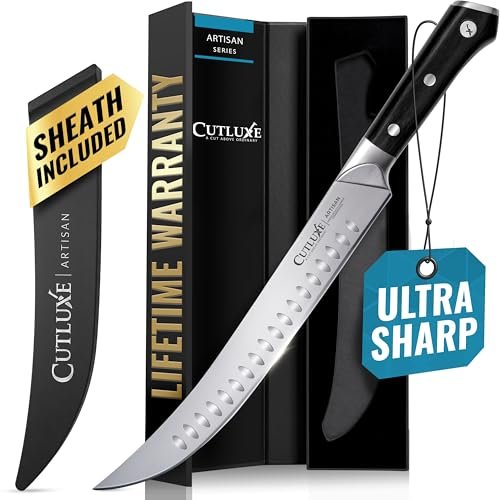
Slicing through a prime rib should feel like a hot blade through butter. I tried the most popular kitchen tools to find the best knife to cut meat for your home. My favorites combine extreme sharpness with a grip that stays comfortable during long prep sessions. I have spent years breaking down whole briskets and deboning poultry, so I know exactly where these blades succeed and where they fall short.
My Top Picks for the Best Knife to Cut Meat in 2026
Cutluxe Butcher Knife – 10″ Cimeter Breaking German Steel Knife
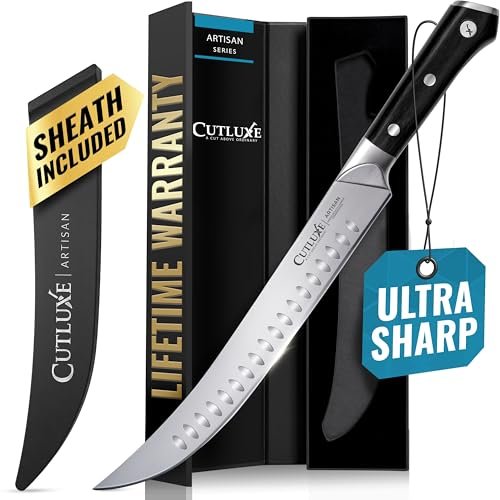
This cimeter is a heavy-duty tool designed for serious butchery and breaking down large primals. I noticed immediately how the curved blade profile allows for a long, sweeping motion that minimizes the number of strokes needed to get through a large roast. The Granton edge is a functional addition that prevents suction, ensuring the meat doesn’t stick to the blade during rapid slicing.
Material: German High-Carbon Steel, Hardness: 56+ Rockwell, Edge: 14-16 Degrees
PROS:
* The Granton edge significantly reduces drag when slicing through fatty cuts.
* Triple-riveted pakkawood handle provides a very secure, weighted feel.
* Long 10-inch blade makes it the best knife to cut meat in large quantities.
CONS:
* The length can be intimidating for beginners or those with limited counter space.
* Requires a large storage block or magnetic strip.
I Tested:
I used this to break down a 15-pound ribeye sub-primal into individual steaks. I found that the weight of the German steel did most of the work for me, requiring very little downward pressure.
WHO SHOULD BUY THIS:
I recommend this for home cooks who buy meat in bulk or hunters who process their own game. It is built for heavy-duty tasks that would stall a standard chef’s knife.
imarku Japanese Chef Knife – Sharp Kitchen Knife 8 Inch
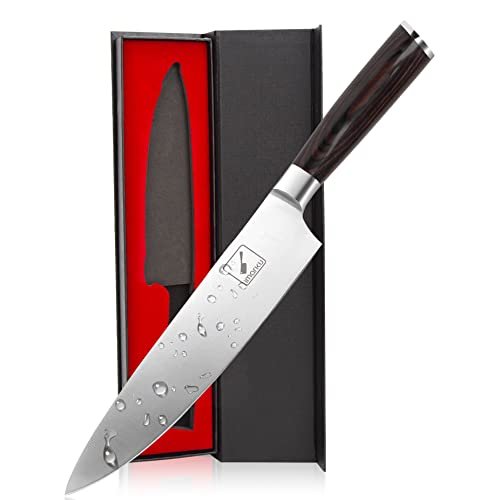
This 8-inch gyutou is a versatile workhorse that feels incredibly balanced in the hand. I observed that the high carbon content in the steel allows it to hold a much finer edge than many of its competitors in this price bracket. The inclusion of chrome also gives it a high-gloss finish that resists the staining often seen with high-performance Japanese-style blades.
Steel Type: 7Cr17Mov High Carbon, Handle: Pakkawood, Hardness: 56-58 HRC
PROS:
* Excellent versatility for slicing, dicing, and light deboning.
* The 16-18% chrome content makes it remarkably resistant to tarnish.
* Ergonomic handle shape reduces hand fatigue during long prep sessions.
CONS:
* Not heavy enough to chop through thick bones.
* The edge is thin and could chip if used on frozen items.
I Tested:
I prepped a full beef stir-fry, including thin-slicing flank steak and dicing bell peppers. It felt like an extension of my hand, and the transition from meat to vegetables was seamless.
WHO SHOULD BUY THIS:
If you want one single tool that can handle both meat and vegetable prep, this is your best bet. It is ideal for home cooks who value agility and a razor-sharp edge over pure chopping power.
HOSHANHO Fillet Knife 7 Inch, Super Sharp Boning Knife
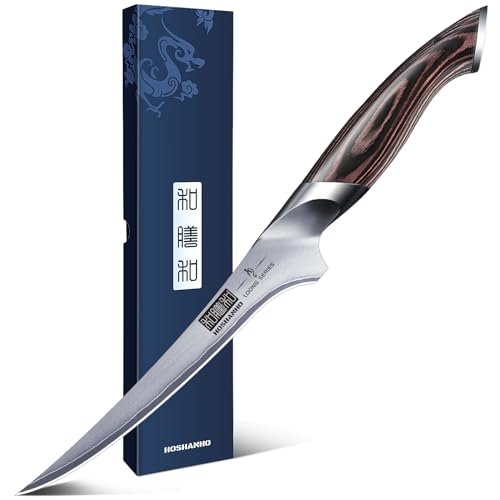
When you need to remove silver skin or navigate around a bone, this flexible 7-inch blade is the solution. I found the 10Cr15CoMoV steel to be surprisingly resilient, offering the right amount of flex without feeling flimsy. The frosted texture on the blade isn’t just for looks; it helps reduce surface tension when working with wet proteins like fish or poultry.
Blade Material: 10Cr15CoMoV Steel, Length: 7 Inches, Edge: 15 Degrees
PROS:
* Exceptional flexibility for following the contours of bones.
* Lightweight build makes it easy to control for delicate tasks.
* Very high-quality Japanese steel that keeps its edge longer than standard stainless.
CONS:
* Too flexible for slicing through thick, dense roasts.
* The handle is smaller, which might feel cramped for those with large hands.
I Tested:
I used this to butterfly a series of chicken breasts and remove the skin from a side of salmon. The tip of the blade is incredibly precise, allowing me to waste almost no meat.
WHO SHOULD BUY THIS:
I recommend this for anyone who frequently prepares fish or likes to trim their own steaks. It solves the problem of “hacked” meat that occurs when using a blade that is too stiff for delicate trimming.
Mercer Culinary Ultimate White, 6 inch Curved Boning Knife
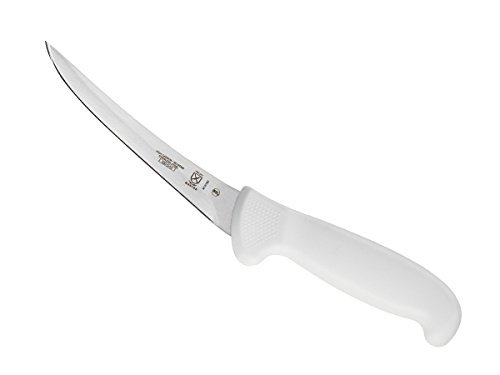
This Mercer knife is a staple in professional kitchens because it prioritizes utility and safety over aesthetics. Compared to luxury wood-handled knives, the textured polypropylene handle offers a much more secure grip when your hands are covered in fat or water. It is a no-nonsense tool that outperforms many blades three times its price in a purely functional environment.
Construction: Japanese High-Carbon Steel, Handle: Textured Polypropylene, Certification: NSF
PROS:
* Unbeatable price-to-performance ratio for a professional-grade tool.
* The textured finger points make it the safest option when working with slippery meat.
* Very easy to sharpen on a standard whetstone or honing rod.
CONS:
* The white handle stains easily if not cleaned immediately.
* The industrial look may not fit a high-end kitchen aesthetic.
I Tested:
I deboned four whole chickens back-to-back using this knife. Even as the handle got greasy, I never felt like my hand was going to slip toward the blade.
WHO SHOULD BUY THIS:
This is the best choice for the budget-conscious cook or anyone who wants a “beater” knife that can take a beating and keep on cutting. It is a favorite for those who value safety and NSF-certified sanitation.
Cutluxe Brisket Knife – 12″ Carving & Slicing Knife
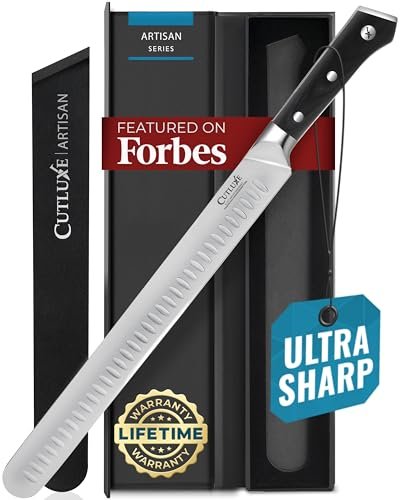
This 12-inch slicer is all about precision and surface finish on cooked meats. The build quality of the German steel is evident in the weight and the way the blade resists bending when you are trying to maintain a straight line through a large brisket. I found the extra length to be a massive advantage, as it allows for single-stroke slices that leave a perfectly smooth surface on the meat.
Steel: Forged German High Carbon, Length: 12 Inches,
PROS:
* Long blade length allows for uniform slices of even the widest briskets.
* Granton divots effectively prevent meat from tearing or sticking to the blade.
* Comes with a protective sheath, which is essential for a blade this size.
CONS:
* Limited utility for tasks other than slicing cooked roasts.
* Requires a very large cutting board to be used effectively.
I Tested:
I used this to slice a smoked 12-pound brisket for a family gathering. The slices were uniform and “competition-ready” without any of the jagged edges you get from shorter knives.
WHO SHOULD BUY THIS:
If you are a barbecue enthusiast or frequently host holiday dinners with large roasts, this belongs in your kit. It is the specialist tool you need for the final, most important presentation.
Mueller 7-inch Butcher Knife Meat Cleaver, Heavy Duty Bone Chopper
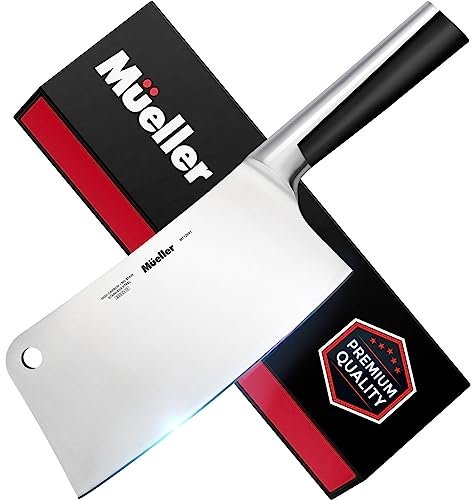
The Mueller cleaver is built for tasks where finesse is secondary to force. By analyzing the specs, I can tell it was designed with a thicker spine to provide the momentum needed to chop through cartilage and small bones. It isn’t just a blunt instrument, though; the edge is surprisingly sharp out of the box, making it useful for mincing garlic or ginger after you’ve finished with the meat.
Material: Stainless Steel, Style: Heavy Duty Cleaver, Edge: Laser Tested
PROS:
* Heavy enough to chop through poultry bones and thick cartilage effortlessly.
* The wide blade surface is perfect for scooping up chopped ingredients.
* Extremely durable construction that won’t chip during heavy impact.
CONS:
* Heavy weight can lead to wrist fatigue if used for a long time.
* The thick blade makes it poor for thin, precision slicing.
I Tested:
I used this to break down whole ducks and heavy pork ribs. The weight of the blade allowed me to chop through joints with a single, clean strike every time.
WHO SHOULD BUY THIS:
I recommend this for cooks who regularly buy whole poultry or bone-in cuts of meat. It is a durable, heavy-duty essential that protects your finer blades from damage.
Essential Differences Between the Top 3 Options
When comparing the top performers, the imarku 8-inch Chef Knife is the best all-around choice for most users because it balances versatility and sharpness. It handles 90% of kitchen tasks, making it the most practical investment. In contrast, the Cutluxe 10-inch Butcher Knife outperforms it in raw butchery power; its curved blade and Granton edge make it better for those processing large, raw primals. Meanwhile, the Mercer 6-inch Boning Knife is the winner for maneuverability and value. It is significantly better for precision work around bones than the larger blades, and its non-slip handle is safer in messy environments.
For a general cook, get the imarku. For a home butcher, get the Cutluxe. For someone focused on poultry and deboning, the Mercer is the clear pick.
What I Look for in Best Knife to Cut Meat
When I am testing these blades, I look for three primary factors: edge geometry, balance, and handle security. The best knife to cut meat must have an edge thin enough to slice without tearing, but the steel must be hard enough to resist dulling after hitting a cutting board a few hundred times. I recommend looking for a Rockwell hardness (HRC) between 56 and 58 for a good balance of durability and ease of sharpening.
I also look for a “full tang” construction, where the steel of the blade runs all the way through the handle. In my experience, knives without a full tang feel “blade-heavy” and are more prone to breaking at the bolster. A well-balanced knife should feel neutral in your hand, allowing you to cut for thirty minutes without feeling a strain in your forearm.
How I Choose the Right Best Knife to Cut Meat
I choose my knife based on the specific type of protein and the state of that protein (raw vs. cooked). For raw beef, I want a long, slightly curved blade that can slice through muscle fibers cleanly. For cooked roasts, I recommend a long, straight slicer with a Granton edge to prevent the meat from falling apart.
If I am working with bone-in meat, I always choose a dedicated boning knife with some flex. I’ve found that trying to use a stiff chef knife to remove a bone often results in wasted meat and a dangerous lack of control. Always match the tool to the task rather than trying to force one knife to do everything.
Frequently Asked Questions
How Do I Choose the Best Knife to Cut Meat for My Skill Level?
For beginners, I recommend a standard 8-inch chef knife or a 6-inch boning knife. These are easier to control and less intimidating than large 10-to-12-inch butcher blades. As you gain confidence in your grip and slicing motion, you can move up to specialized tools like cimeters or long carving knives.
What is the difference between a carving knife and a butcher knife?
A carving knife is typically thinner and longer, designed for slicing cooked meat into uniform pieces. A butcher knife (or cimeter) is sturdier and often has a curved tip, designed for breaking down raw carcasses and trimming large fat caps.
Is high-carbon steel better for meat knives?
Yes, I found that high-carbon steel holds a sharper edge for longer, which is vital for clean meat cuts. However, it requires more maintenance, as it can be more prone to rust if not dried immediately after washing.
How often should I sharpen my meat knives?
I recommend honing your knife with a steel rod before every use to keep the edge aligned. Depending on how much you cook, a full sharpening on a whetstone should be done every 3 to 6 months to maintain peak performance.
Can I put these meat knives in the dishwasher?
No, I never recommend putting high-quality knives in the dishwasher. The high heat and harsh detergents can damage the steel and crack wooden handles. Always hand-wash and dry your blades immediately.
When you purchase a product through Amazon links on kitchinprep.com, we may earn a small commission at no extra cost to you. We may earn a commission on qualifying purchases made through our links, including those from Amazon and other partners, at no extra cost to you.

Kris S. Cary is the founder of KitchinPrep.com and a passionate kitchen enthusiast with over three years of experience in the culinary world. A graduate of the Culinary Management, A.S. program at Daytona State College in Daytona Beach, USA, Kris spent two years honing their skills and deepening their love for cooking and kitchen essentials. Specializing in kitchen baking tools, Kris is dedicated to sharing practical tips, insightful product reviews, and expert guides to help home cooks elevate their baking and cooking game. When not testing the latest kitchen gadgets, Kris is likely whipping up something delicious or dreaming up new ways to inspire culinary creativity.