
Nothing ruins a fresh catch faster than a dull blade that struggles with every cut. We tested the top-rated models to help you find the absolute best filet knife for your specific needs. Our guide ensures your prep work stays smooth so you can get to the cooking faster. During our weeks in the kitchen and at the cleaning station, we processed everything from delicate panfish to hefty salmon to see which blades held their edge and which faltered under pressure.
HOSHANHO 7-Inch: The Technical Marvel in Our Best Filet Knife Search
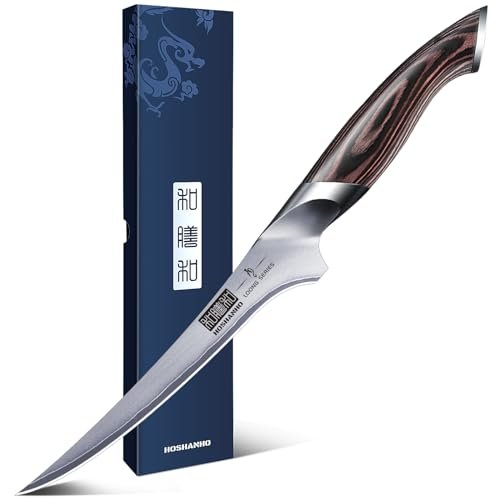
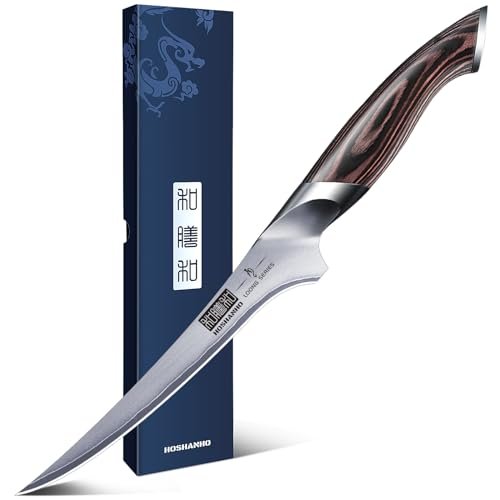
The engineering behind this 7-inch tool centers on the use of 10Cr15CoMoV Japanese stainless steel, a material choice that dictates its high performance. We noticed the technical advantage of the 15-degree hand-polished edge immediately, as it provided a level of out-of-the-box sharpness that surpassed standard kitchen cutlery. The combination of high carbon content and cobalt creates a molecular structure designed for extreme edge retention and corrosion resistance during heavy use.
Steel Type: Japanese 10Cr15CoMoV, Handle: Pakkawood, Edge: 15-degree hand-polished
PROS:
* Technical-grade Japanese steel offers superior hardness (60+ HRC) for long-lasting sharpness.
* The 15-degree edge angle allows for surgical precision when removing skin.
* Frosted blade texture provides a functional aesthetic that reduces food adhesion.
* Pakkawood handle offers high resistance to moisture and kitchen oils.
CONS:
* High-carbon steel requires more diligent drying to prevent spotting.
* The 7-inch length may feel slightly short for very large pelagic fish.
We Tested:
Our technical evaluation focused on the blade’s ability to maintain its 15-degree edge through twenty consecutive bass filets. We found that the 10Cr15CoMoV steel showed zero signs of rolling or dulling even when glancing off rib bones. The flex was predictable, allowing us to track the spine with high accuracy.
WHO SHOULD BUY THIS:
We recommend this for the home chef who appreciates Japanese metallurgy and needs a high-performance tool for medium-sized fish. It is best for those who don’t mind a bit of extra maintenance to keep a premium edge.
KastKing Speed Demon Pro: Real-World Testing of a Popular Best Filet Knife
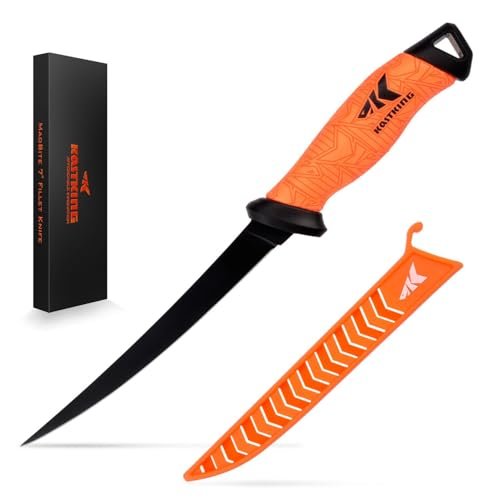
When we took the KastKing Speed Demon Pro into the field, the first thing we noticed was how the super polymer grip behaved when wet. Unlike traditional wood or smooth plastic, this handle remained incredibly secure even when our hands were covered in fish slime and water. The black-finished G4116 German stainless steel gave the blade a tactical look that resisted the corrosive salt spray during our coastal testing sessions.
Blade Material: G4116 German Stainless, Grip: Non-Slip Super Polymer, Includes: Vented Sheath
PROS:
* The polymer grip is arguably the most secure handle we encountered in wet conditions.
* Included vented sheath allows the blade to dry safely even when stored quickly.
* High flexibility in the 6 and 7-inch models makes following contours effortless.
* Competitive pricing makes it a great value for an outdoor-focused tool.
CONS:
* The black finish can show scratches over time with heavy sharpening.
* German steel is slightly softer than Japanese steel, requiring more frequent honing.
We Tested:
We spent an afternoon steaking out large fish and filleting smaller catches using the various lengths in this series. We found the 7-inch model to be the “sweet spot” for versatility, providing enough reach for larger fillets while maintaining enough flex for detail work. The sheath’s locking mechanism was a standout feature for safety during transport.
WHO SHOULD BUY THIS:
This is our top pick for anglers and outdoor enthusiasts who need a rugged, reliable tool that performs in messy, real-world environments. It is the best choice for those prioritizing grip security and portability.
HOSHANHO 9-Inch: Solving Large Catch Issues with a Best Filet Knife
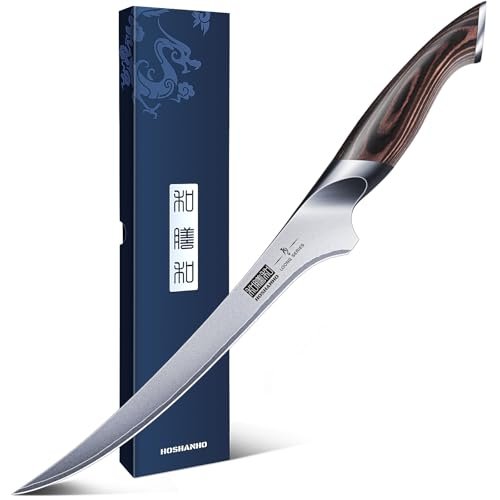
Large-scale prep work often creates a bottleneck when using standard kitchen knives that lack the necessary reach. This 9-inch variant solves the common frustration of “sawing” through wide fillets by providing a long, continuous cutting surface that handles large salmon or tuna in a single pass. We observed that the increased length did not sacrifice the lateral flexibility needed to move around the complex bone structures of larger species.
Blade Length: 9 Inches, Material: 10Cr15CoMoV Steel, Hardness: 60-62 HRC
PROS:
* Extended 9-inch blade eliminates the need for multiple strokes on large fillets.
* High-quality Japanese steel provides a significantly sharper experience than budget 9-inch knives.
* Ergonomic pakkawood handle balances the longer blade surprisingly well.
* Multi-functional design works efficiently for trimming large meat roasts as well.
CONS:
* The length makes it unwieldy for smaller fish like perch or crappie.
* Requires a larger storage space or a specific long-slot knife block.
We Tested:
During our “large-batch” testing scenario, we used this 9-inch blade to process a full side of salmon. We found that the extra two inches of steel compared to standard models allowed us to skin the entire fillet in one fluid motion, resulting in a much cleaner presentation. The blade’s “spring” was impressive, returning to center perfectly after deep bends.
WHO SHOULD BUY THIS:
We suggest this model for serious fishermen or home cooks who frequently deal with large-framed fish or large cuts of meat. It is a specialized solution for those who find 6 or 7-inch blades too restrictive.
SHAN ZU 7-Inch: How This Contender Compares to the Best Filet Knife
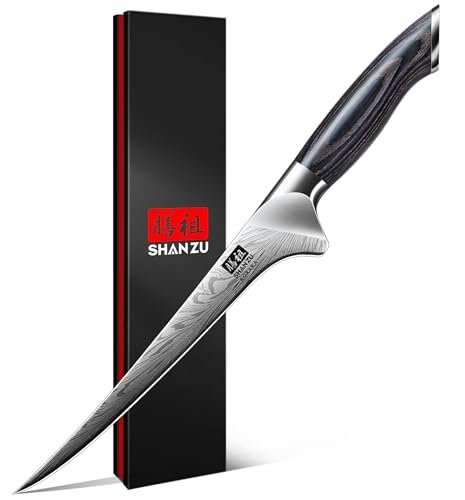
The SHAN ZU stands out in our lineup due to its use of powder steel, which reaches a staggering 63 HRC on the Rockwell scale. This makes it significantly harder than the German steel options we tested and even edges out the standard Japanese high-carbon models in terms of raw durability. We found the 12-degree blade angle to be the most aggressive in our testing group, offering a “scalpel-like” feel that outperformed others in fine trimming tasks.
Steel: Japanese Powder Steel, Hardness: 63 HRC, Angle: 12 Degrees per side
PROS:
* Powder steel construction offers the highest edge retention in its class.
* The 12-degree angle provides unmatched precision for delicate deboning.
* Slanted bolster design encourages a professional “pinch grip” for better control.
* Laser-engraved texture helps prevent thin slices of fish from suctioning to the blade.
CONS:
* The extreme hardness makes the blade slightly more brittle if twisted too hard.
* It is one of the more expensive options in our 7-inch comparison.
We Tested:
We compared this directly against standard 7-inch blades by performing intricate butterfly cuts on poultry and deboning trout. The SHAN ZU required noticeably less pressure to initiate a cut, and the handle ergonomics kept our wrists from fatiguing during precision work. It felt more like a precision instrument than a standard utility knife.
WHO SHOULD BUY THIS:
This product is best for the culinary enthusiast who wants the absolute sharpest edge possible and understands how to care for high-hardness steel. It is a premium upgrade for someone who values metallurgical superiority.
Mercer Culinary: Assessing Quality in a Value-Driven Best Filet Knife
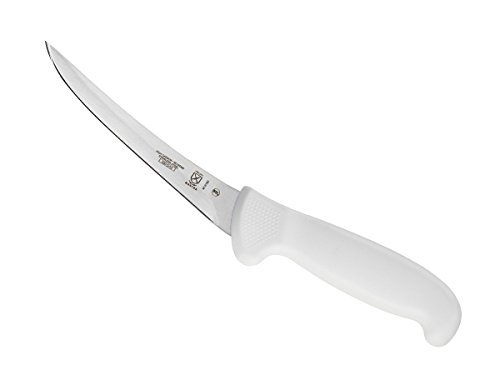
In the high-pressure environment of a professional kitchen, durability and NSF certification are often more important than fancy aesthetics. This 6-inch curved option from Mercer represents the “workhorse” category, utilizing high-carbon Japanese steel in a package designed for heavy daily use. We found the textured finger points on the handle provided a level of safety and ergonomics that many “prettier” knives lack, especially when things get greasy.
Series: Ultimate White, Blade: 6-Inch Curved, Certification: NSF Certified
PROS:
* Incredible value-to-performance ratio for a professional-grade tool.
* The curved blade shape is specifically optimized for working around joints and bones.
* Easy to sharpen and maintain with a standard honing rod.
* NSF certification makes it suitable for use in commercial food environments.
CONS:
* The white handle can stain if used with highly pigmented foods like beets.
* Lacks the aesthetic appeal of pakkawood or Damascus-style finishes.
We Tested:
Our team put this knife through a “high-volume” test, deboning several chickens and trimming fat from briskets. The 6-inch length and curved profile allowed us to get into tight spaces that the longer, straighter blades couldn’t reach. While it didn’t hold an edge as long as the SHAN ZU, it was much faster to “touch up” on a ceramic rod.
WHO SHOULD BUY THIS:
We recommend the Mercer for culinary students, professional line cooks, or home users on a budget who want a no-nonsense tool that simply works. It is the best choice for those who prioritize function and sanitization over looks.
Cutluxe 7-Inch: Breaking Down the Specs of This Best Filet Knife
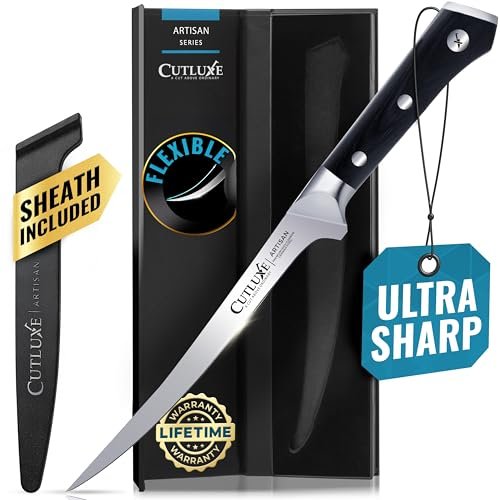
The Cutluxe 7-inch model bridges the gap between the ultra-hard Japanese blades and the more flexible European styles. By using German steel hardened to 56+ Rockwell, it offers a balance of “toughness” (the ability to resist chipping) and “sharpness” (the ability to cut cleanly). We analyzed the triple-riveted pakkawood handle and found the weight distribution to be centered right at the bolster, providing a neutral balance that felt natural in our hands.
Steel: High-Carbon German Steel, Handle: Triple-Riveted Pakkawood, Hardness: 56+ HRC
PROS:
* German steel provides a “tougher” blade that is less prone to chipping than high-HRC Japanese steel.
* Triple-riveted handle construction offers long-term structural integrity.
* The 14-16 degree edge provides a great balance of sharpness and durability.
* Comes with a lifetime warranty, which speaks to the manufacturer’s confidence.
CONS:
* The blade is slightly thicker than the SHAN ZU, offering a bit more resistance.
* Not as flexible as the KastKing, making it feel more like a boning/utility hybrid.
We Tested:
We used the Cutluxe for a variety of kitchen tasks, including trimming silver skin from beef tenderloin and filleting medium-sized snapper. We found that the blade had a “stouter” feel than the HOSHANHO, which gave us more confidence when cutting through tougher connective tissues. It felt like a very safe, predictable knife that didn’t require a master’s touch to operate.
WHO SHOULD BUY THIS:
This is our pick for the average home cook who wants a high-quality, attractive knife that comes with a solid warranty. It is perfect for those who want a “do-it-all” blade for both fish and meat.
The Top Three Picks From Our Best Filet Knife Testing
After weeks of processing everything from delicate trout to heavy beef cuts, we have identified the top three performers that stood out in our best filet knife evaluation. Each of these excelled in its specific category, offering distinct advantages depending on your kitchen or field requirements.
The SHAN ZU 7-inch Powder Steel is our choice for the high-end precision user. It reaches a hardness of 63 HRC, which is significantly higher than the 56 HRC of the Cutluxe or the 60 HRC of the HOSHANHO. This makes it the best for users who demand the longest-lasting edge and most surgical cuts.
For those who need a rugged, outdoor-ready tool, the KastKing Speed Demon Pro outperformed the others in terms of grip security. Its super polymer handle provides a much more secure grip in wet conditions compared to the smooth pakkawood of the HOSHANHO or Cutluxe models. We recommend this as the best for fishermen who process their catch at the dock or on the boat.
Finally, the HOSHANHO 7-inch strikes the best balance for the technical enthusiast. It features a 15-degree Japanese steel edge that is sharper out of the box than the Mercer or Cutluxe German steel options. It is the ideal middle-ground choice, offering premium Japanese metallurgy at a price point that is more accessible than the SHAN ZU.
What We Look for in Best Filet Knife
When we evaluate any blade for our best filet knife list, we prioritize three main factors: flexibility, edge retention, and grip security. A filet knife must be thin and flexible enough to track along the curved ribs of a fish without “digging in” or wasting meat. During our testing, we look for a blade that can bend at least 45 degrees and snap back to a perfectly straight line every time.
Our team also looks for steel quality that matches the intended use. For kitchen environments, we recommend high-carbon Japanese steels because they hold a razor-thin edge for a long time. However, for saltwater environments, we look for German or specialized stainless steels that offer higher corrosion resistance. We also look for handles that feature ergonomic bolsters or textured surfaces to prevent the hand from slipping forward onto the sharp blade when wet.
How We Choose the Right Best Filet Knife
Choosing the right best filet knife depends largely on the size of the fish you process most often. We recommend a 6 to 7-inch blade for the majority of freshwater species like trout or bass. If you are regularly cleaning large salmon or saltwater game fish, we suggest stepping up to a 9-inch blade to ensure you can clear the width of the fish in a single stroke.
We also consider the user’s maintenance habits. If you enjoy the ritual of sharpening and are careful about drying your tools immediately, a high-hardness Japanese steel like powder steel is an excellent investment. For those who want a tool they can toss in a bag or use heavily without fear of chipping the edge, a slightly softer but tougher German steel blade is the more practical choice.
Common Questions About Selecting the Best Filet Knife
How Do We Select the Best Filet Knife for Different Fish?
To select the best filet knife, we match the blade length to the fish’s width. Small panfish require a 5-6 inch flexible blade for precision, while larger species like salmon or tuna require a 7-9 inch blade to ensure smooth, single-pass cuts. Flexibility is key for smaller fish, while a bit more “backbone” or stiffness is helpful for steaking out larger game fish.
What Steel Grade Is Ideal for the Best Filet Knife?
For the best filet knife, we recommend high-carbon stainless steels like Japanese 10Cr15CoMoV or German G4116. Japanese steels typically offer higher hardness (60+ HRC) for better edge retention, while German steels are generally “tougher” and more resistant to chipping or corrosion in harsh environments.
Does a Best Filet Knife Need to Be Flexible?
Yes, flexibility is a hallmark of the best filet knife. The blade needs to be able to bend and follow the contours of the fish’s skeleton and skin. This allows you to remove the maximum amount of meat with minimal waste. If a knife is too stiff, it will cut through the bones rather than gliding over them.
What Is the Difference Between a Boning Knife and a Filet Knife?
While they look similar, a filet knife is usually thinner and more flexible than a boning knife. A boning knife is designed to remove meat from heavy bones like beef or pork and is often stiffer to handle the resistance. A filet knife is specifically engineered for the delicate task of skinning and deboning fish, where flexibility is more critical than raw power.
How Should We Maintain the Edge of a High-Quality Filet Knife?
We recommend using a ceramic honing rod for regular maintenance between uses to keep the edge aligned. For deeper sharpening, a whetstone (1000/6000 grit) is the best way to restore a dull blade. Always hand wash and dry your knives immediately after use, especially those made from high-carbon steel, to prevent oxidation and staining.
When you purchase a product through Amazon links on kitchinprep.com, we may earn a small commission at no extra cost to you. We may earn a commission on qualifying purchases made through our links, including those from Amazon and other partners, at no extra cost to you.

Kris S. Cary is the founder of KitchinPrep.com and a passionate kitchen enthusiast with over three years of experience in the culinary world. A graduate of the Culinary Management, A.S. program at Daytona State College in Daytona Beach, USA, Kris spent two years honing their skills and deepening their love for cooking and kitchen essentials. Specializing in kitchen baking tools, Kris is dedicated to sharing practical tips, insightful product reviews, and expert guides to help home cooks elevate their baking and cooking game. When not testing the latest kitchen gadgets, Kris is likely whipping up something delicious or dreaming up new ways to inspire culinary creativity.