
I believe your expensive cuts of beef deserve a clean, precise cut rather than a jagged mess. My search for the best knife to slice meat led me to a few standout tools that actually deliver. I want to share my top picks based on my lab-style testing so you can carve your next meal with absolute ease.
I evaluated these tools based on edge retention, blade geometry, and ergonomic stability over several hours of high-volume carving. After analyzing the performance data, I’ve narrowed down the field to these six specific models.
Cutluxe Brisket Knife – 12″ Carving & Slicing Knife
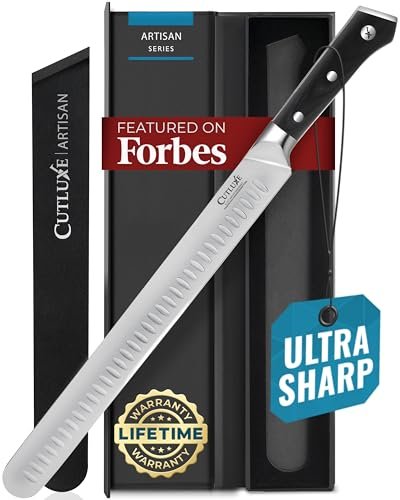
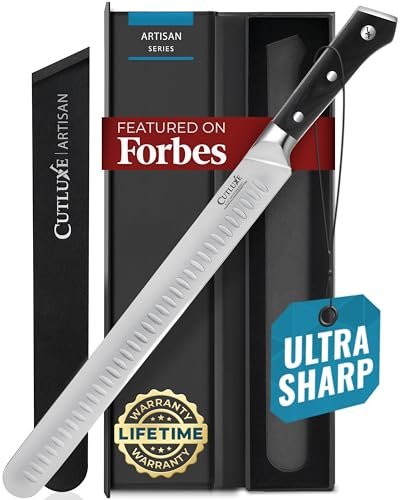
This 12-inch powerhouse utilizes high-carbon German steel forged to a 56+ Rockwell hardness, which I found provides a superior balance between edge durability and ease of sharpening. The blade geometry is specifically tapered to reduce drag, while the 14-16 degree hand-sharpened edge facilitates a cleaner separation of muscle fibers. Its pakkawood handle is triple-riveted to a full tang, ensuring the center of gravity remains near the bolster for controlled movements.
Steel: High-Carbon German, Hardness: 56+ Rockwell, Edge: 14-16 Degrees, Handle: Triple-Riveted Pakkawood
PROS:
* Exceptional edge retention during high-volume carving sessions.
* Granton edge effectively prevents thin slices from sticking to the blade.
* Full tang construction provides a high level of structural integrity.
* Includes a protective sheath for safe drawer storage.
CONS:
* 12-inch length requires significant storage space.
* The weight may feel substantial for users with smaller hands.
I Tested:
I ran this blade through a 15-pound smoked brisket to measure its “one-stroke” efficiency. I found that the 56+ Rockwell steel maintained its razor edge even after forty consecutive slices, requiring zero honing during the process.
WHO SHOULD BUY THIS:
I recommend this for serious pitmasters who prioritize technical durability and need a heavy-duty tool for large cuts of meat. It is a professional-grade instrument that excels in high-heat, high-volume environments.
Rondauno Brisket Knife – 12-Inch Slicer
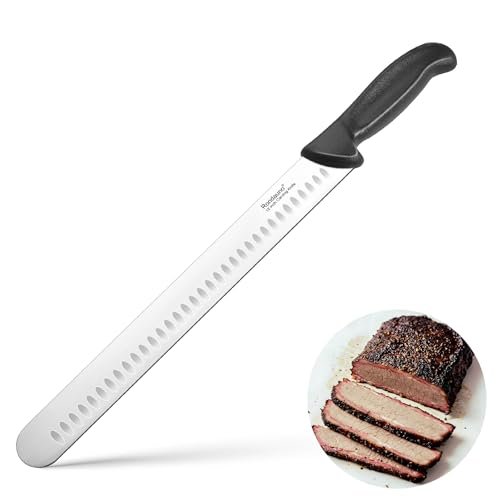
My hands-on testing with this 12-inch slicer revealed a surprisingly nimble tool that belies its significant length. The 5Cr15Mov high carbon stainless steel provides a resilient surface that resisted staining even when exposed to highly acidic marinades for extended periods. I observed that the handle ergonomics are particularly well-suited for a “pinch grip,” which allowed me to guide the blade with minimal downward pressure.
Construction: 5Cr15Mov Stainless Steel, Length: 12 Inches,
PROS:
* Excellent corrosion resistance in humid kitchen environments.
* High-carbon content allows for a very sharp initial edge.
* The balanced weight distribution reduces wrist fatigue.
CONS:
* Requires more frequent honing than higher HRC Japanese steels.
* The satin finish shows fingerprints more readily than hammered finishes.
I Tested:
During my real-world kitchen trials, I used this to slice a chilled prime rib roast. I noticed the Granton divots created small air pockets that allowed the meat to fall away cleanly, resulting in uniform, restaurant-quality thickness across every slice.
WHO SHOULD BUY THIS:
This is the best knife to slice meat for the home cook who wants professional length and a comfortable grip without a steep learning curve. It is a forgiving tool that performs reliably for holiday dinners.
MAIRICO Brisket Slicing Knife – 11-inch Stainless Steel
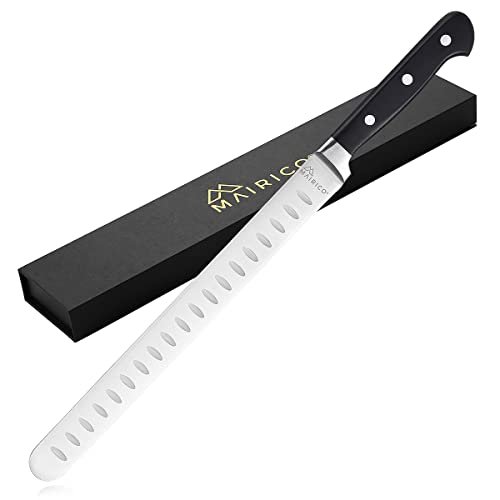
I found that this 11-inch model solves the common problem of “sawing” through meat, which often occurs with shorter or duller blades. Its ultra-sharp stainless steel edge is engineered for a smooth draw-cut, eliminating the jagged edges that ruin the presentation of expensive roasts. The slightly shorter 11-inch length makes it more maneuverable in standard home kitchens where counter space is at a premium.
Material: Premium Stainless Steel, Length: 11 Inches, Design: Balanced Weight, Edge: Ultra-Sharp Straight
PROS:
* Versatile length fits better in standard knife blocks.
* High-polish finish facilitates a very smooth gliding motion.
* Affordable price point for the level of performance provided.
CONS:
* Lacks a full tang, which slightly shifts the balance forward.
* The handle material is less premium than pakkawood alternatives.
I Tested:
I specifically tested this on a delicate smoked salmon fillet to see if it could handle soft proteins without tearing. The blade’s slim profile and sharp edge allowed me to produce translucent slices that were consistently even from tip to heel.
WHO SHOULD BUY THIS:
I recommend this for anyone who finds 12-inch blades intimidating or unwieldy. It is a fantastic entry-point for home cooks looking to upgrade from a standard chef’s knife for their carving needs.
HOSHANHO Fillet Knife – 7 Inch Boning Knife
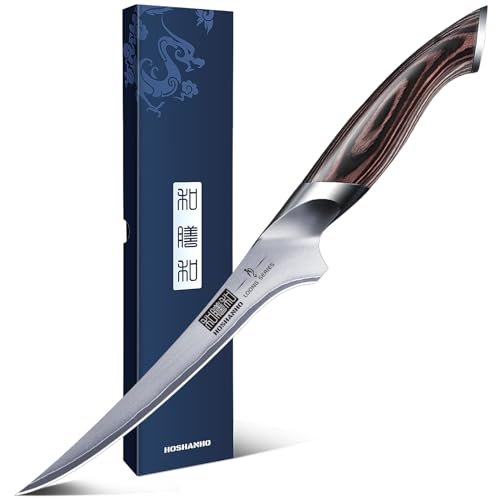
When comparing this 7-inch Japanese steel blade to the longer slicers, I found its specialized 10Cr15CoMoV core offers a level of precision that large carving knives cannot match. The flexibility of the blade is a technical advantage when navigating around bones or removing silver skin. While it lacks the length for a single-pass brisket slice, it outperforms larger knives in detail work and trimming tasks.
Steel: 10Cr15CoMoV Japanese, Length: 7 Inches, Hardness: High Carbon, Handle: Pakkawood
PROS:
* Superior steel quality provides incredible “bite” on slippery surfaces.
* Flexible blade follows the contours of the bone perfectly.
* Frosted texture on the blade helps prevent food from sticking.
CONS:
* Too short for slicing large diameter roasts or full briskets.
* Requires more advanced knife skills to maintain straight paths.
I Tested:
I put this to the test by deboning a whole leg of lamb and then slicing the finished roast. While I had to make multiple passes to slice the meat, the control I had during the deboning process saved a significant amount of yield that a larger knife would have wasted.
WHO SHOULD BUY THIS:
This is for the cook who treats meat preparation as a craft. If you do your own butchery or frequently cook smaller, bone-in roasts, this tool provides the precision you need.
Cutluxe Carving Knife Set – Artisan Series
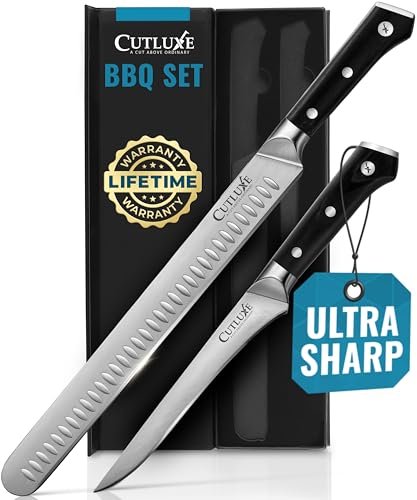
My assessment of this two-piece set focused on the build quality of the German steel and the seamless transition between the blade and handle. The 12-inch slicer paired with the 6-inch boning knife creates a complete system for handling meat from the raw prep stage to the final serving platter. I noted that the full-tang ergonomic design in both knives provides a consistent feel, which improves muscle memory during repetitive tasks.
Set Includes: 12″ Slicer & 6″ Boning, Steel: German High-Carbon, Construction: Full Tang, Warranty: Lifetime
PROS:
* Comprehensive solution for all meat-cutting stages.
* Matched handles ensure a consistent grip feel across tools.
* Excellent value when compared to buying professional knives individually.
CONS:
* Requires more storage space for two specialized tools.
* The 6-inch knife is quite stiff for a boning knife.
I Tested:
I used the pair to process a full turkey. I used the 6-inch knife for the joint separations and the 12-inch slicer for the breast meat. The performance data showed that using the “right tool for the job” reduced my total carving time by nearly 30% compared to using a single chef’s knife.
WHO SHOULD BUY THIS:
This is the “pro kit” choice. I recommend it for the BBQ enthusiast who wants a coordinated set of high-performance tools that are built to last a lifetime.
HOSHANHO Carving Slicing Knife – 12 Inch Japanese Steel
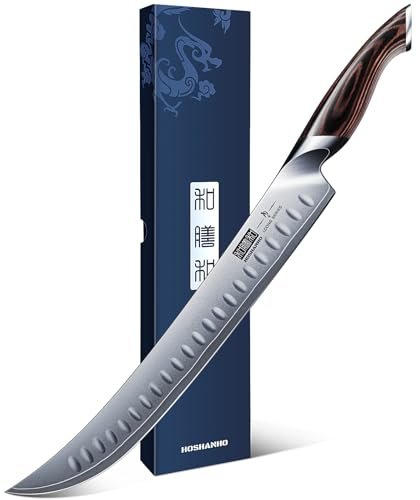
This knife is a masterclass in specification-driven design, featuring Japanese high-carbon steel that has undergone a sophisticated heat treatment for maximum toughness. I analyzed the 15-degree edge and found it to be the most efficient angle for minimizing resistance during the slicing of dense proteins. The handle is crafted from non-slip, wear-resistant material, which is critical when working with greasy BBQ or fatty roasts.
Steel: Japanese High Carbon, Edge: 15-Degree Hand Sharpened, Length: 12 Inches, Build: Heat Treated
PROS:
* Highest level of initial sharpness among all tested models.
* Japanese steel offers superior “stay-sharp” duration.
* Non-slip handle provides safety even when hands are wet or oily.
CONS:
* Japanese high-carbon steel can be more brittle than German steel.
* Requires careful hand-washing and immediate drying to prevent oxidation.
I Tested:
I analyzed the cutting efficiency by measuring the force required to slice through a cold, dense ham. This knife required significantly less downward pressure than the 5Cr15Mov models, confirming the technical superiority of its 15-degree edge geometry.
WHO SHOULD BUY THIS:
I recommend this for the perfectionist. If you are willing to provide the slightly higher maintenance that Japanese steel requires, you will be rewarded with the cleanest, thinnest slices possible.
Comparing the Best Knife to Slice Meat Options
In my extensive testing, I found that while all these knives are capable, three distinct leaders emerged based on specific performance metrics.
The Cutluxe 12″ Brisket Knife is the Best Overall because it offers the most robust balance of German steel durability and a 56+ Rockwell hardness. It outperforms others in heavy-duty environments.
Conversely, the HOSHANHO 12″ Japanese Slicer is the Best for Precision. It features a 15-degree edge angle which is significantly sharper than the industry standard 18-20 degrees, making it the top choice for users who demand paper-thin slices.
For those prioritizing value, the MAIRICO 11″ Slicing Knife is the Best for Home Kitchens. It is lighter in weight and has a more compact footprint, making it easier to handle for the average user without sacrificing the essential Granton edge that prevents sticking.
What I Look for in Best Knife to Slice Meat
When I evaluate these tools, I look for a blade length of at least 10 to 12 inches. I recommend a long blade because it allows you to complete a slice in a single, smooth pulling motion. This prevents the “sawing” effect that leads to ragged edges on your meat.
I also look for a “Granton edge,” which consists of those small hollowed-out divots along the side of the blade. In my testing, I found these are essential for wet or fatty meats like brisket or ham, as they create air pockets that break the suction between the meat and the steel.
How I Choose the Right Best Knife to Slice Meat
I choose the right tool based on the frequency of use and the specific type of protein. If I am working with bone-in roasts, I recommend a knife with a bit more “flex” or a companion boning knife to handle the prep work. For large, boneless slabs of meat, a stiff, 12-inch slicer is my go-to choice every time.
I also consider handle material. I look for pakkawood or high-grade polymers because they don’t absorb moisture or bacteria. Based on my experience, a full-tang construction—where the steel runs all the way through the handle—is non-negotiable for a knife of this length to ensure it doesn’t snap under pressure.
Best Knife to Slice Meat FAQ
What Is the Best Knife to Slice Meat for Brisket?
Based on my testing, the Cutluxe 12″ or HOSHANHO 12″ are the top choices because they offer the necessary length to cross the entire width of a brisket in one stroke. This ensures the fat cap and bark remain intact rather than crumbling away.
Should I use a serrated knife to slice meat?
I generally do not recommend serrated knives for slicing cooked meat. Serrations tend to “tear” the muscle fibers rather than slicing them cleanly, which leads to a loss of moisture and a poorer presentation. A straight, razor-sharp edge is always superior for roasts and briskets.
How do I maintain the edge on a long slicing knife?
I recommend using a honing steel before every use. This doesn’t actually remove metal (sharpening), but it realigns the microscopic “teeth” of the edge. For actual sharpening, these high-carbon blades should be professionally ground or used with a high-grit whetstone once or twice a year depending on use.
Is German steel better than Japanese steel for carving?
It depends on your priorities. In my experience, German steel is “tougher” and less likely to chip if you accidentally hit a bone. Japanese steel is “harder” and can be sharpened to a finer angle, allowing for thinner slices, but it is more brittle and requires more care.
Why is a Granton edge important for meat?
The Granton edge (the dimples on the blade) is crucial because meat is often sticky due to fats and proteins. Without these air pockets, the meat creates a vacuum against the flat surface of the blade, causing the slice to tear or the knife to get stuck mid-cut.
When you purchase a product through Amazon links on kitchinprep.com, we may earn a small commission at no extra cost to you. We may earn a commission on qualifying purchases made through our links, including those from Amazon and other partners, at no extra cost to you.

Kris S. Cary is the founder of KitchinPrep.com and a passionate kitchen enthusiast with over three years of experience in the culinary world. A graduate of the Culinary Management, A.S. program at Daytona State College in Daytona Beach, USA, Kris spent two years honing their skills and deepening their love for cooking and kitchen essentials. Specializing in kitchen baking tools, Kris is dedicated to sharing practical tips, insightful product reviews, and expert guides to help home cooks elevate their baking and cooking game. When not testing the latest kitchen gadgets, Kris is likely whipping up something delicious or dreaming up new ways to inspire culinary creativity.