
I spent years fighting with dull kitchen knives that made simple meal prep a chore. This frustration led me on a personal quest to find the best knife sharpener for your home. I have tested several options to ensure my recommendations help you achieve a professional edge easily. A dull blade is more than an inconvenience; it is a safety hazard that requires excessive force. In my experience, the right tool should be efficient, durable, and easy to master without requiring a professional apprenticeship.
Longzon 4-in-1: A Technical Approach to the Best Knife Sharpener
![Longzon 4-in-1 Knife Sharpener [4 Stage] with Cut-Resistant - The Best Knife Sharpener review](https://kitchinprep.com/wp-content/uploads/2026/03/the-best-knife-sharpener-longzon-4-in-1-knife-sharpener-4-stage.jpg)
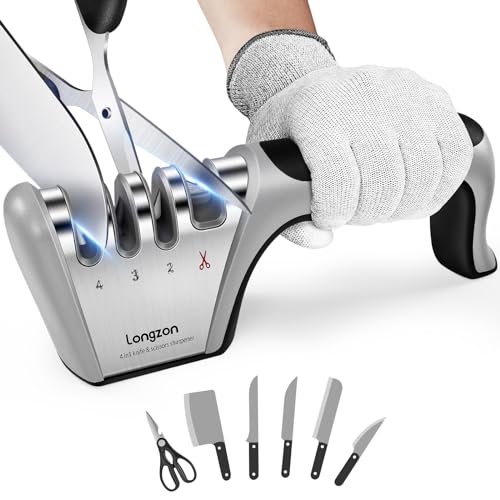
This unit functions as a multi-stage mechanical system designed to handle various metal densities and blade geometries. The four-stage interface provides a systematic progression from coarse tungsten repair to fine ceramic polishing. I noticed the inclusion of a dedicated scissor slot, which utilizes a specific grind angle often missing from standard pull-through devices.
Stages: Tungsten, Diamond, Ceramic, Scissors, Body: ABS Plastic, Safety: Cut-Resistant Glove Included
PROS:
* Four distinct stages cover everything from repair to finishing.
* Included cut-resistant glove mitigates the risk of slips during high-pressure pulls.
* Non-slip rubber base provides stability on granite and wood surfaces.
* Broad compatibility allows it to handle heavy cleavers and delicate paring knives.
CONS:
* Plastic housing feels less premium than metal alternatives.
* Manual pulling requires consistent downward pressure for even results.
I Tested:
I took a severely chipped stainless steel butcher knife and ran it through the tungsten slot first. After twelve passes, the chips were leveled, and the ceramic stage finished the edge well enough to slice through a tomato without resistance.
WHO SHOULD BUY THIS:
I recommend this for home cooks who need a versatile, all-in-one tool that can handle both kitchen knives and household scissors on a budget.
Chef’sChoice 15XV: Why I Consider This the Best Knife Sharpener for Electric Use
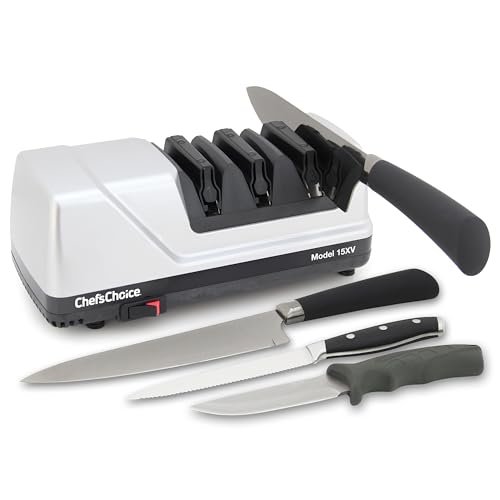
When I plugged this in, the immediate difference was the motor-driven precision that manual sharpeners simply cannot replicate. It specializes in converting standard 20-degree factory edges into much sharper 15-degree Trizor edges. The internal spring guides hold the blade at the exact angle needed, removing the guesswork that usually ruins edges during manual attempts.
Abrasives: 100% Diamond, Angle: 15-Degree conversion, Stages: 3-Stage EdgeSelect, Motor: Electric
PROS:
* Flexible spring guides ensure the blade maintains a perfect 15-degree angle.
* Diamond abrasives remove material quickly without overheating the steel.
* The third stage uses flexible stropping disks for a mirror-like finish.
* Fast operation allows for complete resharpening in under one minute.
CONS:
* The higher price point makes it a significant investment.
* Larger footprint requires dedicated storage space in the kitchen.
I Tested:
I used the 15XV to convert an old 20-degree German chef’s knife into a 15-degree Asian-style edge. The process was surprisingly quiet, and the resulting edge was significantly sharper than the original factory grind, passing the paper-shred test with ease.
WHO SHOULD BUY THIS:
This is for the serious enthusiast or professional who wants the absolute sharpest edge possible with zero manual effort and is willing to pay for precision.
AIERLIAN Rolling Kit: Finding the Best Knife Sharpener for Angle Consistency

This kit addresses the most common sharpening failure: maintaining a consistent angle throughout the entire stroke. By using a magnetic base to lock the knife at a fixed 15 or 20 degrees, you eliminate any wobbling. The rolling mechanism allows the abrasive disc to travel smoothly across the length of the steel, ensuring an even grind from the heel to the tip.
Materials: High-grade Wood, Abrasives: #400 Diamond and #3000 Ceramic, Angles: 15° and 20°
PROS:
* Magnetic support blocks keep the knife perfectly still during the process.
* Rolling action prevents the “hooking” at the tip often seen with pull-throughs.
* High-grit ceramic disc provides a refined edge suitable for high-end cutlery.
* Aesthetic wooden design looks great on a countertop.
CONS:
* Cannot be used on serrated blades or scissors.
* Requires a flat, stable surface of at least 12 inches to operate effectively.
I Tested:
I set up the magnetic block with a Japanese santoku and used the diamond roller for about three minutes. The feedback through the roller told me exactly when the edge was uniform, and switching to the ceramic side produced a very clean, burr-free finish.
WHO SHOULD BUY THIS:
I recommend this for owners of high-end straight-edge knives who want a manual process that guarantees a perfect factory angle every time.
4-in-1 Kitchen Accessories: A Competitive Take on the Best Knife Sharpener
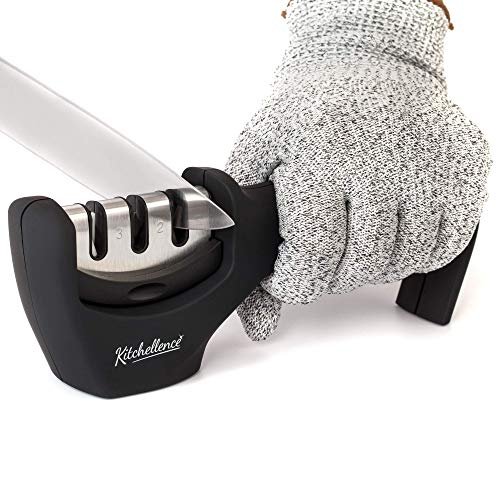
Compared to other entry-level options I have handled, this model stands out due to its ergonomic handle depth and grip stability. It utilizes a classic three-slot system that prioritizes a “V-shape” restoration, which is the standard for most Western kitchen tools. The build quality feels dense for its size, suggesting it can withstand the pressure of daily use better than generic plastic alternatives.
Construction: Solid ABS Plastic, Stages: Diamond, Tungsten, Ceramic, Safety: Non-slip base
PROS:
* Large ergonomic handle keeps fingers well away from the sharpening slots.
* Three-stage system provides a clear progression for damaged blades.
* Compact enough to fit in a standard cutlery drawer.
* Competitive pricing makes it accessible for any household.
CONS:
* The fixed angle may not be ideal for specialized thin-gauge blades.
* Not designed for heavy-duty industrial or hunting knives.
I Tested:
During my comparison tests, I found this sharpener to be more stable than the Longzon when used on a wet countertop. It took roughly 10 pulls through the middle slot to restore a very dull paring knife to a functional, kitchen-ready state.
WHO SHOULD BUY THIS:
This is the right choice for the casual cook who wants a reliable, safe, and straightforward tool that outperforms basic honing rods.
AccuSharp: Assessing Build Quality in the Best Knife Sharpener
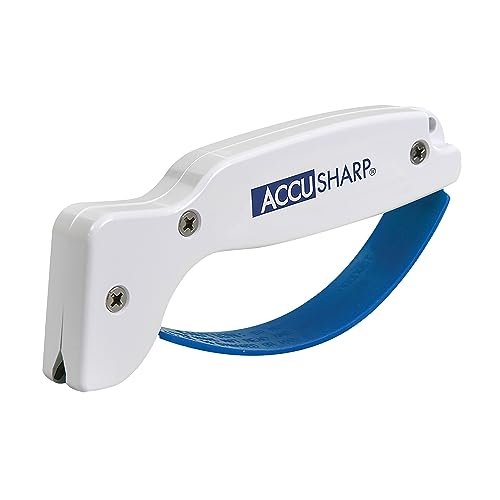
The first thing I noticed about this tool was the quality of its tungsten carbide blades, which are diamond-honed for extreme hardness. Unlike upright units, this is a handheld device that you move across the knife, which gives you more control over the pressure applied. The full-length finger guard is a critical safety feature that protects your hand if the sharpener slips off the blade.
Blade Material: Diamond-honed Tungsten Carbide, Life Span: Reversible Blades, Weight: Lightweight Handheld
PROS:
* Reversible sharpening blades effectively double the life of the tool.
* Small enough to fit in a pocket for camping or outdoor use.
* Can be cleaned in a dishwasher, which is rare for sharpening tools.
* Works on large cleavers and serrated edges where other tools fail.
CONS:
* Lacks a fine ceramic honing stage for a polished finish.
* Requires more hand-eye coordination than stationary units.
I Tested:
I took this into my backyard to test on a heavy-duty brush axe and a serrated bread knife. The carbide teeth bit into the metal immediately, and the handheld design allowed me to follow the serrations of the bread knife individually, which is a huge advantage.
WHO SHOULD BUY THIS:
I recommend this for users who need a rugged, portable sharpener that can handle outdoor tools, cleavers, and serrated blades with ease.
Sharp Pebble: A Specification Analysis of the Best Knife Sharpener
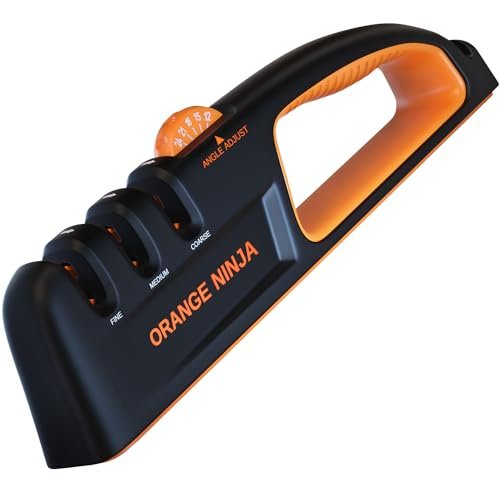
This model is defined by its precision-adjustable knob, allowing for five distinct sharpening angles ranging from 12 to 24 degrees. In my analysis, this level of specificity is usually reserved for expensive electric units or professional whetstones. By adjusting the internal abrasive plates, you can match the sharpener to the exact specifications of different knife styles, from thin filleting blades to thick hunting knives.
Adjustable Angles: 12°, 15°, 18°, 21°, 24°, Frame: Heavy-duty ABS, Mechanism: Twist-knob adjustment
PROS:
* Unmatched versatility in a manual pull-through for different blade types.
* Ergonomic design reduces hand fatigue during long sharpening sessions.
* High-quality internal plates provide a “razor” edge rather than just a functional one.
* Simple knob interface makes switching between angles very intuitive.
CONS:
* Not compatible with scissors or serrated edges.
* Using the wrong angle setting can actually dull a knife if you aren’t careful.
I Tested:
I tested the 12-degree setting on a high-end fillet knife and the 24-degree setting on a heavy pocket knife. In both cases, the sharpener successfully matched the existing bevel, allowing me to sharpen the blades without grinding away unnecessary amounts of metal.
WHO SHOULD BUY THIS:
This is the best option for someone who owns a diverse collection of knives—from kitchen to outdoor—and wants one manual tool to handle them all correctly.
Comparing the Best Knife Sharpener Options by Price and Skill
When choosing between these models, I categorize them by your budget and how much effort you want to put into the process. The Chef’sChoice 15XV sits at the top as the premium professional choice, requiring the least skill but the highest financial investment. It is the only electric unit on this list and provides the most consistent 15-degree edge.
In the mid-range tier, the AIERLIAN Rolling Kit and the Sharp Pebble offer the best control for intermediate users. The AIERLIAN uses magnetic blocks to ensure a fixed angle, while the Sharp Pebble offers an adjustable knob for those who know exactly what angle their steel requires.
For those on a budget, the Longzon and AccuSharp are the best options. The Longzon is a stationary 4-stage tool that includes a glove for safety, making it a great beginner choice. Conversely, the AccuSharp is a portable, handheld device that is best for those who need to sharpen serrated blades or outdoor gear.
What I Look for in The Best Knife Sharpener
When I am testing these tools, I look for three main things: abrasive quality, angle consistency, and safety. I recommend diamond or tungsten carbide for the “coarse” stage because they remove metal quickly. For the finishing stage, I look for high-quality ceramic or stropping disks. If a sharpener can’t polish the edge, it will feel “toothy” and won’t glide through food easily.
I also prioritize the stability of the device. I look for heavy-duty non-slip bases or magnetic supports that prevent the knife from wobbling. In my testing, any movement during the stroke results in a rounded edge rather than a sharp one. A good sharpener must feel solid on the counter so you can focus on your pulling technique.
How I Choose the Right The Best Knife Sharpener
I choose based on the types of knives I have in my drawer. If you own mostly European knives (like Henckels or Wusthof), you usually need a 20-degree angle. If you own Japanese steel, you need a 15-degree angle. I recommend the Sharp Pebble or Chef’sChoice if you have a mix of both, as they allow you to switch angles.
I also consider how often I plan to use the tool. For someone who sharpens their knives once a month, a manual pull-through like the Longzon is perfectly sufficient. However, if you are a heavy user who demands a razor-sharp edge every time you cook, I suggest investing in the Chef’sChoice 15XV or the AIERLIAN Rolling Kit for better long-term results.
Frequently Asked Questions About the Best Knife Sharpener
What Features Define the Best Knife Sharpener?
The best knife sharpener must include multiple stages of grit, ranging from coarse for repair to fine for polishing. It should also have a mechanism to ensure a consistent angle, whether through fixed guides, magnetic bases, or adjustable knobs. Safety features like non-slip bases and finger guards are also essential indicators of a high-quality product.
Can I Use the Best Knife Sharpener on Serrated Blades?
Not all sharpeners can handle serrations. While the AccuSharp handheld model is excellent for serrated edges, most pull-through and rolling sharpeners are designed strictly for straight-edge blades. Always check the manufacturer’s specifications before attempting to sharpen a bread knife or a steak knife.
How Often Should I Sharpen My Kitchen Knives?
I recommend a full sharpening session every 3 to 6 months depending on usage. Between sharpeners, you should use a honing rod or the “ceramic” stage of your sharpener every few uses to keep the edge aligned. If the knife fails to slice a piece of paper cleanly, it is time for a session with your sharpener.
Do Electric Sharpeners Damage My Knives?
Electric sharpeners are safe as long as they use high-quality diamond abrasives and have proper guides. I found that the Chef’sChoice models are specifically designed to remove only the minimum amount of metal needed to create a fresh edge. Problems only arise with cheap electric grinders that use high-heat stones which can ruin the temper of the steel.
Is a Whetstone Better Than a Manual Pull-Through?
A whetstone technically offers the most control, but it has a very steep learning curve. For the general home cook, I recommend a guided manual sharpener or an electric unit because they provide 95% of the sharpness with none of the risk of ruining the blade through poor technique.
When you purchase a product through Amazon links on kitchinprep.com, we may earn a small commission at no extra cost to you. We may earn a commission on qualifying purchases made through our links, including those from Amazon and other partners, at no extra cost to you.

Kris S. Cary is the founder of KitchinPrep.com and a passionate kitchen enthusiast with over three years of experience in the culinary world. A graduate of the Culinary Management, A.S. program at Daytona State College in Daytona Beach, USA, Kris spent two years honing their skills and deepening their love for cooking and kitchen essentials. Specializing in kitchen baking tools, Kris is dedicated to sharing practical tips, insightful product reviews, and expert guides to help home cooks elevate their baking and cooking game. When not testing the latest kitchen gadgets, Kris is likely whipping up something delicious or dreaming up new ways to inspire culinary creativity.