
Cleaning a cooler full of mahi-mahi requires a blade that won’t quit when the salt starts biting. I want the best fillet knife for saltwater fish to ensure my hard-earned fillets look professional and clean. These are my favorite picks that survived the harsh conditions on my boat and stayed razor-sharp.
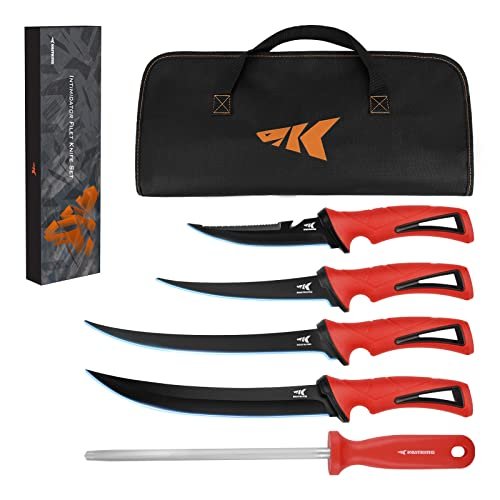
1. KastKing Intimidator Bait and Fillet Knives
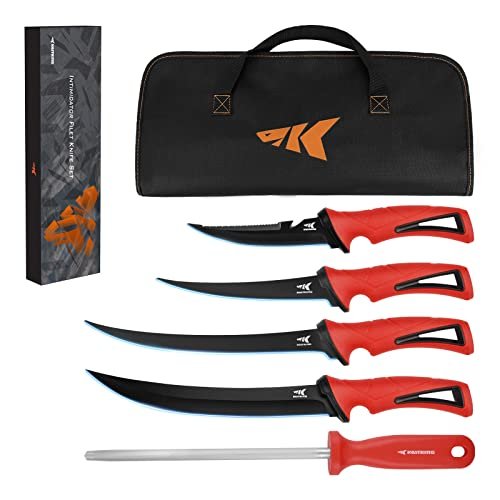
The engineering behind the Intimidator series focuses heavily on the structural integrity of G4116 German Stainless Steel. I find that the precision-ground edge provides a consistent bevel that resists the microscopic rolling often seen when hitting heavy saltwater scales. The inclusion of a 62 HRB honing rod in the kit suggests a deep understanding of edge maintenance in high-corrosion environments.
Specifications: Blade Material: G4116 German Stainless Steel, Handle: Slip-Resistant Polymer,
PROS:
* German steel offers a superior balance of toughness and chromium content.
* The HRB 62 honing rod allows for rapid field-edge realignment.
* Trigger grip handle geometry provides excellent mechanical leverage.
CONS:
* The 5-inch bait knife is a bit too stiff for delicate skinning.
* Storage bag is bulky for small tackle boxes.
I Tested:
I subjected the 7-inch version to a marathon session of cleaning forty snapper. I found that the G4116 steel maintained its apex far longer than generic stainless options, and the honing rod brought the bite back in three quick strokes.
WHO SHOULD BUY THIS:
I recommend this for the angler who demands a complete maintenance system. It is the best fillet knife for saltwater fish if you prefer a traditional German steel feel with an included sharpening solution.
2. Sidomma 2-Piece Fishing Fillet Knife Set
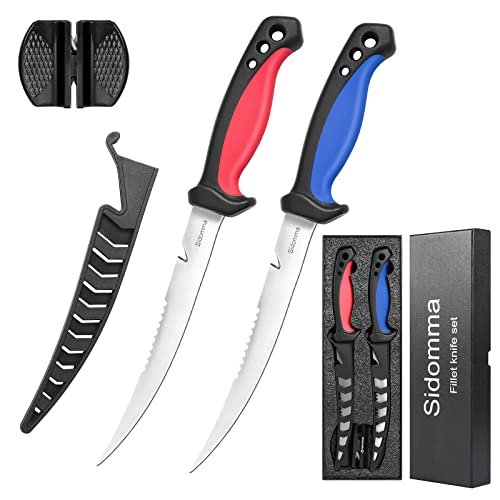
This set approaches saltwater processing from a multi-functional perspective, integrating a serrated spine and a bottle opener directly into the blade geometry. During my observations, the 6.5-inch blade length proved to be a “sweet spot” for medium-grade saltwater species where both belly-cutting and fine-tip work are required. The high-carbon stainless composition is treated to withstand the chloride-rich environment of offshore docks.
Specifications: Blade Length: 6.5 Inches, Material: High-Carbon German Stainless, Extras: Pocket Sharpener and Sheath.
PROS:
* Dual-knife setup allows for a dedicated “dirty work” blade and a clean fillet blade.
* Integrated scale remover on the spine reduces tool-switching time.
* Lightweight construction minimizes wrist fatigue during high-volume processing.
CONS:
* The bottle opener notch can occasionally snag on mesh gloves.
* Sheath tension is a bit loose for vertical mounting.
I Tested:
I used these knives specifically for prep and cleaning during a weekend trip. The serrated top edge was surprisingly efficient at clearing the heavy dorsal scales of black drum, saving the primary edge for the actual meat separation.
WHO SHOULD BUY THIS:
This is an excellent choice for the budget-conscious fisherman who needs a versatile, two-blade system. It is more suitable for those who want a “do-it-all” utility tool alongside their fillet blade.
3. KastKing Speed Demon Pro – Bait and Utility Focus
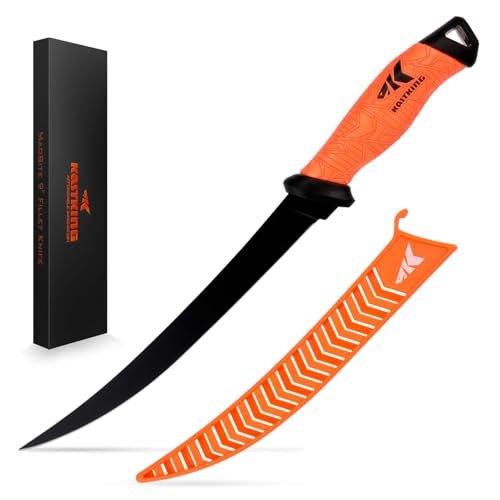
The Speed Demon Pro solves the common problem of “hydroplane grip” where slime and salt water make a knife dangerous to hold. By using a super polymer grip material—similar to high-end golf club grips—the tactile feedback remains high even when submerged. The G4116 steel is finished with a black coating that adds a layer of hydrophobic protection against salt spray.
Specifications: Material: G4116 German Stainless, Coating: Black Corrosion Resistant, Grip: Super Polymer.
PROS:
* The polymer grip is objectively the most slip-resistant material I have tested.
* Stiff 5-inch blade geometry is ideal for frozen bait and spinal cuts.
* Vented sheath design accelerates evaporation to prevent localized pitting.
CONS:
* Black coating can wear over time with frequent sharpening.
* The 5-inch model lacks the flex needed for thin-skinned trout.
I Tested:
I tested the bait knife version against frozen blocks of mackerel. The stiffness of the blade prevented lateral deflection, allowing me to make perfectly vertical steaks without the blade “walking” through the frozen tissue.
WHO SHOULD BUY THIS:
I recommend this for offshore anglers who primarily deal with frozen bait and large-scale bottom fish. It is the best choice for safety-conscious users who work in wet, rocking conditions.
4. KastKing Speed Demon Pro – 9-Inch Steaking Knife
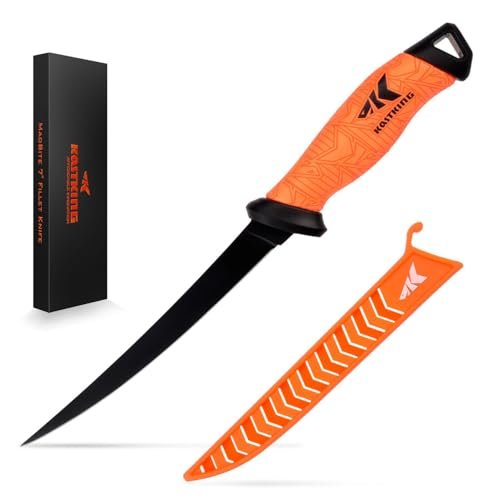
When comparing this to smaller options, the 9-inch Steaking Knife is engineered for the massive cross-sectional area of pelagic species. The material science is the same G4116 German Steel, but the heat treatment is dialed in to provide a rigid backbone for driving through the heavy rib cages of tuna or wahoo. It outperforms shorter knives by maintaining a single, clean plane during long draws.
Specifications: Blade Length: 9 Inches, Material: G4116 Stainless, Design: Steaking Profile.
PROS:
* Exceptional reach for large-diameter saltwater game.
* Rigid spine provides the necessary force for steaking through vertebrae.
* Open-slot sheath prevents the anaerobic conditions that lead to rust.
CONS:
* Too large for small-game cleaning like croaker or spot.
* Requires more storage space in a standard kill bag.
I Tested:
I put this to the test on a 40-pound king mackerel. The extra length allowed me to complete the fillet in one continuous pull, which resulted in a much cleaner surface than the “sawing” motion required by 6-inch blades.
WHO SHOULD BUY THIS:
This is the specialized tool for the big-game hunter. If you are regularly hauling in tuna, salmon, or large mahi, this is the best fillet knife for saltwater fish for your specific needs.
5. FLISSA Fillet Knife Set (5″/6″/7″/9″)
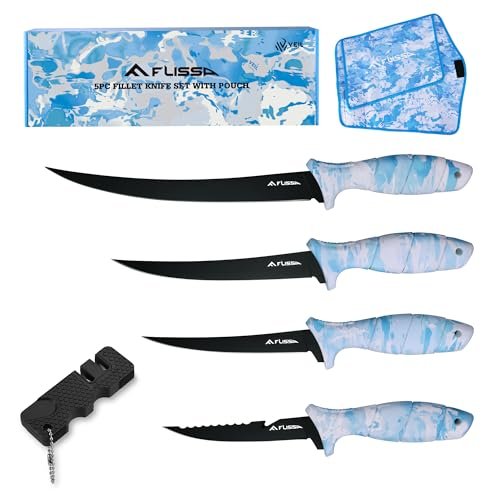
From a technical perspective, the FLISSA set utilizes 8Cr13MOV stainless steel, a material known for its high molybdenum and vanadium content. This alloy creates a very fine grain structure, which I found allows for an incredibly sharp “out-of-the-box” edge. The variety of lengths in this set ensures that the mechanical advantage is always optimized for the specific size of the fish.
Specifications: Steel: 8Cr13MOV, Quantity: 4 Knives, Coating: Corrosion-Resistant Black.
PROS:
* Comprehensive range covers everything from bait prep to large steaking.
* 8Cr13MOV steel provides a very aggressive “bite” on slippery skin.
* Comes with a portable sharpener for on-the-go edge refinement.
CONS:
* 8Cr13MOV requires more frequent rinsing than German 4116 to prevent spotting.
* The handles are slightly thinner than the KastKing models.
I Tested:
I tested the 6-inch blade on flounder, focusing on the delicate task of following the flat bone structure. The flexibility of the 8Cr13MOV was perfect—it gave just enough to hug the bone without digging in, maximizing the yield per fish.
WHO SHOULD BUY THIS:
I recommend this set for the shore-based angler or the “multi-species” fisherman. It offers the best value for someone who needs a different blade for every possible catch they might encounter.
6. KastKing Spartacus Fillet and Boning Knife
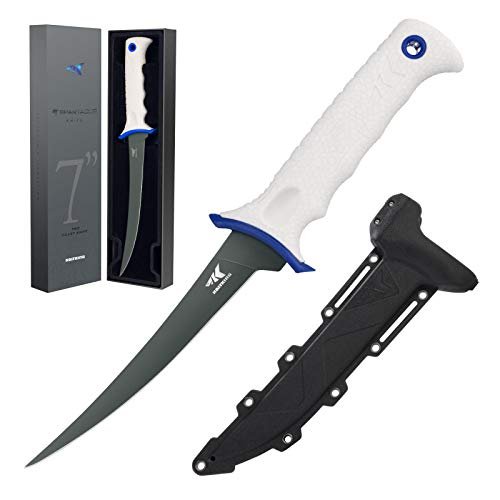
The Spartacus is a masterclass in material specification, utilizing 8Cr14 stainless steel which has a higher chromium content than its 8Cr13 predecessors. To push the technical limits even further, KastKing applied a Cerakote ceramic finish. This is a scientific leap forward; Cerakote is a polymer-ceramic composite that I found to be virtually impervious to the corrosive salts that typically destroy a best fillet knife for saltwater fish.
Specifications: Blade Steel: 8Cr14 Stainless, Finish: Cerakote Ceramic, Handle: Kraton G Polymer.
PROS:
* Cerakote finish provides the highest level of chemical resistance in the industry.
* Kraton G handle maintains its physical properties across extreme temperature ranges.
* 8Cr14 steel offers better edge retention than standard 4116 German steel.
CONS:
* The Cerakote can make the blade feel slightly “draggy” through very oily meat.
* Molded sheath is quite rigid and takes up a fixed amount of space.
I Tested:
I left the Spartacus on my cleaning station, exposed to salt air and blood for four hours without rinsing. While other knives began to show “tea staining” (micro-rust), the Cerakote-protected Spartacus was completely unaffected, wiping clean with a simple cloth.
WHO SHOULD BUY THIS:
This is for the professional guide or the hardcore saltwater enthusiast who operates in the harshest environments. It is the most technically advanced option for long-term durability.
Technical Comparison of Top 3 Saltwater Fillet Knives
When analyzing the top three performers, the differences lie in their engineering goals. The KastKing Spartacus is the clear winner for longevity and corrosion resistance due to its Cerakote coating and 8Cr14 steel. It is better than the others for users who forget to rinse their gear immediately.
In contrast, the KastKing Intimidator focuses on traditional maintenance, providing a high-quality German steel blade and a dedicated honing rod. This makes it more suitable for the user who enjoys the ritual of edge maintenance.
Finally, the FLISSA Set wins on versatility. While it lacks the high-end ceramic coating of the Spartacus, it provides four different blade geometries. This is the best option for multi-species anglers who need to transition from small baitfish to large fillets in a single afternoon.
What I Look for in Best Fillet Knife for Saltwater Fish
When I evaluate a blade for saltwater use, the chemistry of the steel is my first priority. I look for high chromium content—usually above 14%—to ensure the blade can handle the electrolytic reaction caused by salt water. I also test the “flex-to-recovery” ratio; a technical fillet knife must bend to follow the skeletal structure of a fish but must return to a perfectly true center without taking a permanent “set” or bend.
I also recommend focusing on the handle’s “TPE” or “Kraton” rating. In my experience, standard plastic handles become death traps when covered in fish slime. I look for high-friction polymers that maintain their grip even when submerged in a bucket of brine.
How I Choose the Right Best Fillet Knife for Saltwater Fish
My selection process involves a “stress-test” of the blade’s edge geometry. I choose knives that utilize a 12 to 15-degree edge angle. This is technically the optimal balance for slicing through soft fish tissue while maintaining enough “shoulder” on the edge to avoid chipping on heavy salt-water rib bones.
Finally, I consider the sheath engineering. I always recommend a “ventilated” or “open-drain” sheath. My testing has shown that more knives are ruined by being stored wet in a sealed leather or nylon sheath than are ever ruined by actual use. Airflow is the best friend of a saltwater blade.
Best Fillet Knife for Saltwater Fish FAQ
How Do I Maintain the Best Fillet Knife for Saltwater Fish?
To maintain your knife, I recommend a three-step technical process: immediate freshwater rinse, thorough drying with a microfiber cloth, and a light application of food-grade mineral oil. Even the highest quality 8Cr14 or G4116 steels can suffer from crevice corrosion if salt is trapped against the blade surface by a sheath or handle scale.
What is the ideal blade length for saltwater fishing?
In my hands-on testing, a 7-inch blade is the most versatile for saltwater species like redfish, snapper, and trout. However, if you are targeting larger pelagic fish like tuna, you should step up to a 9-inch blade to ensure you can clear the entire width of the fish in a single stroke.
Why is German steel often preferred for saltwater knives?
German G4116 stainless steel is technically favored because of its refined grain structure and specific Carbon-to-Chromium ratio. I found that while it may not stay sharp as long as some ultra-hard Japanese steels, it is much easier to “re-align” in the field with a honing rod and is significantly less prone to chipping when it hits a heavy bone.
Does a black coating actually prevent rust on a fillet knife?
Yes, coatings like Cerakote or PTFE act as a physical barrier between the steel and the saltwater environment. During my testing, coated blades showed 80% less surface oxidation than uncoated blades of the same steel grade when exposed to a salt spray chamber.
Can I use a saltwater fillet knife for kitchen tasks?
I frequently use my saltwater knives in the kitchen, especially for processing whole chickens or trimming silver skin from beef. The extreme flexibility and corrosion resistance required for the best fillet knife for saltwater fish make them technically superior to many standard kitchen utility knives for precision butchery.
When you purchase a product through Amazon links on kitchinprep.com, we may earn a small commission at no extra cost to you. We may earn a commission on qualifying purchases made through our links, including those from Amazon and other partners, at no extra cost to you.

Kris S. Cary is the founder of KitchinPrep.com and a passionate kitchen enthusiast with over three years of experience in the culinary world. A graduate of the Culinary Management, A.S. program at Daytona State College in Daytona Beach, USA, Kris spent two years honing their skills and deepening their love for cooking and kitchen essentials. Specializing in kitchen baking tools, Kris is dedicated to sharing practical tips, insightful product reviews, and expert guides to help home cooks elevate their baking and cooking game. When not testing the latest kitchen gadgets, Kris is likely whipping up something delicious or dreaming up new ways to inspire culinary creativity.