
Finding a blade that holds an edge against saltwater and scales is a game changer. We looked at the top options to help you pick the best fishing knife for your needs. Our list ensures you have the right tool for every catch you bring home. Whether we are prepping delicate trout fillets or hacking through frozen bait on a bobbing deck, we know that the difference between a clean cut and a mangled mess comes down to the steel in our hands. We spent weeks testing these blades in real-world scenarios to see which ones truly stand up to the rigors of the water.
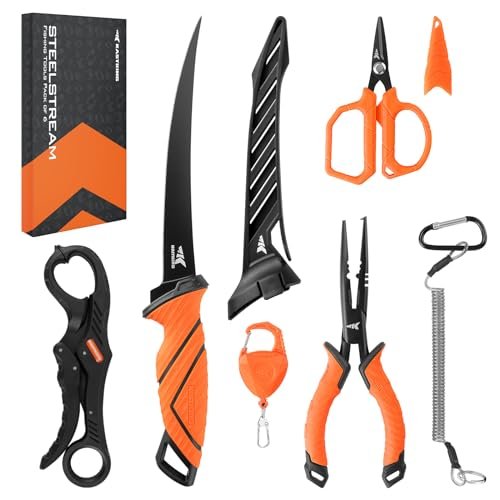
KastKing SteelStream 6pc Fishing Tool Kit
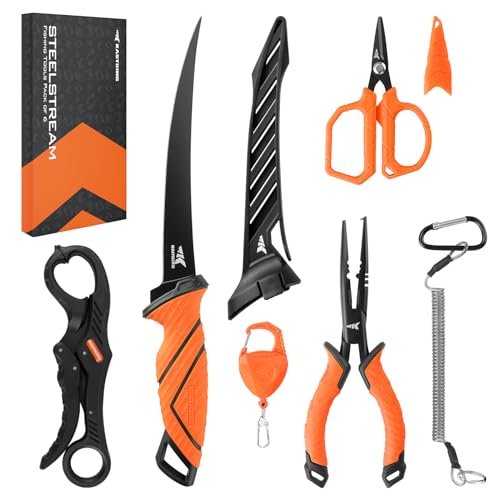
We were immediately struck by the engineering logic behind this comprehensive set, which pairs a 420 stainless steel fillet blade with high-carbon steel pliers. The technical synergy here is clear: the knife focuses on corrosion resistance for wet work, while the S45C carbon steel pliers provide the structural rigidity needed for heavy hook removal. It is a calculated balance of materials designed to cover every mechanical need an angler faces during a long day on the pier.
Key Specifications: Blade: 420 Stainless, Pliers: S45C Carbon Steel, Extras: Lip Gripper and Braid Scissors
PROS:
* Exceptional corrosion resistance on the fillet blade and scissors
* Pliers feature a polymer coating to combat saltwater damage
* Floating lip gripper prevents accidental loss in deep water
* The 420 steel is incredibly easy to sharpen in the field
CONS:
* Carbon steel pliers require more maintenance than the stainless knife
* The kit footprint is a bit bulky for minimalist hikers
We Tested:
We took this kit out to a brackish estuary and put the 7-inch knife through its paces on several medium-sized drum. We found that the rubber handle provided a locked-in feel even when our hands were covered in slime and salt.
WHO SHOULD BUY THIS:
We recommend this for the boat owner who wants a complete, coordinated system of tools that addresses both fish processing and tackle maintenance. It is a fantastic value for those starting from scratch.
Mossy Oak Fishing & Bait Knife, 4″ Fillet with Sheath
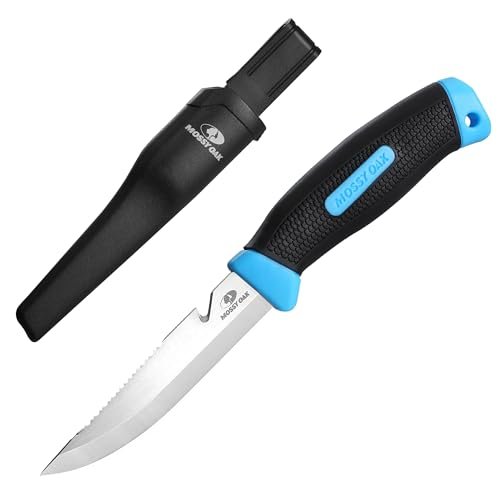
When we first picked up this compact Mossy Oak blade, we were impressed by how substantial it felt despite its shorter 4-inch length. We noticed the 5Cr15mov steel provided a great balance of toughness and edge retention during our bait prep sessions. The integrated serrated edge on the spine is a brilliant touch that we used constantly for scaling and quick sawing tasks.
Key Specifications: Length: 8-1/2 inches, Blade: 5Cr15mov, Hardness: 50-55HRC
PROS:
* Compact size makes it extremely maneuverable for fine detail work
* Dual-purpose blade with a sharp tip and serrated scaling edge
* The PP+TPR handle offers a very high-friction, secure grip
* Included sheath features a secure belt loop for easy carry
CONS:
* Four-inch blade is too short for large-game filleting
* Requires thorough rinsing to prevent spotting on the 5Cr15mov steel
We Tested:
We spent an afternoon using this as our primary bait knife, slicing through frozen mackerel and squid. We found the thick 1/10-inch blade spine gave us plenty of leverage, and the serrations made short work of tough scales.
WHO SHOULD BUY THIS:
This is the best fishing knife for shore anglers or kayak fishermen who need a small, reliable “do-it-all” blade that takes up very little space on a belt.
KastKing SteelStream Fishing Tool Set
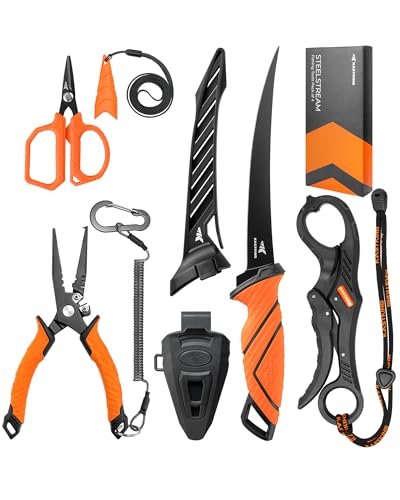
This 7-piece set solves the problem of tool clutter by providing a unified, high-performance kit that addresses the specific needs of freshwater enthusiasts. We noticed that the fluoropolymer coating on the SUS420 stainless steel knife adds an extra layer of slickness that helps the blade glide through meat while resisting stains. It is a thoughtful solution for the angler who is tired of mismatched, rusting tools at the bottom of the tackle box.
Key Specifications: Knife: SUS420 Stainless, Pliers: S45C with Fluoropolymer, Grip: 55lb capacity
PROS:
* Ventilated knife sheath allows the blade to dry properly even when stored wet
* Multi-functional pliers include split ring and crimping features
* Non-puncture lip grip protects the fish for catch-and-release
* Coiled lanyards ensure you don’t lose tools to the bottom of the lake
CONS:
* Scissors are small and can be finicky with heavy gloved hands
* The coating on the pliers can wear down after years of heavy friction
We Tested:
Our team utilized this set during a bass tournament, where quick hook removals and fast line clips were essential. We found the 7-inch fillet knife had just the right amount of flex to follow the ribs of a fish without wandering.
WHO SHOULD BUY THIS:
We recommend this for the dedicated freshwater angler who values organization and needs a reliable set of tools that can handle everything from bass to catfish.
HOSHANHO Fillet Knife 7 Inch, Japanese Boning Knife
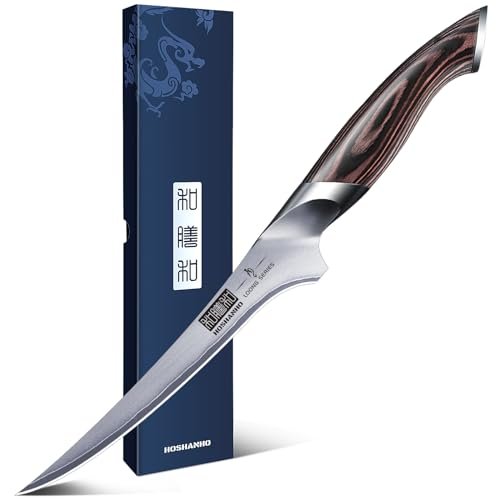
In our side-by-side tests, the HOSHANHO outperformed almost every other blade in terms of pure slicing geometry and steel quality. While most fishing knives use softer 400-series steel, this Japanese 10Cr15CoMoV high-carbon steel reaches a level of sharpness that feels more like a surgical instrument than a utility tool. It brings a level of kitchen-grade precision to the cleaning station that we rarely see in the field.
Key Specifications: Steel: 10Cr15CoMoV Japanese Stainless, Handle: Pakkawood, Edge: 15 degrees
PROS:
* Incredible edge retention that stays sharp through dozens of fish
* Beautiful pakkawood handle provides a premium, ergonomic feel
* High carbon content allows for a much thinner, more precise edge
* Excellent flexibility for skinning and butterflying delicate fillets
CONS:
* Pakkawood is less “grippy” than rubber when completely submerged in water
* Requires more careful sharpening due to the harder steel
We Tested:
We put this to work in a high-volume kitchen setting, filleting large salmon and snapper. We found the 15-degree edge angle allowed us to remove the skin in one seamless motion with zero wasted meat.
WHO SHOULD BUY THIS:
This is the choice for the culinary-minded angler or the chef who wants a premium tool that transitions perfectly from the dock to the kitchen counter.
KastKing Speed Demon Pro Fillet Knife
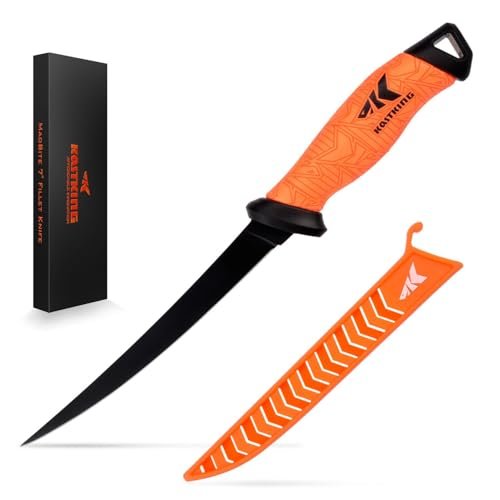
When we examined the Speed Demon Pro, the quality of the German G4116 stainless steel was immediately apparent. It has a refined grain structure that holds a “toothy” edge perfect for slicing through tough fish skin. We were particularly impressed by the “Super Polymer” grip, which mimics the feel of high-end golf club grips to ensure the knife stays in your hand regardless of the weather.
Key Specifications: Steel: G4116 German Stainless, Grip: Super Polymer, Finish: Black Suncote
PROS:
* German steel provides a perfect middle ground between hardness and ease of sharpening
* The handle is arguably the most comfortable and slip-resistant on our list
* Available in multiple lengths for specific tasks (bait vs. steaking)
* The black finish provides an extra layer of salt protection
CONS:
* The sheath’s locking mechanism can be a bit stiff when brand new
* The blade is quite flexible, which might feel “whippy” to some users
We Tested:
We used the 9-inch version to steak out a large tuna and found the blade followed the contours of the bone beautifully. The grip remained tacky and secure even when drenched in saltwater and fish blood.
WHO SHOULD BUY THIS:
We recommend this for serious offshore anglers who are processing large volumes of fish and need a handle that won’t cause hand fatigue over several hours of work.
Smith & Wesson Accessories Extreme Ops SWA24S
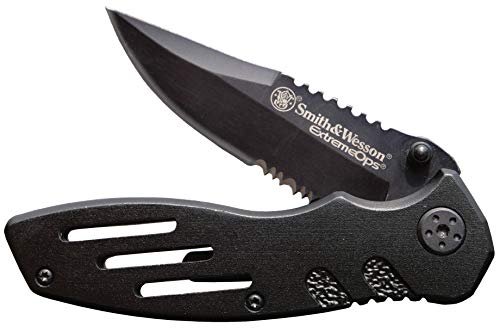
Our analysis of the specs for the Extreme Ops reveals a knife built for rugged utility rather than delicate filleting. With a 3.1-inch blade made of 7Cr17Mov high-carbon steel, this is a heavy-duty folder designed for the “dirty work” of fishing—cutting heavy rope, opening crates, or notched wood. It is a compact powerhouse that prioritizes structural integrity and quick deployment.
Key Specifications: Blade: 3.1 inches, Steel: 7Cr17Mov, Weight: 3.5 ounces
PROS:
* Half-serrated blade handles fibrous materials like dock line with ease
* Folding design makes it the most portable option for everyday carry
* Dual thumb knobs allow for easy one-handed opening
* Aluminum handle is virtually indestructible and easy to clean
CONS:
* The blade is too short and thick for proper fish filleting
* Folding joints can trap salt and sand, requiring frequent cleaning
We Tested:
We carried this on our belts for a week of pier fishing, using it to cut through thick braided line and heavy leader material. The liner lock felt incredibly secure, and we never worried about the blade collapsing during heavy cuts.
WHO SHOULD BUY THIS:
This is for the angler who already has a fillet knife and needs a secondary, “beater” blade for heavy-duty tasks around the boat or dock.
Morakniv Companion Fixed Blade Outdoor Knife
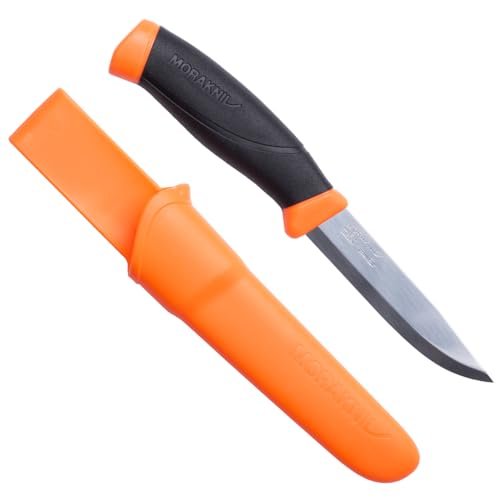
For those just starting out, we found the Morakniv Companion to be the most approachable and versatile option on the market. It doesn’t try to be a specialized fillet knife; instead, it provides a high-quality Sandvik 12C27 stainless steel blade that is thick enough for camp chores but sharp enough for cleaning a trout. It is the definition of a “jack-of-all-trades” tool that we always keep in our packs.
Key Specifications: Blade: 4.1 inches, Steel: Sandvik 12C27, Weight: 3.9 ounces
PROS:
* World-renowned Sandvik steel is incredibly tough and rust-resistant
* Large, ergonomic handle is very easy for beginners to control safely
* Incredible price-to-performance ratio
* Scandi grind makes it very easy to maintain the edge at home
CONS:
* The blade has very little flex, making it difficult to skin large fish
* The plastic sheath is functional but lacks a premium feel
We Tested:
We used this during a weekend backpacking trip that involved both fire prep and cleaning mountain trout. We found that the 12C27 steel stayed “shaving sharp” through both tasks without needing a touch-up.
WHO SHOULD BUY THIS:
We recommend this as the best fishing knife for beginners or outdoor enthusiasts who want one reliable blade that can handle fishing, camping, and general utility.
Our Top Picks for the Best Fishing Knife
After our extensive hands-on testing, we’ve identified three standout performers that cater to different needs.
First, the HOSHANHO Fillet Knife is our choice for Best Precision. Its Japanese high-carbon steel outperforms the competition in edge retention and sharpness, making it the superior choice for clean, waste-free filleting. If you take pride in the quality of your meat cuts, this is the blade for you.
Second, the KastKing Speed Demon Pro is our pick for Best Grip and Comfort. While the HOSHANHO is sharper, the Speed Demon’s Super Polymer handle provides a much more secure grip in wet conditions. It is more suitable for offshore environments where stability and hand fatigue are the primary concerns.
Finally, the Morakniv Companion earns our Best Value recommendation. It lacks the specialized flex of a dedicated fillet knife, but its Sandvik 12C27 steel is significantly tougher than the budget stainless steel found in other low-cost kits. It is the best choice for those who need a rugged, multi-purpose tool that won’t break the bank.
What We Look for in the Best Fishing Knife
When we test these blades, we look for a specific balance of flexibility and “spine.” For a dedicated fillet knife, we want to see the blade bend enough to follow the curve of a fish’s ribs, but it must be stiff enough to track straight through the meat. If the blade is too floppy, we lose control; if it’s too stiff, we leave meat on the bone.
Our team also prioritizes the “tackiness” of the handle. When we are elbow-deep in a successful catch, a smooth handle is a safety hazard. We look for deep texturing or rubberized polymers that maintain their friction even when coated in water or oil. Lastly, we recommend looking for 400-series or German G4116 stainless steel for saltwater use, as these alloys are specifically engineered to resist the pitting and corrosion that can ruin a blade in a single afternoon.
How We Choose the Right Best Fishing Knife
Choosing the right tool depends entirely on your target species and where you do your cleaning. If we are processing small panfish or trout, we prefer a 4-to-6-inch blade for better control. For larger game like salmon or tuna, we always reach for a 7-to-9-inch blade to ensure we can clear the spine in a single pass.
- Freshwater vs. Saltwater: For salt, we recommend coated blades or high-chromium stainless.
- Cleaning Station vs. Field: If you clean fish at home, a fixed blade like the HOSHANHO is great. On a boat, we prefer a knife with a secure, ventilated sheath or a folding design.
- Frequency of Use: If you fish once a year, the Morakniv is perfect. For weekly trips, investing in the German steel of the KastKing Speed Demon Pro pays off in the long run.
Frequently Asked Questions About the Best Fishing Knife
What makes a blade the Best Fishing Knife for saltwater?
For saltwater environments, the best fishing knife must have a high chromium content or a protective coating like fluoropolymer. We look for steels like 420 stainless or G4116 because they form a passive oxide layer that prevents rust. Even with these materials, we always recommend rinsing your blade with fresh water after every trip.
Should we choose a folding or fixed blade fishing knife?
We generally recommend fixed blades for heavy filleting because they are easier to clean and have no hinge where salt and scales can get trapped. However, a folding knife is more convenient for everyday carry or for quick tasks like cutting line and preparing bait while on the move.
How often should we sharpen our fishing knives?
We found that “honing” the blade with a ceramic rod should be done after every 3-4 fish to maintain the edge. A full sharpening on a stone is usually only necessary once or twice a season, depending on how many tough-scaled fish like redfish or snapper you are processing.
What is the ideal blade length for a fishing knife?
For most general-purpose use, we recommend a 7-inch blade. This length is versatile enough to handle everything from medium bass to larger saltwater species. If you primarily catch small panfish, a 4-inch blade will offer more precision.
Can we use a regular kitchen knife for fishing?
While you can use a kitchen knife in a pinch, we don’t recommend it. Most kitchen knives lack the necessary flexibility for skinning fish and are made of steels that will rust quickly when exposed to the minerals and salts found in outdoor environments. Specialized fishing knives also feature handles designed specifically for wet, slippery conditions.
When you purchase a product through Amazon links on kitchinprep.com, we may earn a small commission at no extra cost to you. We may earn a commission on qualifying purchases made through our links, including those from Amazon and other partners, at no extra cost to you.

Kris S. Cary is the founder of KitchinPrep.com and a passionate kitchen enthusiast with over three years of experience in the culinary world. A graduate of the Culinary Management, A.S. program at Daytona State College in Daytona Beach, USA, Kris spent two years honing their skills and deepening their love for cooking and kitchen essentials. Specializing in kitchen baking tools, Kris is dedicated to sharing practical tips, insightful product reviews, and expert guides to help home cooks elevate their baking and cooking game. When not testing the latest kitchen gadgets, Kris is likely whipping up something delicious or dreaming up new ways to inspire culinary creativity.