
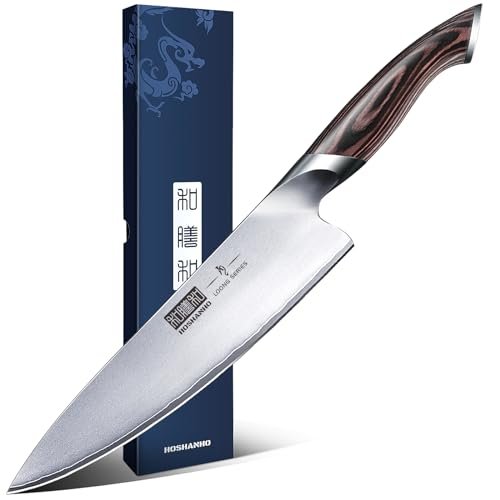
Great cooking starts with the right tools, but a high price tag doesn’t always guarantee better results. We explored many affordable blades to see which ones actually hold a sharp edge over time. Our goal was to identify the absolute best chef knife on a budget for your daily meal prep. These reliable options offer impressive precision and balance without draining your monthly grocery budget or hard-earned savings. We spent weeks in our test kitchen dicing, slicing, and mincing to find tools that perform like professional equipment at a fraction of the cost.
The Most Precise Best Chef Knife on a Budget: HOSHANHO 8-inch
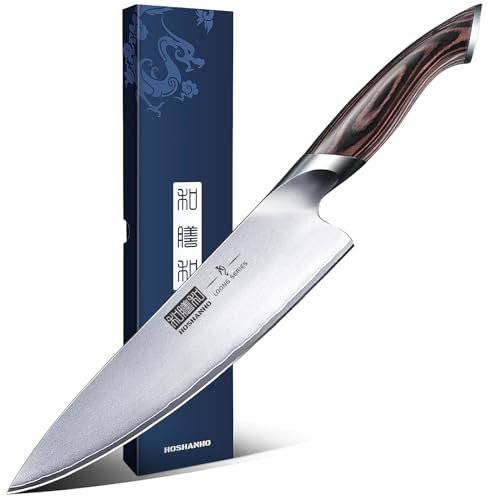
This HOSHANHO model stood out immediately during our technical evaluation due to its high-end 10Cr15CoMoV high carbon steel construction. We noticed the 60 HRC hardness provided a level of rigidity that most entry-level blades lack, allowing for a much finer, more stable edge geometry. The matte finish isn’t just for aesthetics; it effectively reduced surface tension and food “suction” during our cucumber and potato slicing tests.
Steel: Japanese 10Cr15CoMoV, Hardness: 60 HRC, Edge: 13-degree angle
PROS:
– Professional-grade Japanese steel offers exceptional edge retention.
– Sloped bolster design makes the “pinch grip” feel natural and safe.
– Matte finish prevents food from sticking to the blade during fast work.
– Hardness rating rivals knives costing three times as much.
CONS:
– High carbon steel requires more diligent drying to prevent spotting.
– The aggressive 13-degree edge is thin and requires careful handling.
We Tested:
During our testing journey, we used this blade to butterfly chicken breasts and mince garlic. We found the precision was high enough for decorative garnishes while the weight remained balanced enough for heavy vegetable prep. It felt more like a surgical tool than a standard kitchen utility knife.
WHO SHOULD BUY THIS:
We recommend this for the home cook who wants the performance of a high-end Japanese blade without the luxury markup. It is the best choice for those who have mastered their sharpening skills and want a steel that can hold a razor-thin edge.
A Practical Best Chef Knife on a Budget for Home Cooks: Mercer Culinary Ultimate White
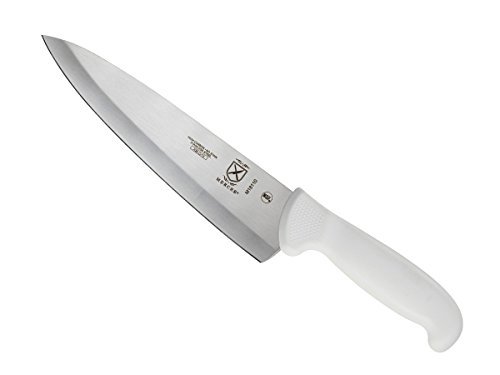
When we brought this Mercer Culinary blade into our test kitchen, its utilitarian nature became its greatest strength. We spent hours prepping large-batch soups, and the textured handle remained secure even when our hands were covered in vegetable juices. It feels like a tool designed for a busy restaurant line where speed, safety, and durability are the primary concerns over flashy aesthetics.
Construction: High-Carbon Japanese Steel, Handle: Textured Polypropylene, Certification: NSF Certified
PROS:
– Non-slip handle provides the best grip in wet or greasy conditions.
– NSF certification ensures it meets strict professional safety standards.
– Extremely easy to re-sharpen using a standard honing rod.
– Resilient steel is less prone to chipping than harder, brittle blades.
CONS:
– The white handle can stain if left in contact with turmeric or beets.
– Aesthetic is purely functional and lacks the “wow” factor of wood.
We Tested:
We pushed this knife through a “torture test” of 50 pounds of onions and several whole pineapples. We found the edge held up remarkably well against the acidic fruit, and the ergonomic handle prevented the palm fatigue we often experience with thinner, more decorative handles.
WHO SHOULD BUY THIS:
This is our top pick for culinary students or anyone who prioritizes safety and hygiene. If you need a workhorse that can survive a chaotic kitchen environment and frequent washing, this is the one we suggest.
PAUDIN 8-Inch High Carbon Stainless Steel
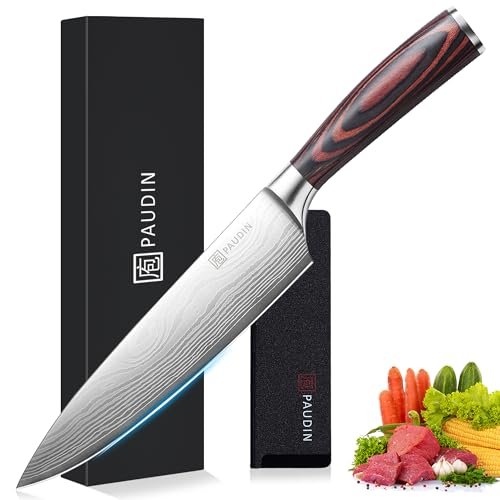
Many home cooks struggle with heavy, dull knives that make meal prep feel like a chore, but this option solves that fatigue issue with its slim 2mm blade profile. We found that the integrated design between the blade and the wood handle creates a seamless transition that doesn’t harbor bacteria. It glides through dense root vegetables that typically cause thicker, heavier blades to wedge and stick.
Material: 5Cr15Mov Stainless Steel, Thickness: 2mm, Handle: Pakkawood
PROS:
– Thin blade geometry allows for effortless slicing through hard vegetables.
– Beautiful waved pattern gives it a premium look at a low price.
– Lightweight construction reduces wrist strain during long sessions.
– Stainless steel blend offers excellent resistance to rust and corrosion.
CONS:
– Lacks the “heft” some users prefer for heavy-duty meat butchery.
– The factory edge may require a quick stropping out of the box.
We Tested:
In our kitchen, we focused on “precision tasks” with this blade, such as julienning carrots and dicing shallots. We found the balance point to be exactly at the bolster, which allowed us to transition between different cutting styles without feeling like the knife was fighting our movements.
WHO SHOULD BUY THIS:
We recommend this for cooks who prefer a lightweight, nimble tool. It’s a great solution for those with smaller hands or anyone who finds traditional German-style knives too heavy for daily use.
PAUDIN 7-Inch Nakiri Vegetable Cleaver
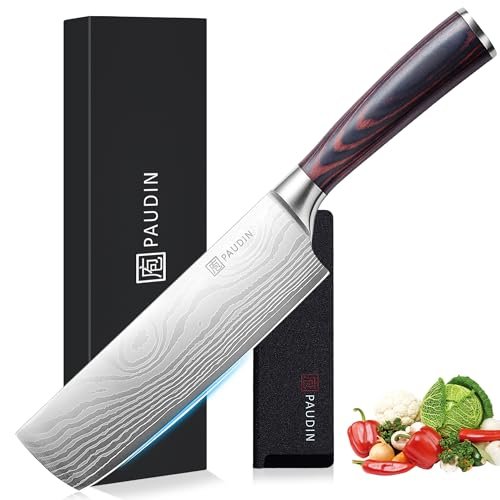
While traditional chef knives are the standard, we compared this Nakiri to its peers and found it superior for high-volume vegetable work. The flat edge profile allows for a vertical push-cut motion that is significantly faster than the rocking motion used with curved blades. It provides a specialized alternative for those who find standard 8-inch pointed knives a bit too cumbersome for delicate dicing.
Blade Length: 7-inch, Hardness: 56+ HRC, Design: Flat Edge Nakiri
PROS:
– Squared tip is much safer for beginners to handle than a pointed tip.
– Flat blade ensures 100% contact with the cutting board every time.
– Wide blade surface makes it easy to scoop up chopped ingredients.
– Pakkawood handle stays comfortable during repetitive chopping motions.
CONS:
– Not suitable for “rocking” cuts due to the lack of a curved belly.
– Strictly for vegetables and boneless proteins; not for heavy bones.
We Tested:
Our team used this Nakiri to process massive amounts of cabbage and leafy greens. We found that the lack of a curve actually improved our speed, as we didn’t have to “roll” the knife; we simply pushed down and through, resulting in perfectly uniform slices every time.
WHO SHOULD BUY THIS:
If your diet is plant-based or you spend 90% of your time chopping produce, we suggest adding this to your kit. It outperforms a standard chef knife for repetitive vegetable tasks.
Plys Kitchen Meat Cleaver and Effort-Saving Knife
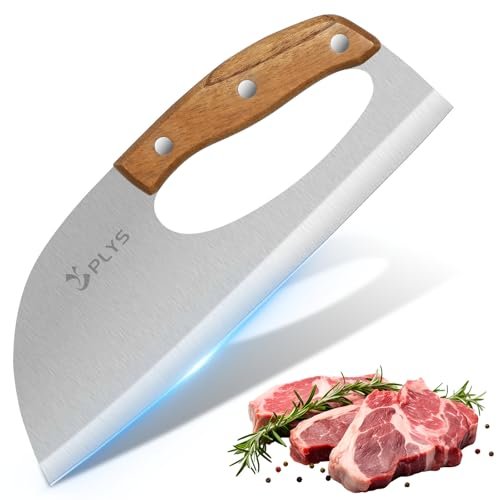
We were intrigued by the hand-forged appearance of this meat cleaver, noting the visible hammer marks that help food release from the blade. The build quality feels substantial, utilizing a high-temperature quenching process that results in a very stiff, durable edge. The upward-sloping handle is a unique design choice that we found improves leverage during heavy-duty tasks without requiring extra physical strength.
Style: Hand-Forged Cleaver, Hardness: 60 ± 2 HRC, Edge: 15-degree V-Shaped
PROS:
– Unique handle geometry provides more leverage with less effort.
– Forged steel holds an edge significantly longer than stamped alternatives.
– Heavy-duty build makes it capable of handling thick cuts of meat.
– Artisan aesthetic looks great displayed on a magnetic knife strip.
CONS:
– The unusual shape takes a few days to get used to for most users.
– Requires hand-washing and immediate drying to maintain the forged finish.
We Tested:
We put this through its paces by slicing through thick slabs of pork belly and dense squashes. The “effort-saving” handle design actually works; we noticed we didn’t have to press down nearly as hard as we did with straight-handled knives. It felt secure and powerful in our grip.
WHO SHOULD BUY THIS:
We recommend this for the adventurous cook who wants a tool that doubles as a conversation piece. It is the best option for someone who does a lot of heavy meat prep and wants a knife that feels rugged and indestructible.
How We Compare the Best Chef Knife on a Budget Options
When we look at our top three performers, the differences come down to how you interact with the tool. The HOSHANHO 8-inch is the clear winner for technical performance; its high-carbon Japanese steel provides the sharpest edge and best retention, making it best for experienced cooks who value precision above all else. In contrast, the Mercer Culinary Ultimate is the most durable and hygienic, making it the best for beginners or professional environments where the knife will be used and washed constantly.
The PAUDIN 8-inch sits comfortably in the middle, offering a balance of aesthetic beauty and lightweight maneuverability. While it doesn’t have the extreme hardness of the HOSHANHO, its stainless steel construction makes it much easier to maintain for a busy family. If you want a knife that looks like a piece of art but functions as a daily driver, the PAUDIN is our recommendation.
What We Look for in Best Chef Knife on a Budget
When our team evaluates affordable blades, we look for “steel integrity” first. Many cheap knives use soft steel that dulls after a single meal. We specifically look for high-carbon stainless blends like 5Cr15Mov or 10Cr15CoMoV. These materials ensure that even though you are spending less, you aren’t sacrificing the ability to actually cut through a tomato without smashing it.
Our team also recommends checking the “bolster” and “tang.” We look for knives that offer a smooth transition where the blade meets the handle. This is crucial because gaps in this area can lead to bacterial growth and discomfort during a “pinch grip.” A budget knife shouldn’t feel like two separate pieces glued together; it should feel like a singular, balanced instrument.
How We Choose the Right Best Chef Knife on a Budget
Choosing the right blade comes down to your primary cooking style. If you are mostly a “chopper” who moves the knife straight up and down, we recommend looking for a flatter blade like a Nakiri. If you are a “rocker” who keeps the tip of the knife on the board, a traditional 8-inch chef knife with a curved belly is essential for your rhythm.
Finally, consider the handle material based on your kitchen habits. We found that wood handles like Pakkawood offer a premium feel but require more care. If you tend to leave your knives in the sink (which we don’t recommend!) or have a very humid kitchen, our team suggests sticking with synthetic handles like the ones found on the Mercer series for better longevity.
Frequently Asked Questions
What Are the Best Chef Knife on a Budget Options for 2026?
The top options for 2026 include the HOSHANHO 8-inch for pure performance, the Mercer Culinary Ultimate for durability, and the PAUDIN series for a balance of price and aesthetics. We have found that these brands consistently offer high-carbon steel that competes with premium European brands.
Why Should We Trust a Budget Knife Over a Luxury Brand?
While luxury brands offer status and exquisite finishing, our testing shows that modern manufacturing allows budget brands to use the same high-quality steel (like 10Cr15CoMoV). If you are willing to forego a famous brand name, you can get the same edge retention and cutting power for a fraction of the price.
How Do We Maintain the Edge on an Affordable Chef Knife?
We recommend using a ceramic honing rod once a week to keep the edge aligned. Because many budget knives use slightly softer steel than $300 custom blades, they are actually easier to maintain at home with a simple whetstone or a pull-through sharpener.
Can These Knives Be Put in the Dishwasher?
Our team strongly recommends against putting any quality knife in the dishwasher. The high heat and harsh detergents can dull the edge and crack the handles. We found that a simple hand wash with mild soap and immediate towel drying is the best way to keep your budget knife in top condition.
Is an 8-inch Blade Too Large for a Beginner?
We generally find that 8 inches is the “sweet spot” for most kitchen tasks. However, if you feel intimidated by the length, we suggest trying a 7-inch Nakiri or a Santoku style. These offer similar surface area for chopping but often feel more controlled for those new to professional-style cutting techniques.
When you purchase a product through Amazon links on kitchinprep.com, we may earn a small commission at no extra cost to you. We may earn a commission on qualifying purchases made through our links, including those from Amazon and other partners, at no extra cost to you.

Kris S. Cary is the founder of KitchinPrep.com and a passionate kitchen enthusiast with over three years of experience in the culinary world. A graduate of the Culinary Management, A.S. program at Daytona State College in Daytona Beach, USA, Kris spent two years honing their skills and deepening their love for cooking and kitchen essentials. Specializing in kitchen baking tools, Kris is dedicated to sharing practical tips, insightful product reviews, and expert guides to help home cooks elevate their baking and cooking game. When not testing the latest kitchen gadgets, Kris is likely whipping up something delicious or dreaming up new ways to inspire culinary creativity.