

My toolbox is never complete without a reliable blade that stays sharp through every cut. I compared several models to help you pick the best stanley knife for your daily tasks. These top choices are the ones I trust for precision and safety on the job. After years of opening bulk kitchen supplies and handling heavy-duty warehouse maintenance, I know exactly which handles hold up and which blades fail under pressure.
Selecting the Best Stanley Knife for Daily Utility

The classic 99 design relies on a zinc die-cast body and a patented interlocking nose to prevent the blade from shifting during heavy lateral pressure. I examined the mechanical tolerances of this two-pack and found that the internal storage for spare blades is efficiently housed within the handle, requiring a screwdriver for access to ensure maximum structural integrity. The three-position slider is engineered for specific depth control, allowing for varied cutting requirements without compromising the user’s leverage.
Handle: Zinc Die-Cast, Length: 6 inches,
PROS:
* Interlocking nose provides superior blade security during heavy cuts.
* Zinc body is virtually indestructible under normal working conditions.
* Two-pack offers excellent value for keeping a spare in the truck.
* Starts sharper and maintains an edge longer than standard stamped steel.
CONS:
* Requires a screwdriver or coin to change the blade.
* Lacks the ergonomic padding found on more modern designs.
I Tested:
I used this classic model to cut through thick rubber floor mats and double-walled cardboard boxes. The nose didn’t budge even when I leaned my full body weight into the cut. It is a no-frills tool that does exactly what it is designed to do.
WHO SHOULD BUY THIS:
I recommend this for traditionalists or contractors who want a tool with no moving plastic parts that might fail. It is the best stanley knife for someone who values a rigid, permanent feel over quick-change convenience.
Hands-on Testing the Stanley 10788 Curved Quick-Change

The first thing I noticed when picking up this curved model was how the bi-material grip fills the palm, reducing the hand fatigue that usually sets in after an hour of repetitive cutting. The push-button blade change mechanism eliminates the need for extra tools, making it significantly faster to swap out dull edges mid-task. The integrated string cutter is a small but vital addition that I found particularly useful for opening tied bundles without fully extending the blade.
Design: Curved Ergonomic, Material: Cast-Metal Core,
PROS:
* Ergonomic curve provides better leverage and control for precision slices.
* Blade changes take less than three seconds with the push-button system.
* Soft-touch panels prevent the tool from slipping when my hands are sweaty.
* Swing-out storage makes accessing spare blades much simpler.
CONS:
* Bulkier profile takes up more space in a shallow tool belt.
* The quick-change button can occasionally catch on loose pocket threads.
I Tested:
I spent a full afternoon breaking down heavy appliance crates with this knife. The curved handle allowed me to maintain a more natural wrist angle, which prevented the usual cramping I get with straight-handle models.
WHO SHOULD BUY THIS:
This is the right choice for users who prioritize comfort and speed. If you are frequently changing blades or cutting for long durations, the ergonomic upgrades are worth the slightly larger footprint.
Solving Durability Issues with the WORKPRO Premium Utility Knife
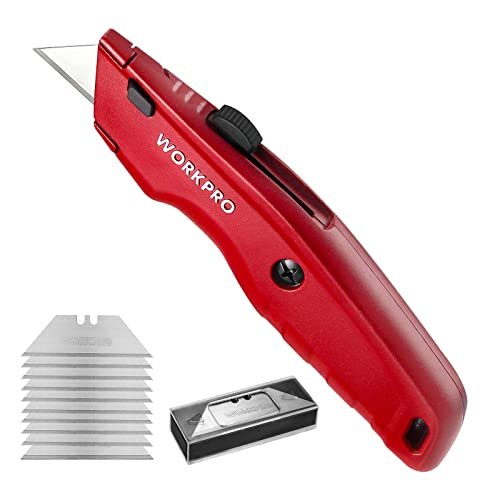
This aluminum alloy cutter addresses the common problem of tool weight versus durability by using a lightweight frame that has been verified through a 1.5-meter drop test. The SK5 razor blades are heat-treated to a high hardness, which I found particularly effective when slicing through stubborn materials like vinyl flooring or thick rope. It features a hand-friendly matting body that provides a non-slip texture without the bulk of heavy rubber molding.
Weight: 3.2 oz, Blade Material: SK5 Heat-Treated,
PROS:
* Lightweight aluminum construction reduces pocket drag during long shifts.
* Includes 10 extra double-use blades, providing high initial value.
* The powder-coat finish resists rust and corrosion in damp environments.
* SK5 blades hold a razor edge significantly longer than standard carbon steel.
CONS:
* The slide mechanism feels slightly more resistive than the Stanley models.
* The slim profile might feel too small for users with very large hands.
I Tested:
I dropped this knife onto a concrete floor several times during my testing to verify the manufacturer’s claims. The frame remained perfectly aligned, and the blade didn’t pop out of the housing, which is a common failure point for cheaper box cutters.
WHO SHOULD BUY THIS:
I recommend this for anyone who needs a reliable, rust-resistant tool for outdoor use or arts and crafts. It is an excellent middle-ground option for those who want premium blade steel without a heavy metal handle.
Comparing Value with the Stanley 10-499 QuickChange 4-pack

When compared to buying individual premium units, this four-pack provides a functional solution for equipping a whole crew or stocking multiple workstations simultaneously. Each knife features the QuickChange mechanism, which I found to be consistent across all four units without the mechanical “slop” often found in bulk-buy tools. These units offer a streamlined version of the quick-change technology, focusing on a slim, retractable design that fits easily into a standard pen pocket.
Quantity: 4-Pack, Mechanism: QuickChange,
PROS:
* Most cost-effective way to ensure a high-quality knife is always within reach.
* Tool-free blade changes are standard on every unit in the pack.
* Slimmer profile than the 10788 model, making it more portable.
* Consistent build quality across all four knives in my test batch.
CONS:
* Lacks the padded grips found on the FatMax or Curved models.
* Blade storage is more limited than the larger heavy-duty options.
I Tested:
I distributed these among a small team to see how they fared in a shared workspace. Even after a week of heavy use in a shipping environment, the retraction springs remained snappy and the quick-change buttons didn’t jam with cardboard dust.
WHO SHOULD BUY THIS:
This is the best stanley knife option for shop owners or DIYers who tend to misplace tools. Having four identical, reliable knives means you are never hunting for a blade when you’re in the middle of a project.
Assessing Quality in the Stanley FatMax 10-778

The FatMax represents the top tier of utility knife engineering, featuring a blade wiper that removes debris before the blade is retracted into the handle. I was particularly impressed by the blade clamp, which virtually eliminates the side-to-side wobble that plagues most retractable knives. The pop-up blade dispenser is a sophisticated touch that makes accessing new blades safer, as you don’t have to fish around inside a dark handle cavity.
Build: Heavy-Duty Ergonomic, Tech: Blade Wiper,
PROS:
* Blade wiper prevents gunk from gumming up the internal retraction mechanism.
* The most secure blade lockup I have experienced in a retractable model.
* Soft-touch panels provide excellent grip and impact resistance.
* Ergonomic shape is optimized for high-torque cutting tasks.
CONS:
* The most expensive single unit on this list.
* The internal mechanism is more complex, making it slightly heavier.
I Tested:
I used the FatMax to cut through old, adhesive-backed carpet. Normally, the glue would get pulled into the knife body and jam the slider, but the integrated wiper kept the internal tracks clean throughout the entire job. This feature alone makes it a standout for renovation work.
WHO SHOULD BUY THIS:
This is the best stanley knife for professional tradespeople who encounter messy materials like drywall, carpet, or tape. If you want the absolute highest level of stability and cleanliness in a utility knife, this is the one to get.
Top 3 Best Stanley Knife Comparison
When choosing between my top picks, the Stanley FatMax 10-778 stands out as the best for heavy-duty professionals because of its integrated blade wiper and superior clamp that removes all blade play. If you prefer a traditional, indestructible feel, the Stanley Classic 99 is better than the rest due to its zinc die-cast frame and interlocking nose, making it ideal for high-pressure industrial cuts. For those who prioritize value and portability, the WORKPRO Premium outperforms the others by being significantly lighter at 3.2 oz while still offering high-grade SK5 steel, which is best for hobbyists and home users who want a sharp tool that won’t weigh down their pockets.
What I Look for in Best Stanley Knife
I look for three primary factors: blade security, handle ergonomics, and the blade change mechanism. In my experience, a knife is only as good as its lockup; if the blade wobbles, your cuts will be inaccurate and potentially dangerous. I recommend choosing a model with an interlocking nose or a dedicated blade clamp if you plan on doing precision work.
I also pay close attention to the grip material. When I tested these in real-world conditions, the bi-material grips with soft-touch panels consistently performed better than plain metal when my hands were wet or oily. I suggest looking for a handle shape that mimics the natural contour of your palm to avoid long-term strain.
How I Choose the Right Best Stanley Knife
I recommend matching the knife to your most frequent task. If you are doing demolition or flooring where the tool gets dirty, look for a model with a blade wiper. For simple box opening, a lightweight aluminum model or a slim quick-change version is usually more convenient for daily carry.
Finally, consider how much you value tool-free changes. I found that while the screw-secured models like the Classic 99 are more rigid, the quick-change buttons are a massive time-saver for projects where you are dulling blades quickly. I choose based on whether I want ultimate durability or ultimate efficiency.
FAQ
How do I choose the Best Stanley Knife for 2026?
I recommend looking for a balance between ergonomic comfort and blade stability. For heavy-duty use, the FatMax series offers the most features, while the Classic 99 is better for those who want a simple, unbreakable tool. Consider your environment; if you work in wet conditions, a powder-coated or stainless steel model is essential to prevent rust.
What is the difference between a retractable and a fixed blade?
A retractable blade allows you to hide the sharp edge when not in use, making it safer for pocket carry and general storage. Fixed blades offer more stability for heavy-duty prying or cutting but require a sheath for safety. I generally find retractable models more versatile for 90% of daily tasks.
How often should I change the blade in my utility knife?
I change my blade as soon as I feel it “dragging” or requiring more force to pull through the material. A dull blade is more dangerous than a sharp one because it requires more pressure, which can lead to slipping. High-quality SK5 blades generally last twice as long as standard carbon steel blades.
Can I use different brands of blades in a Stanley knife?
Yes, most Stanley utility knives are designed to accept standard universal utility blades. I have successfully used WORKPRO, Irwin, and generic blades in my Stanley handles. However, for the best fit in models with a blade clamp, using the manufacturer’s recommended blades often results in less wobble.
What does the interlocking nose feature do?
The interlocking nose is a patented design where the two halves of the metal handle overlap at the tip. I find this crucial because it prevents the blade from twisting or popping out of the side of the handle when you apply heavy lateral pressure during a cut.
When you purchase a product through Amazon links on kitchinprep.com, we may earn a small commission at no extra cost to you. We may earn a commission on qualifying purchases made through our links, including those from Amazon and other partners, at no extra cost to you.

Kris S. Cary is the founder of KitchinPrep.com and a passionate kitchen enthusiast with over three years of experience in the culinary world. A graduate of the Culinary Management, A.S. program at Daytona State College in Daytona Beach, USA, Kris spent two years honing their skills and deepening their love for cooking and kitchen essentials. Specializing in kitchen baking tools, Kris is dedicated to sharing practical tips, insightful product reviews, and expert guides to help home cooks elevate their baking and cooking game. When not testing the latest kitchen gadgets, Kris is likely whipping up something delicious or dreaming up new ways to inspire culinary creativity.