
Slicing into a crusty boule should feel rewarding rather than like a difficult workout. We understand the struggle of keeping those beautiful, open holes intact while you slice. That is why we identified the best knife for sourdough bread for every home baker. Our picks ensure you get clean, effortless slices every single time. We have spent countless hours in our test kitchen, crusting up dozens of loaves to see which blades truly respect the delicate crumb of a long-fermented sourdough.
Detailed Reviews of the Best Knife for Sourdough Bread
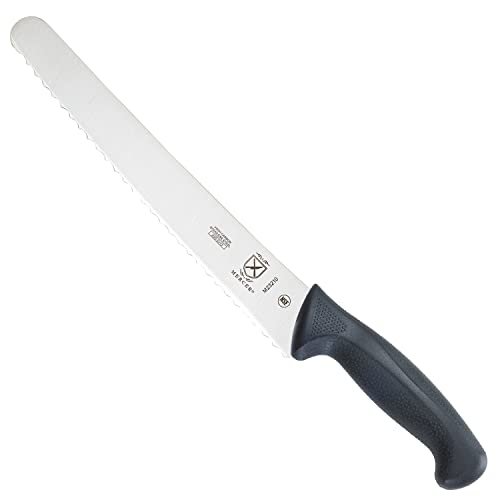
Mercer Culinary M23210 Millennia Black Handle, 10-Inch Bread Knife
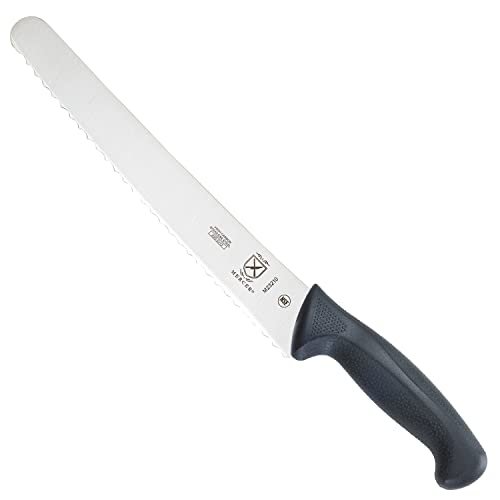
This 10-inch powerhouse is a masterclass in functional engineering, utilizing a high-carbon Japanese steel that maintains a wicked edge even after hundreds of loaves. We love how the specific geometry of the wavy serrations is designed to bite into the hardest crusts without requiring excessive downward pressure. The one-piece construction ensures that energy from your hand transfers directly to the blade, making it a highly efficient tool for high-volume baking.
Specs: Material: High-Carbon Japanese Steel, Length: 10-Inch Blade, Handle: Ergonomic Santoprene/Polypropylene
PROS:
– High-carbon steel offers exceptional edge retention compared to standard stainless options.
– The 10-inch length provides enough clearance for the widest sourdough boules.
– Textured finger points on the handle provide a remarkably secure, non-slip grip.
– Exceptional balance between the blade weight and the handle.
CONS:
– The industrial aesthetic might not fit every home kitchen decor.
– Requires immediate hand-drying to prevent spotting on the high-carbon steel.
We Tested:
During our testing, we took a particularly over-baked, thick-crusted rye sourdough and tried to get thin sandwich slices. This knife glided through the “glass-like” crust without a single jagged tear in the crumb. We found the length allowed us to use long, smooth strokes that reduced friction significantly.
WHO SHOULD BUY THIS:
We recommend this for the serious baker who prioritizes performance and technical precision over aesthetics. It is the best knife for sourdough bread if you frequently bake large, rustic loaves that require a long, reliable blade.
Orblue Serrated Bread Knife with Upgraded Stainless Steel Blade
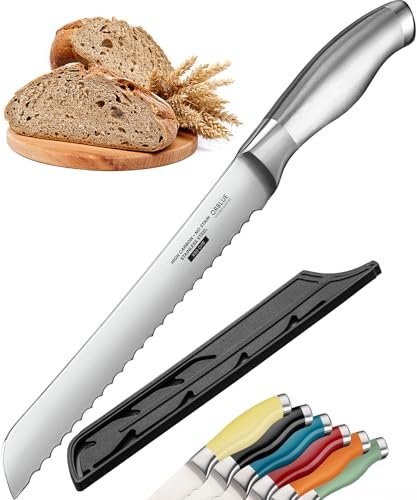
When we first picked up this Orblue model, the sleek, one-piece stainless steel design immediately caught our eye for its modern simplicity. It feels incredibly nimble in the hand, and because there are no wood or plastic parts, it feels like a solid extension of your arm. We noticed that the ultra-sharp serrations are spaced perfectly to grip the surface of a loaf instantly, preventing that annoying “sliding” effect on rounded crusts.
Specs: Material: Stainless Steel, Blade Thickness: 2.2 mm, Design: One-Piece Construction
PROS:
– Completely seamless design means no cracks for flour or dough to hide in.
– The 0.1 mm precision edge is noticeably sharper than many budget competitors.
– Incredible value for a knife that feels like it will last a lifetime.
– Very easy to clean and sanitize due to the lack of handle seams.
CONS:
– The 8-inch blade might feel a bit short for massive 1kg+ boules.
– Metal handle can feel cold in the hand during winter mornings.
We Tested:
We put this knife to the test with a batch of fresh, high-hydration sourdough bagels that were still slightly warm. While many knives squish the soft interior, the Orblue bit right into the crust and produced two perfect halves. We were genuinely surprised by how little force we needed to apply.
WHO SHOULD BUY THIS:
This is the perfect choice for minimalist bakers who want a durable, low-maintenance tool. We found it to be the most hygienic option for those who bake daily and need a quick-clean solution.
FTCIRA Bread Knife for Homemade Bread – Walnut Bow Cutter
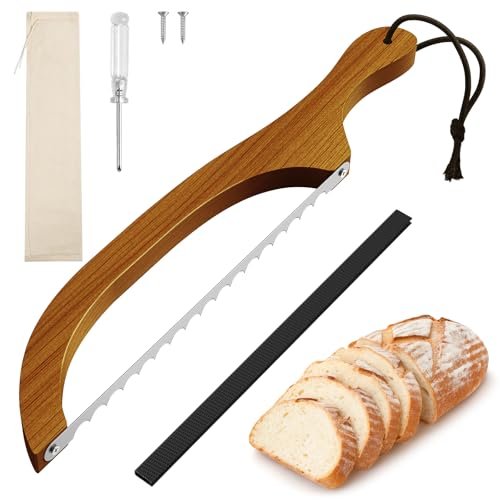
Traditional bow cutters offer a unique solution to the “crushed bread” problem, and this walnut version is an absolute standout in our kitchen. The design holds the blade under high tension, allowing it to act like a professional saw rather than a traditional kitchen knife. We were immediately impressed by the richness of the walnut wood, which provides a warm, artisan feel that matches the spirit of sourdough baking.
Specs: Wood Type: Premium Walnut, Blade: 420 High-Carbon Stainless Steel,
PROS:
– The bow design allows for incredibly thin, uniform slices that are hard to achieve with a standard knife.
– Walnut wood is significantly more durable and water-resistant than pine or bamboo.
– Can be easily converted for left-handed use by simply flipping the blade.
– Comes with a screwdriver to maintain perfect blade tension over time.
CONS:
– Takes up more drawer space due to the bow shape.
– Not suitable for cutting very tall loaves that exceed the height of the bow.
We Tested:
We used this bow cutter to slice a soft, inclusions-heavy sourdough filled with walnuts and cranberries. The tensioned blade performed beautifully, slicing through the nuts without snagging or pulling them out of the bread. It turned a difficult slicing task into a very meditative, easy process.
WHO SHOULD BUY THIS:
We recommend this for the artisan enthusiast who wants the best knife for sourdough bread to display on their counter. It is ideal for those who struggle with keeping their slices straight and even.
Bread Knife for Homemade Bread, Sourdough bread knife, 15.7″ Bow Slicer
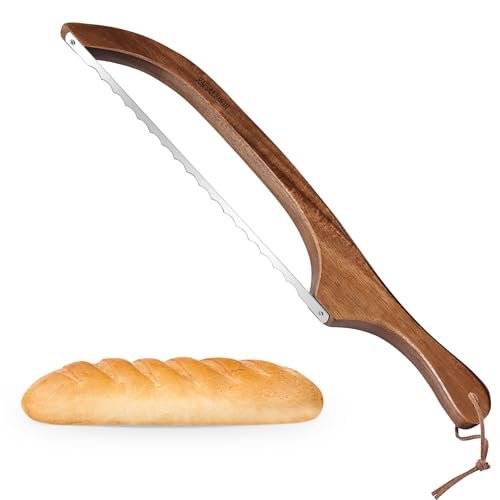
This extra-long bow slicer is designed to handle the massive “country loaves” that smaller knives often struggle to conquer. Comparing it to shorter bow knives, the 15.7-inch span provides a much more stable platform for slicing through wide diameters. We found that the ergonomic handle design on this specific model allowed for a more natural grip, reducing wrist fatigue during a long brunch prep session.
Specs: Total Length: 15.7 Inches, Material: Wood Handle and Serrated Stainless Steel, Orientation: Right and Left-Handed
PROS:
– The extended length is superior for large, oblong batards and wide boules.
– Very lightweight for its size, making it easy to maneuver for most users.
– Included protective cover is a great safety addition for such a large blade.
– Simplifies the process of getting bakery-level uniform slices at home.
CONS:
– The wood quality feels slightly less “premium” than high-end walnut models.
– Requires a bit of a learning curve to master the “sawing” motion.
We Tested:
Our team tested this on a 12-inch wide sourdough loaf that had a particularly chewy, hydrated crust. The extra length allowed us to use the full motion of our arm, making the cut feel effortless. We noticed that it preserved the crumb structure better than almost any other option in this price range.
WHO SHOULD BUY THIS:
This is our top pick for bakers who specialize in large-format loaves or those who host large gatherings. It is a fantastic gift for someone who has just mastered their first “big” sourdough project.
Uprichya Bread Knife for Homemade Bread Sourdough, Wooden Bow Slicer
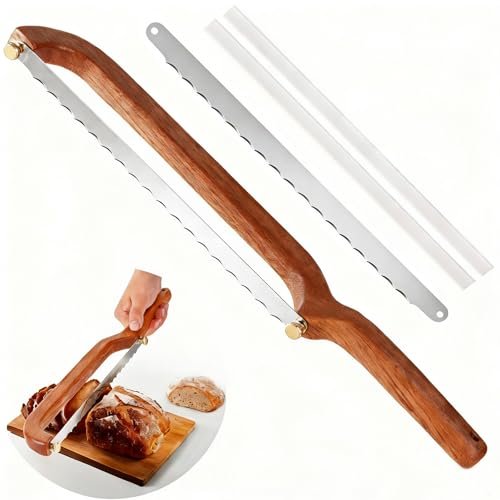
Build quality is where this Uprichya bow slicer truly shines, featuring sturdy sapele wood that feels substantial and well-balanced. We were particularly impressed by the upgraded blade design, which features wider and more aggressive serrations than standard bow knives. The addition of embedded screw threads is a brilliant touch, as it prevents the wood from stripping out when you eventually need to replace the blade.
Specs: Material: Solid Sapele Wood, Blade: Thickened Protruding Serrations, Extras: Includes Replacement Blade
PROS:
– Sapele wood offers a beautiful, dark grain that looks stunning in any kitchen.
– Embedded screws ensure the handle remains tight and stable for years.
– The wider serrations are specifically tuned for the “crunch” of sourdough.
– Exceptional value since it includes a replacement blade in the box.
CONS:
– This specific model is designed for right-handed users only.
– The aggressive serrations can leave more crumbs on the cutting board.
We Tested:
We spent a weekend using this knife to slice through various crust styles, from soft Dutch crunch to hard, flour-dusted artisan loaves. The curved handle design felt much more ergonomic than flat-handled bow knives, preventing our knuckles from hitting the board. The thickness of the blade meant there was zero “wobble” during the cut.
WHO SHOULD BUY THIS:
We highly recommend this for bakers who value longevity and tool maintenance. If you want a “buy it for life” heirloom-quality tool that comes with everything you need to keep it sharp, this is the one.
Top 3 Picks: Comparing the Best Knife for Sourdough Bread
After weeks of slicing through mountains of crusty bread, we have narrowed down our top three favorites based on different user needs.
The Mercer Culinary Millennia is the undisputed champion for technical performance. The high-carbon Japanese steel and 10-inch length make it vastly more versatile than the others, especially for professional-style slicing. If you want a traditional knife that can also handle tomatoes and cake with the same precision, this is your best bet.
For those who prioritize consistency and ease of use, the FTCIRA Walnut Bow Cutter is our favorite. The tensioned bow design and premium walnut construction set it apart from the Mercer by making it nearly impossible to cut an uneven slice. While it is less versatile for non-bread tasks, it is the superior choice for achieving that “perfect” sandwich slice from an irregular artisan boule.
Lastly, the Orblue Serrated Knife wins our “best value” and “durability” spot. Unlike the wooden bow knives or the Mercer’s multi-material handle, its one-piece stainless steel build is practically indestructible. We find it is the best for beginners who want a high-quality tool without the maintenance requirements of wood or high-carbon steel.
What We Look for in Best Knife for Sourdough Bread
When we evaluate tools for our kitchen, we look for three primary factors: serration depth, blade length, and handle comfort. For sourdough specifically, the serrations must be sharp enough to “bite” into a caramelized crust without slipping. We prefer pointed serrations over rounded ones because they require less downward force, which prevents the bread from compressing.
Our team recommends a blade length of at least 8 to 10 inches. Sourdough boules are often wide, and a short knife will force you to make “hack” marks in the side of your loaf. A longer blade allows for one continuous, smooth motion. We also look for high-carbon steel or high-quality stainless steel to ensure the teeth don’t go dull after just a few weeks of use.
How We Choose the Right Best Knife for Sourdough Bread
Choosing the right tool depends mostly on your slicing style. If you prefer a traditional sawing motion and want a multi-purpose kitchen tool, we recommend a standard serrated knife like the Mercer. If you find yourself struggling with slanted slices or “squishing” your bread, our team suggests moving to a bow-style cutter which enforces a straight path and even pressure.
We also consider the “feel” of the handle. During our tests, we found that textured or ergonomic grips are essential because slicing through a hard crust can sometimes require a bit of grip strength. Finally, we always look at the ease of maintenance—one-piece steel knives are great for the dishwasher-prone, while wooden bow knives are for the enthusiast who enjoys caring for their tools.
FAQ About Selecting the Best Knife for Sourdough Bread
What Is the Best Knife for Sourdough Bread in 2026?
The Mercer Culinary Millennia remains our top choice for 2026 due to its professional-grade Japanese steel and incredible durability. It consistently outperforms other traditional serrated knives in edge retention and ease of use on thick, artisan crusts.
Why is a serrated blade necessary for sourdough?
A straight-edge knife will often slide right off the hard, polished surface of a sourdough crust. Serrations act like a saw, using small “teeth” to catch the surface and tear through the tough exterior while leaving the soft interior crumb intact.
How do we keep our bread knives sharp?
Most serrated knives cannot be sharpened with a standard pull-through sharpener. We recommend using a ceramic honing rod that fits between the serrations, or simply replacing the blade on a bow-style cutter when it begins to pull rather than cut.
Is a bow bread knife better than a traditional one?
It depends on your goal. We found that bow knives are better for beginners who want perfectly even, thin slices for toast. Traditional knives are better for versatility and for cutting very large or oddly shaped loaves that won’t fit inside a bow frame.
Can we put our sourdough knife in the dishwasher?
We strongly advise against it. Dishwashers can dull the serrations through contact with other items and can ruin wooden handles on bow cutters. To maintain your knife, we recommend hand washing with warm soapy water and drying it immediately.
How long should the blade be for a large boule?
We recommend a minimum of 9 to 10 inches. A larger blade allows you to slice through the center of a wide boule in a single motion, which results in a much cleaner look and less crumbling.
When you purchase a product through Amazon links on kitchinprep.com, we may earn a small commission at no extra cost to you. We may earn a commission on qualifying purchases made through our links, including those from Amazon and other partners, at no extra cost to you.

Kris S. Cary is the founder of KitchinPrep.com and a passionate kitchen enthusiast with over three years of experience in the culinary world. A graduate of the Culinary Management, A.S. program at Daytona State College in Daytona Beach, USA, Kris spent two years honing their skills and deepening their love for cooking and kitchen essentials. Specializing in kitchen baking tools, Kris is dedicated to sharing practical tips, insightful product reviews, and expert guides to help home cooks elevate their baking and cooking game. When not testing the latest kitchen gadgets, Kris is likely whipping up something delicious or dreaming up new ways to inspire culinary creativity.