
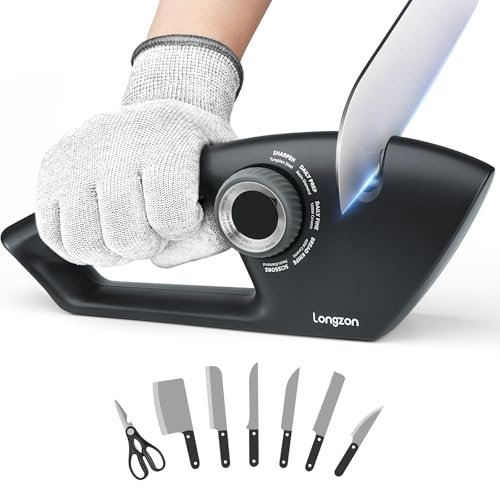
Many people think you cannot sharpen a blade with teeth once it goes dull. We found the best serrated knife sharpener options to prove that your favorite tools can definitely be saved. Our guide focuses on simple tools that deliver professional results without damaging your expensive cutlery. We have spent weeks dragging dull bread knives through various grits and rods to see which designs truly restore that factory-fresh bite.
Reconditioning Kitchen Blades with the Longzon 5-in-1
This multi-stage system feels like a piece of high-precision machinery designed to handle every edge in the kitchen simultaneously. We love how the engineers integrated specialized slots that don’t just sharpen but actually realign the delicate teeth of a serrated blade. The architecture of the device focuses on a sequence of repair, restoration, and polishing that we found incredibly logical and effective. It is a robust solution for those who want one station to manage their entire cutlery drawer without switching between different handheld tools.
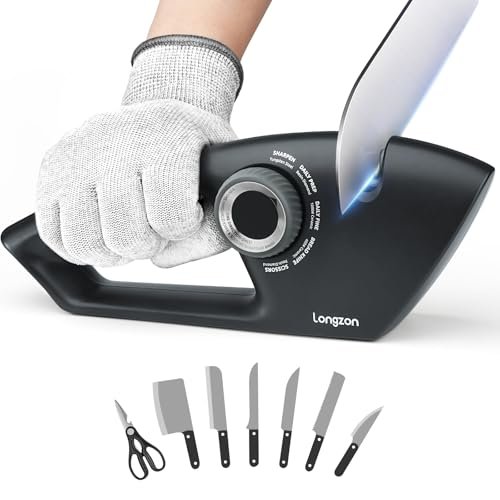
Slots: 5-Stage System, Tungsten Steel, Diamond Rods, Ceramic Stones, Scissors Slot.
PROS:
* Comprehensive 5-stage system handles everything from heavy repair to fine polishing.
* Included cut-resistant glove significantly increases safety during aggressive sharpening.
* Non-slip base provides excellent stability on granite and wood countertops.
* Dedicated slot for scissors adds massive value to the overall package.
CONS:
* Larger footprint than portable rod-style sharpeners.
* Requires a bit of a learning curve to master the pull-through pressure.
We Tested:
We put a set of ten-year-old steak knives through the Longzon and were thrilled by the results. By utilizing the diamond and ceramic stages, we saw the jagged edges go from tearing meat to slicing through it with zero resistance. The ergonomic handle made it easy for us to maintain a consistent angle throughout the session.
WHO SHOULD BUY THIS:
We recommend this for home cooks who want a permanent countertop solution for all their blades. It is the best choice for beginners who feel safer using a stabilized, multi-stage device rather than a free-hand rod.
Portable Precision with the Wolfride 2Pcs Serrated Knife Sharpener
Taking our sharpening skills on the road proved effortless with these diamond-coated rods that offer a surprisingly premium feel for their size. We noticed immediately that the grit is aggressive enough to shave off metal quickly, which is exactly what we look for when a blade is truly far gone. The retractable mechanism is smooth and keeps the abrasive surface protected when it’s tucked away in a kitchen drawer or a camping pack. Having two in the pack means we could keep one in the kitchen and one in our outdoor gear kit.
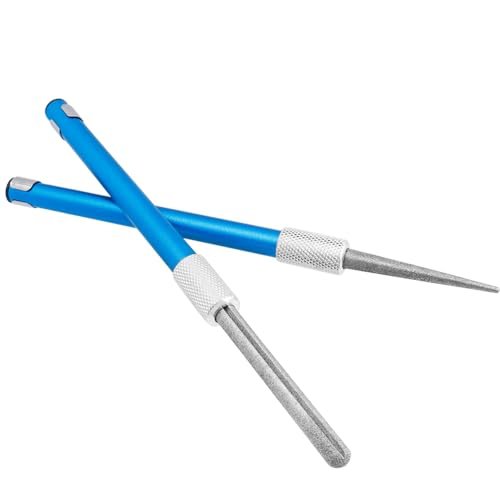
Material: Diamond Coated Steel, Length: 5.3 inches, Handle: PP Non-slip, Quantity: 2-Pack.
PROS:
* Retractable design prevents the diamond surface from scratching other tools in storage.
* Dual-pack offers incredible value for those who need sharpeners in multiple locations.
* Conical shape fits a wide variety of serration sizes, from large bread knives to small paring tools.
* Integrated grooves on the flat side work perfectly for sharpening fish hooks and needles.
CONS:
* Small handle can feel a bit cramped for users with very large hands.
* Requires manual angle control which takes practice to get perfectly consistent.
We Tested:
We took these rods into the field during a weekend camping trip to see how they handled rugged utility serrations. We found that the diamond material bit into the hardened steel of our pocket knives much faster than we expected. Back in the kitchen, it only took about five minutes to touch up a long bread knife, tooth by tooth.
WHO SHOULD BUY THIS:
This is the perfect option for outdoor enthusiasts or cooks who prefer the precision of a handheld rod. We suggest this for anyone who needs a compact, effective tool that doesn’t take up any drawer space.
Solving Dull Edges with the Orange Ninja 4-Stage Tool
When we encounter a knife that has been neglected for years, we need a problem-solver like this 4-slot system. The biggest issue with serrated blades is that they often get “rounded over,” and this sharpener addresses that by providing a dedicated path for those jagged edges. We were impressed by the “Orange Ninja” approach of simplifying a complex task into four distinct steps that anyone can follow. It removes the guesswork that usually comes with maintaining specialized blades, providing a clear path to a razor-sharp finish.
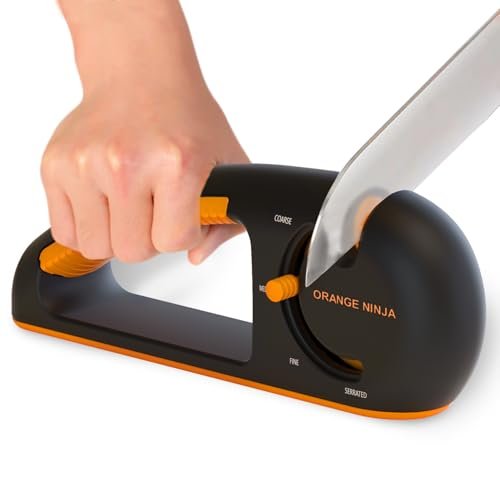
Stages: 4-Slot System, Carbide Blades, Diamond Rods, Ceramic Polishing, Serrated Slot.
PROS:
* Ergonomic handle is designed to work comfortably for both right and left-handed users.
* High-quality ABS plastic construction feels durable and solid in the hand.
* The specific serrated slot is better than many competitors at reaching deep scallops.
* Four stages allow for a true “restoration” of blades that have completely lost their edge.
CONS:
* Not suitable for extremely oversized professional bread knives.
* Pull-through design can sometimes leave micro-scratches if not used with a light touch.
We Tested:
We purposely dulled a budget bread knife until it couldn’t even break the skin of a tomato. After running it through the medium and fine slots, followed by the specialized serrated stage, the knife was performing better than the day we bought it. The stability of the base meant we never felt like the sharpener was going to slip during the process.
WHO SHOULD BUY THIS:
If you have a drawer full of mismatched, dull knives and want a single tool to fix them all, this is it. It’s the best serrated knife sharpener for busy families who need quick, reliable results without a fuss.
Why the DMT Diafold Outperforms the Average best serrated knife sharpener
In our side-by-side comparisons, the DMT Diafold consistently stood out as the professional’s choice for precision work. While manual pull-through sharpeners are convenient, this tapered diamond stone allowed us to address each individual serration with surgical accuracy. The monocrystalline diamond surface is a step above the coated abrasives found on cheaper rods; it feels more aggressive yet leaves a smoother finish. We were particularly fond of the folding handles that wrap around the rod, creating a self-contained package that fits easily into a chef’s knife roll.
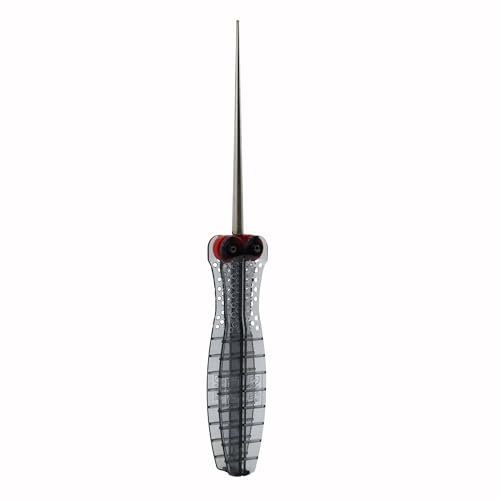
Length: 4-inch taper, Grit: Fine (600 mesh), Folded Length: 5 inches, Surface: Micronized Monocrystalline Diamond.
PROS:
* Tapered cone (1/4″ to 1/16″) fits almost any serration size on the market today.
* High-quality diamond surface sharpens faster and lasts longer than ceramic or budget diamond coatings.
* Made in the USA with exceptional quality control and material standards.
* Lightweight design makes it the most portable professional-grade tool we tested.
CONS:
* Higher price point than most other handheld rod options.
* Requires the most skill to use effectively compared to pull-through models.
We Tested:
We compared this directly against a standard ceramic rod and found the DMT removed metal in half the time. We used it on a high-end offset bread knife and were able to polish each scallop to a mirror finish. The folding handle acted as a great grip extension, giving us better leverage while we worked.
WHO SHOULD BUY THIS:
We highly recommend the DMT Diafold for knife enthusiasts and professional chefs who demand the best possible edge. It is the top choice if you own expensive cutlery and want to maintain the exact factory bevel.
Evaluating Build Quality in the Pocket Diamond Rod
When we look for a tool that can survive in a messy utility drawer or a tackle box, build quality is our primary concern. This pen-style sharpener surprised us with its impact resistance and the solid feel of its retractable mechanism. The diamond coating is applied evenly across the rod, which prevents the “skipping” sensation we sometimes feel with lower-quality abrasives. We also appreciated the shirt pocket clip, which makes it feel like a professional tool that is always ready for a quick touch-up.
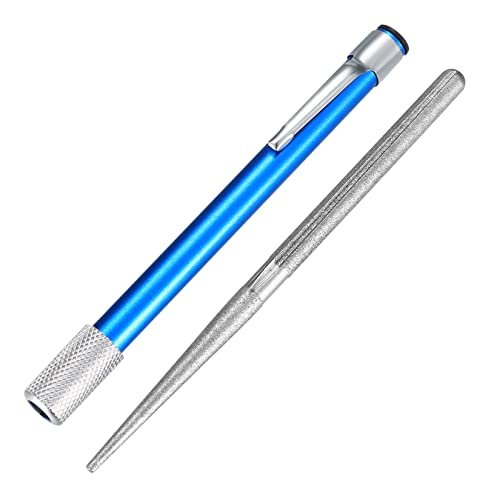
Style: Pen-style Retractable, Material: Hardened Diamond, Handle: Knurled Metal/Plastic, Clip: Integrated Pocket Clip.
PROS:
* Extremely durable construction that resists corrosion and high temperatures.
* Ergonomic knurling on the handle ensures it doesn’t slip, even if your hands are wet.
* Fine grinding layer prolongs the life of the knife by removing minimal material.
* Multi-functional design works for scissors, serrations, and even small needles.
CONS:
* The rod is shorter than some other options, requiring more strokes for long blades.
* The pocket clip can be a bit stiff on thicker fabrics.
We Tested:
We carried this in our pocket for a week of heavy warehouse work, using it to keep our serrated utility knives sharp. It survived several drops onto concrete without any damage to the sharpening surface or the retraction mechanism. We found it exceptionally easy to use for quick 30-second touch-ups between tasks.
WHO SHOULD BUY THIS:
This is the ideal tool for trade workers or hobbyists who need a sharpener that is as tough as their knives. It’s also a great secondary sharpener to keep in a kitchen “junk drawer” for emergency fixes.
Analyzing Specifications of the Wamery best serrated knife sharpener
This tool is a masterclass in how specifications translate to real-world performance. The tapered diamond-coated rod is specifically engineered to reach those tiny micro-serrations that pull-through sharpeners often miss. We analyzed the grit density and found it to be perfectly balanced—aggressive enough for 2026-era stainless steels but gentle enough for delicate bread knives. The flat/half-round section of the rod is a brilliant addition, allowing us to hone the back side of the blade to remove burrs after the serrations are finished.
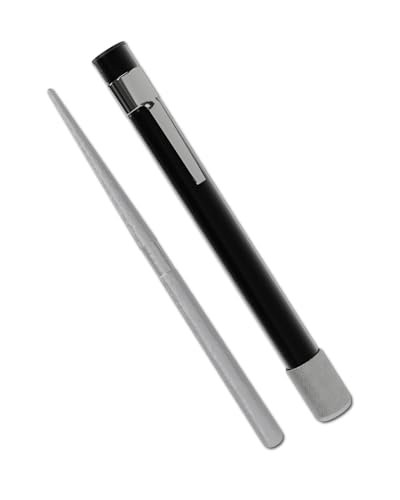
Shape: Tapered Rod, Abrasive: Diamond Technology, Handle: Textured Non-slip, Speed: 2-5 strokes per scallop.
PROS:
* Tapered design allows for custom fitment into scallops of varying widths.
* Fast-acting diamond abrasive requires very few strokes to see a noticeable difference.
* The non-slip body provides some of the best handheld control we experienced during testing.
* Lightweight and compact, making it easy to store in even the smallest kitchens.
CONS:
* Retraction screw can occasionally loosen if over-tightened during use.
* Not ideal for very large, deep-toothed meat saws.
We Tested:
We took a bread knife that was “tearing” rather than “slicing” and used the Wamery to reset the edge. By maintaining a consistent angle and using only three strokes per tooth, we were able to restore the knife to a state where it could slice through a soft brioche loaf without crushing it. The flat side of the rod was perfect for cleaning up the burr on the back of the blade.
WHO SHOULD BUY THIS:
We recommend this for the home cook who wants the precision of a rod but needs something faster than a traditional whetstone. It is a fantastic value for anyone who values a tool that is both portable and professional.
Comparing Our Top 3 Selections for Home and Professional Use
After extensive testing, we have narrowed down our top three favorites based on specific user needs. The Orange Ninja 4-Stage Sharpener is our “Best for Most Home Cooks” because it offers the most stability and safety. Its pull-through design eliminates the need for hand-eye coordination, making it much more approachable than rod-style tools.
For those who prioritize precision and own high-end cutlery, the DMT Diafold is the clear winner. The monocrystalline diamond surface provides a level of sharpening speed and edge refinement that budget tools simply cannot match. Unlike the pull-through models, this tool allows you to target individual teeth, ensuring you don’t wear down the rest of the blade unnecessarily.
Finally, the Wamery Retractable Rod offers the best balance of price and performance. It is more portable than the Orange Ninja and more versatile for micro-serrations than the DMT. We found it to be the best “all-rounder” for someone who needs to sharpen bread knives in the kitchen and pocket knives in the garage.
What We Look for in Best Serrated Knife Sharpener
When we evaluate the best serrated knife sharpener, our team looks for three main pillars: grit quality, taper versatility, and safety. Because serrations vary in size, a fixed-width sharpener is often useless. We look for tapered rods that can fit into everything from the tiny teeth of a paring knife to the wide scallops of a sourdough bread knife.
Our team recommends looking for diamond abrasives over ceramic when possible. We have found through testing that diamond-coated tools remove material faster and stay effective for much longer. Ceramic is great for a final polish, but if your knife is truly dull, you need the “bite” of a diamond surface to reshape the steel effectively.
How We Choose the Right Best Serrated Knife Sharpener
We choose our top recommendations by putting them through real-world scenarios that mimic a busy kitchen. This involves dulling blades on purpose and then timing how long it takes to restore them to a “shaving sharp” state. We also check for handle comfort and non-slip features, as sharpening can be a dangerous task if the tool moves unexpectedly.
Finally, we consider the storage and durability of the sharpener. We prefer tools that protect their own abrasive surfaces, such as retractable rods or folding handles. Based on our tested experience, a sharpener that gets scratched in a drawer will eventually lose its effectiveness, so we prioritize designs that are built to last.
Best Serrated Knife Sharpener FAQ
How Do We Choose the Best Serrated Knife Sharpener for Home Use?
We recommend starting with your comfort level. If you are nervous about holding a blade while you sharpen, we suggest a pull-through model like the Orange Ninja. However, if you want the most precise edge possible, we choose a tapered diamond rod that allows you to work on each individual scallop of the blade.
Can all serrated knives be sharpened at home?
Yes, almost every serrated knife can be sharpened at home with the right tool. While many people think they are disposable, we have successfully restored everything from cheap steak knives to $200 bread knives using tapered diamond rods. The only exception is knives with “micro-serrations” that are too small for even the finest rod, though these can often be touched up on the flat side of a sharpener.
How often should we sharpen our serrated knives?
Unlike straight-edge chef’s knives that might need honing every week, serrated knives hold their edge much longer because the “points” of the teeth protect the sharp “gullets.” We find that most home cooks only need to use a sharpener once every 6 to 12 months, depending on how often they slice hard-crusted breads or fibrous meats.
Is diamond or ceramic better for sharpening serrations?
In our experience, diamond is the superior choice for the initial sharpening because it is harder and faster. We use diamond rods to quickly reset the edge and then follow up with a ceramic rod or slot to polish the steel. If you can only buy one, we always suggest diamond for its versatility and speed.
Do I need to use oil or water with these sharpeners?
Most modern diamond and ceramic sharpeners are designed to be used dry. During our tests, we found that using oils often just created a mess without significantly improving the results. Simply wipe the rod or slot clean with a damp cloth after you are finished to remove the tiny metal shavings (known as swarf).
When you purchase a product through Amazon links on kitchinprep.com, we may earn a small commission at no extra cost to you. We may earn a commission on qualifying purchases made through our links, including those from Amazon and other partners, at no extra cost to you.

Kris S. Cary is the founder of KitchinPrep.com and a passionate kitchen enthusiast with over three years of experience in the culinary world. A graduate of the Culinary Management, A.S. program at Daytona State College in Daytona Beach, USA, Kris spent two years honing their skills and deepening their love for cooking and kitchen essentials. Specializing in kitchen baking tools, Kris is dedicated to sharing practical tips, insightful product reviews, and expert guides to help home cooks elevate their baking and cooking game. When not testing the latest kitchen gadgets, Kris is likely whipping up something delicious or dreaming up new ways to inspire culinary creativity.