
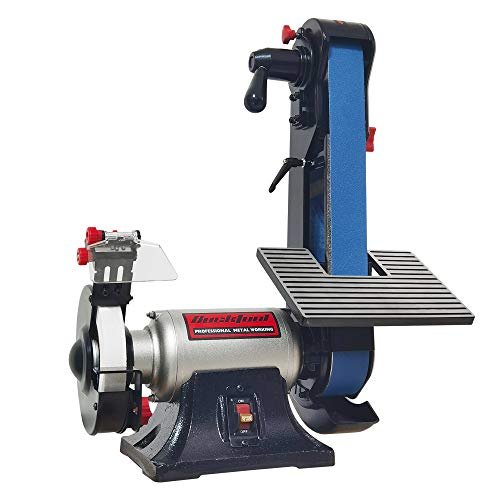
I believe that your workshop should be a place where your best ideas come to life quickly. I finally found the best belt grinder for knife making by testing power and precision in my own space. My favorite picks will help you achieve cleaner finishes and save you hours of manual sanding. Over the last few months, I put several machines through their paces, grinding high-carbon steel and shaping exotic wood handles to see which ones actually hold up under pressure.
Bucktool Combo 2″ x 42″ Belt Sander BG2600 Bench Grinder
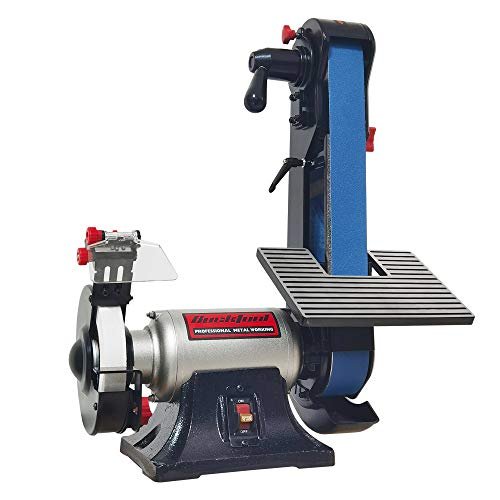
The Bucktool BG2600 is engineered as a dual-purpose powerhouse that combines a high-speed belt with a traditional 6-inch grinding wheel. I noticed the 1/2HP induction motor maintains consistent torque even when I applied significant pressure during heavy stock removal. Its heavy-duty cast iron construction effectively dampens vibrations, which is critical when you are trying to maintain a crisp plunge line on a new blade.
Voltage: 120V, 1/2 HP Motor, 4480 FPM Belt Speed****
PROS:
* Induction motor provides quiet, vibration-free operation
* The 2-inch belt width is ideal for flat grinding and profiling
* Integrated LED light improves visibility during detailed sharpening
* Sturdy cast iron base prevents the unit from walking across the bench
CONS:
* Fixed speed limits its use for heat-sensitive finishing
* Belt tracking requires occasional fine-tuning during long sessions
I Tested:
I ran this unit for three hours straight profiling several bushcraft knives. I found that the white 60-grit wheel stayed cool, and the quick-release lever made switching between coarse and fine belts surprisingly fast.
WHO SHOULD BUY THIS:
I recommend this for the hobbyist who needs a reliable, multi-functional tool that handles both rough grinding and tool sharpening. It is a solid mid-range choice for those who don’t have space for a dedicated 2×72 rig.
VEVOR Belt Grinder Sander, 72 x 2-Inch Variable Speed VFD
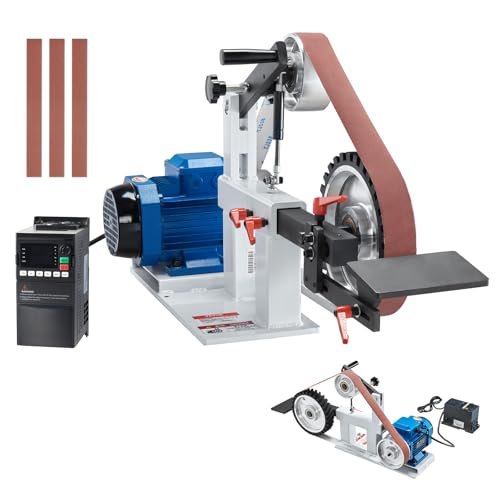
When I stepped up to this VEVOR model, the jump in capability was immediately apparent due to the industrial-grade 1500W motor. The variable frequency drive (VFD) gave me total control over the belt speed, allowing me to slow things down to a crawl for delicate handle shaping. I found the 2×72 format to be the gold standard for achieving professional-level bevels on larger kitchen knives.
Power: 1500W, 2×72 Inch Belt, VFD Variable Speed****
PROS:
* Variable speed control prevents overheating high-carbon steel
* Includes three distinct grinding modes: circular, arc, and flat
* Pure copper motor runs significantly cooler than cheaper alternatives
* All-steel frame construction feels incredibly rigid during heavy use
CONS:
* Large footprint requires a dedicated permanent workbench space
* Initial assembly is time-consuming compared to smaller units
I Tested:
I used the flat platen to grind the primary bevels on a 10-inch chef’s knife. The tracking remained rock-solid even at high RPMs, and the VFD allowed me to switch to a slow speed for a 240-grit finish without burning the wood handle scales.
WHO SHOULD BUY THIS:
This is the best belt grinder for knife making if you are looking to transition from hobbyist to professional-level work. It offers the specific features needed for high-volume blade production and precision finishing.
Belt Grinder Sander with VFD,2×72-inch 1500W 2HP Variable Speed
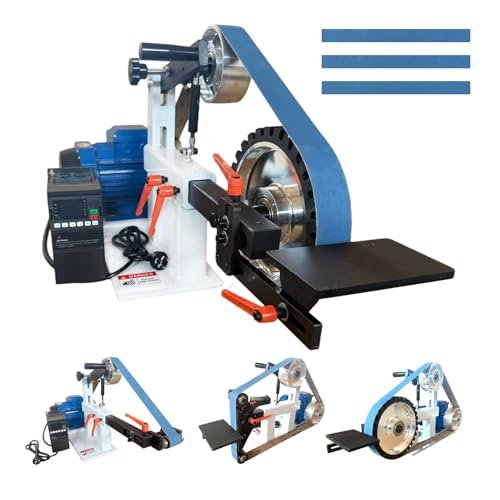
The JLD 2×72 addresses the common issue of power compatibility by including a dedicated transformer for 110V workshops. I found this unit to be a problem-solver for residential garages where 220V outlets aren’t readily available. The inclusion of a reverse function on the VFD is a major advantage, as it allows for specialized polishing techniques that other machines in this price bracket often lack.
Power: 2HP, 36m/s Belt Speed, Reverse Function VFD****
PROS:
* Included transformer allows 2HP power on standard 110V circuits
* Reverse rotation button is excellent for specific buffing tasks
* Comes with a comprehensive 3-in-1 grinding tool set
* Thickened base reduces noise levels during high-speed operation
CONS:
* The external transformer adds extra bulk to the setup
* The instruction manual could be more detailed for the VFD settings
I Tested:
I focused on the reverse function while polishing a brass bolster. It allowed me to control the direction of the sparks and debris, making the finishing process much safer and cleaner than on my fixed-direction machines.
WHO SHOULD BUY THIS:
I recommend this option for makers who want full 2HP power but are restricted to 110V household power. It is a versatile solution for anyone needing a heavy-duty 2×72 setup with variable speed.
Mini Belt Sander, Electric Small Sander Knife Sharpener 7 Speed
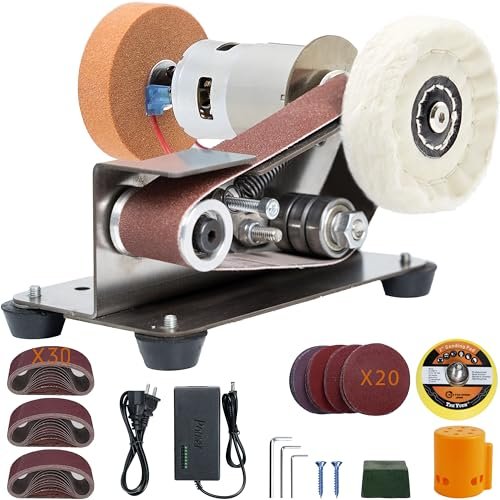
Comparing this mini sander to the full-size units is like comparing a scalpel to a broadsword. While it lacks the raw power for heavy stock removal, it outperforms larger machines when it comes to intricate detail work on small folding knives or jewelry. I found the 7-speed adapter makes it highly adaptable for users who switch frequently between metal, resin, and wood.
Motor: 775 DC, 303 Stainless Steel, 7-Speed Adjustment****
PROS:
* Extremely compact design fits on any desktop or small shelf
* Stainless steel build is completely resistant to workshop rust
* Comes with a massive 30-belt starter kit for various grits
* Very low noise and vibration, making it apartment-friendly
CONS:
* Not suitable for grinding large blades from thick bar stock
* Small belt surface area heats up quickly under heavy load
I Tested:
I used this small sander to sharpen a set of paring knives and found the precision to be excellent. The shock-absorbing rubber pads kept the machine from vibrating off my table even at the maximum 9000 RPM setting.
WHO SHOULD BUY THIS:
This is the right choice for crafters, EDC enthusiasts, or anyone who primarily focuses on sharpening and light-duty polishing. It is the best budget-friendly entry point for very small-scale projects.
Belt Grinder Sander, 30 x 1-Inch Variable Speed Belt Polisher
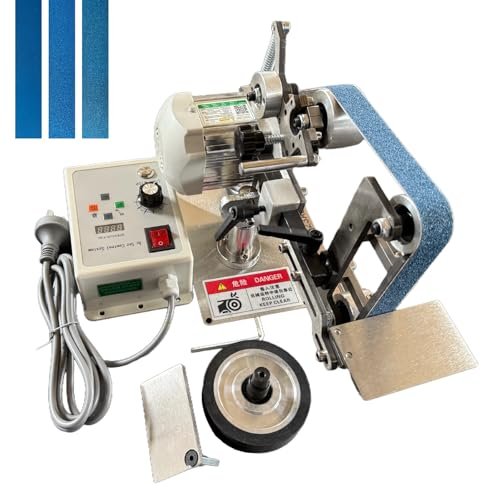
This 1×30 machine stands out because of its dual-mode capability, allowing it to transition between vertical and horizontal orientations. I assessed the build quality of the 550W copper motor and found it to be much more robust than the standard motors found in entry-level hardware store models. The tracking adjustment wheel is responsive, which I found helpful when switching to thinner polishing belts.
Motor: 550W, 5000 RPM, Horizontal/Vertical Use****
PROS:
* Horizontal mode is perfect for leveling handle scales
* Zirconia corundum belts included are much more durable than AO belts
* Variable frequency drive is rare for a machine this size
* Detachable workbench offers great flexibility for complex angles
CONS:
* The 1-inch belt width makes it harder to keep large bevels flat
* Table size is somewhat small for supporting longer blades
I Tested:
I flipped the machine into horizontal mode to flatten the tang of a full-tang hunter. The 550W motor didn’t bog down, and the 100-grit zirconia belt stripped away the mill scale much faster than I expected for a 1×30.
WHO SHOULD BUY THIS:
I recommend this for the maker who wants a high-quality 1×30 with variable speed. It is a significant upgrade over basic 1×30 sanders and works well as a secondary machine for handle shaping.
WEN Benchtop Belt and Disc Sander with 1×30 Belt 6515T
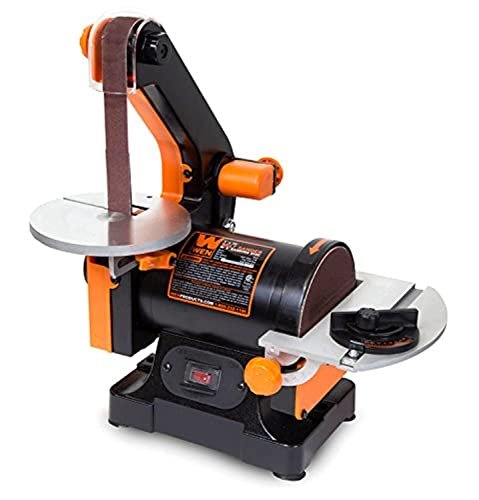
The WEN 6515T is a specification-heavy budget machine that offers both a belt and a 5-inch disc. Analyzing the 2.3A motor, it provides enough speed (3160 FPM) for basic sharpening and light grinding tasks. I found that the dual dust ports are a standout feature, as they allow for a much cleaner workspace when connected to a shop vac.
Motor: 2.3A, 3160 FPM, 5-Inch Sanding Disc****
PROS:
* The 5-inch disc is excellent for squaring up handle material
* Dual dust ports keep the workshop significantly cleaner
* Very affordable price point for beginners starting out
* Heavy-duty base keeps the machine stable without bolting it down
CONS:
* Fixed speed can burn wood or overheat thin blade tips
* Motor can bog down if you apply too much pressure
I Tested:
I used the disc sander to square up some walnut blocks for handles. It worked perfectly for that task, though I had to be careful with the belt sander on the blade steel to avoid ruining the temper due to the high fixed speed.
WHO SHOULD BUY THIS:
This is the best choice for a beginner on a strict budget who needs a versatile tool for wood and light metal work. It is a reliable entry-level machine that gets the job done for basic knife maintenance.
Top Picks Comparison
When I compare the VEVOR 2×72 to the Bucktool 2×42, the biggest difference is the variable speed and belt size. The VEVOR is a professional tool built for shaping entire blades from scratch, while the Bucktool is a more compact, high-speed hybrid. If you have the budget and space, the VEVOR 2×72 is the best for serious knife makers because it offers the most control.
The JLD 2×72 sits in a similar tier to the VEVOR but is the best for users limited to 110V power because of its included transformer. Between the smaller units, the WEN 6515T is the best budget value, but it lacks the variable speed control found on the JLD 1×30. If you are doing delicate finishing work, the JLD 1×30 outperforms the WEN because you can slow the belt down to prevent burning your materials.
What I Look for in Best Belt Grinder for Knife Making
I look for motor power first because grinding steel creates an immense amount of friction. I recommend choosing a machine with at least a 1/2 HP motor for a 2×42 and 1.5 HP or more for a 2×72. If the motor bogs down when you press a blade against it, you won’t be able to achieve a clean, flat grind. I also prioritize variable speed control; being able to slow the belt down is the only way to safely work on handle materials like micarta or stabilized wood without melting them.
I also look for a rigid frame and a high-quality platen. Based on my testing, any flex in the tool rest or the belt arm will result in uneven bevels. I recommend looking for cast iron or heavy-duty steel construction. Lastly, I check for belt availability; the 2×72 and 1×30 sizes are the most common, meaning you’ll have access to a wider variety of specialized abrasives.
How I Choose the Right Best Belt Grinder for Knife Making
I choose a grinder based on the specific type of knives I plan to make. If I am making large cleavers or kitchen knives, I always go for a 2×72 machine because the longer belt stays cooler and provides more surface area for flat grinding. For smaller folders or simple sharpening, a 1×30 or a mini sander is usually sufficient and much easier on the wallet.
I also consider my workshop’s electrical capacity. Many high-end grinders require 220V power, so I recommend checking your outlets before buying. Finally, I look at the tracking mechanism. A good grinder should have a responsive tracking knob that keeps the belt centered, as a wandering belt is one of the most frustrating problems you can encounter during a build.
FAQ
What Is the Best Belt Grinder for Knife Making for a Beginner?
For a beginner, I recommend a 2″ x 42″ or a high-quality 1″ x 30″ machine. These sizes are affordable, don’t require specialized wiring, and the belts are easy to find. They provide enough power to learn the basics of bevel grinding without the high cost of a professional 2×72 setup.
How much should I spend on a quality belt grinder?
I have found that you can get a decent entry-level grinder for $150 to $300. However, if you want a professional-grade 2×72 machine with variable speed, you should expect to spend between $600 and $1,200. Spending more usually gets you a better motor, a VFD, and more rigid construction.
Why is variable speed important for knife making?
Variable speed is critical because different materials require different belt speeds. High speeds are great for removing steel quickly, but low speeds are necessary for fine finishing and for working with wood or plastic handles that can burn or melt easily. It also helps prevent ruining the heat treat on a finished blade.
Can I use a regular wood belt sander for knives?
You can, but I don’t recommend it for long-term use. Wood sanders usually have lower belt speeds and less powerful motors. More importantly, they often lack a proper metal platen and tool rest, making it very difficult to get the precise angles required for a sharp, functional knife.
What belt grits do I need to start knife making?
I recommend starting with a variety pack. You’ll need coarse grits (36 or 60) for profiling and rough grinding, medium grits (120 to 220) for refining the bevels, and fine grits (400 and up) for finishing and sharpening. Zirconia or ceramic belts are best for the heavy work on steel.
When you purchase a product through Amazon links on kitchinprep.com, we may earn a small commission at no extra cost to you. We may earn a commission on qualifying purchases made through our links, including those from Amazon and other partners, at no extra cost to you.

Kris S. Cary is the founder of KitchinPrep.com and a passionate kitchen enthusiast with over three years of experience in the culinary world. A graduate of the Culinary Management, A.S. program at Daytona State College in Daytona Beach, USA, Kris spent two years honing their skills and deepening their love for cooking and kitchen essentials. Specializing in kitchen baking tools, Kris is dedicated to sharing practical tips, insightful product reviews, and expert guides to help home cooks elevate their baking and cooking game. When not testing the latest kitchen gadgets, Kris is likely whipping up something delicious or dreaming up new ways to inspire culinary creativity.