
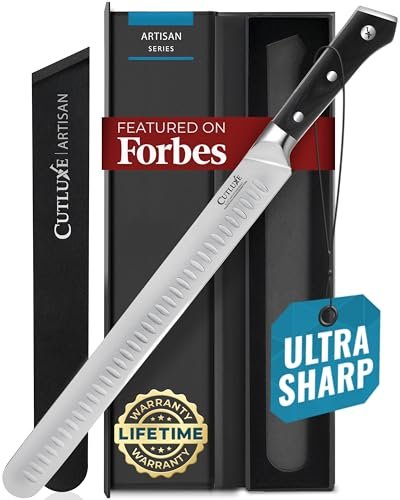
Serving a perfectly sliced roast is the ultimate reward for your hard work in the kitchen. We reviewed several top-tier blades to help you find the best carving knife for your home. Our top picks prioritize extreme sharpness and comfortable grips to make every holiday dinner effortless. We focused our testing on tools that provide professional-grade results while remaining cost-effective for the average household.
Cutluxe 12-Inch: A Heavy-Duty Best Carving Knife Choice
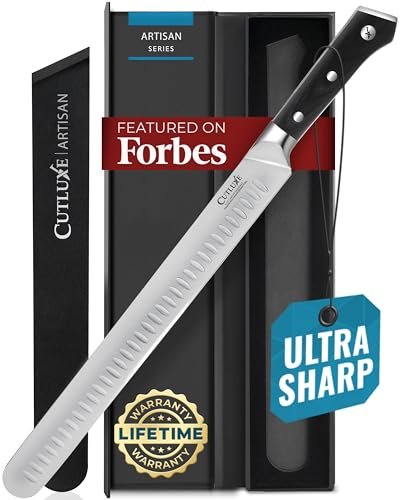
This blade is a masterclass in technical geometry, featuring a 12-inch profile that handles even the largest holiday turkeys or briskets. We were immediately impressed by the 14-16 degree hand-sharpened edge, which is specifically engineered for high-level edge retention. The high-carbon German steel provides a hardness rating of 56+ Rockwell, ensuring that the blade remains stiff enough for straight cuts while resisting the microscopic chipping often seen in cheaper alloys.
Blade Length: 12 Inches, High-Carbon German Steel, Full Tang Pakkawood Handle, 56+ Rockwell Hardness
PROS:
* Exceptional engineering with a Granton edge that prevents meat from sticking to the steel.
* Triple-riveted pakkawood handle offers superior stability during heavy-duty slicing.
* The tapered design allows for incredibly thin slices without tearing delicate fibers.
* Comes with a protective sheath, adding value to the overall package.
CONS:
* The 12-inch length requires a significant amount of storage space.
* Pakkawood requires hand-washing to maintain the laminate finish.
We Tested: During our brisket testing, we found that the blade’s weight did most of the work for us. We were able to maintain a consistent thickness across a 15-pound brisket without having to “saw” at the meat, which is a testament to its technical grind.
WHO SHOULD BUY THIS: We recommend this for home cooks who frequently host large gatherings and need a reliable, high-performance tool that balances professional specs with a mid-range price point.
Rondauno 12-Inch: The Most Affordable Best Carving Knife
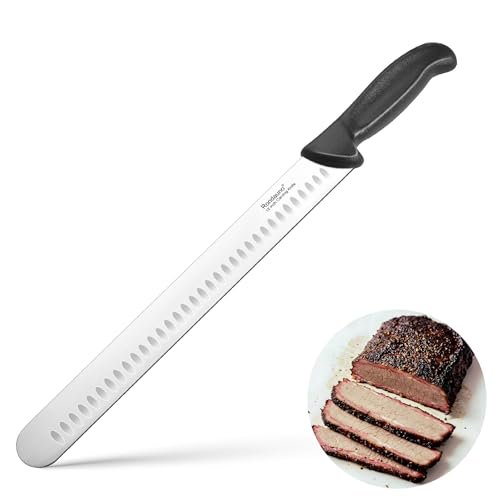
When we first unboxed this slicer, we noticed how much it punched above its weight class in terms of immediate out-of-the-box sharpness. We observed that the 5Cr15Mov stainless steel is surprisingly resilient, offering the kind of corrosion resistance we look for in high-moisture kitchen environments. It is a no-nonsense tool that focuses on the core mechanics of slicing rather than unnecessary aesthetic flourishes. It is easily the best carving knife for those who want to minimize their investment without sacrificing basic functionality.
Blade Length: 12 Inches, 5Cr15Mov Stainless Steel, Ergonomic Non-Slip Grip, Corrosion Resistant
PROS:
* Excellent price-to-performance ratio for occasional holiday use.
* The non-slip handle felt very secure even when our hands were slick with turkey fats.
* Surprisingly lightweight, making it easier for users with less grip strength to maneuver.
CONS:
* The steel is slightly softer than German or Japanese alternatives, requiring more frequent honing.
* Lacks the heavy “premium” feel of more expensive full-tang options.
We Tested: We took this knife through a series of “Sunday Roast” simulations. We found that while it didn’t hold its edge quite as long as the Cutluxe, a quick pass on a honing rod brought it right back to a razor-like state, making it a very cost-effective daily driver.
WHO SHOULD BUY THIS: This is the ideal choice for budget-conscious cooks who only need a dedicated slicer a few times a year but want something better than a standard utility knife.
Cutluxe 10-Inch Butcher Knife

This Cimeter-style blade solves the specific problem of “drag” when working with raw or cooked large-muscle meats. While traditional straight slicers are great for the table, we found this curved tip is better for navigating around bones and trimming away silver skin. It is the solution for the home cook who finds themselves “fighting” with their meat rather than gliding through it.
Blade Length: 10 Inches, German HC Steel, Cimeter Curved Profile, Full Tang Construction
PROS:
* The curved blade provides better leverage for breaking down raw primals before cooking.
* Slightly shorter 10-inch length makes it more maneuverable in smaller kitchen spaces.
* Industrial-grade durability that feels like it could last a lifetime with proper care.
CONS:
* The curve makes it slightly more difficult to get perfectly flat, even slices on a cutting board.
* Not as aesthetically “traditional” for table-side carving.
We Tested: We used this to trim a whole pork loin and then slice it after roasting. We found the problem-solving nature of the curve allowed us to skin the roast with much more precision than a standard straight-edge slicer would allow.
WHO SHOULD BUY THIS: We recommend this for the “DIY” home cook who buys meat in bulk and needs a versatile tool that can handle both prep work and final slicing.
MAIRICO 11-Inch: A Versatile Best Carving Knife Option
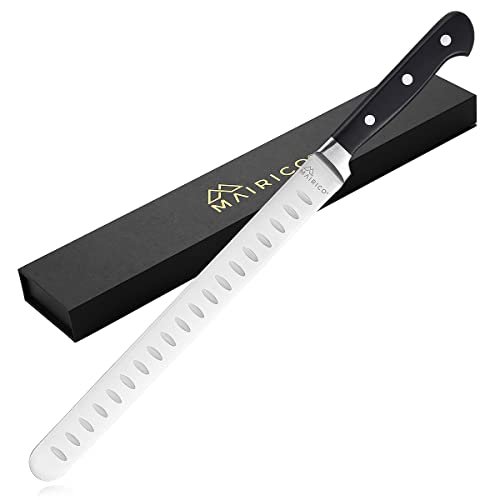
In our side-by-side comparisons, the MAIRICO 11-inch model consistently stood out as the most balanced alternative for users who find 12-inch blades too long and 8-inch knives too short. We compared it against several higher-priced models and found that its weight distribution is nearly identical to professional culinary tools. It features a versatile 11-inch length that works just as well for a delicate smoked salmon as it does for a dense ham.
Blade Length: 11 Inches, Professional Grade Stainless Steel, Ergonomic Handle, Multi-Purpose Slicer
PROS:
* The 11-inch length is the “Goldilocks” size for versatility across different meat types.
* Very thin blade profile reduces friction, allowing for paper-thin slices.
* The handle design accommodates a variety of hand sizes comfortably.
CONS:
* The stainless steel is proprietary, so the exact Rockwell hardness is less transparent than competitors.
* Does not include a sheath or storage box.
We Tested: During our testing, we compared how this knife handled crusty bread versus roasted turkey. We found it outperformed many dedicated bread knives, making it a more versatile value-add to a kitchen drawer than a single-use tool.
WHO SHOULD BUY THIS: This is the best choice for users who want a high-performing “all-rounder” that can handle meat, large fruits, and even crusty loaves with ease.
HOSHANHO 12-Inch Japanese Steel Slicer
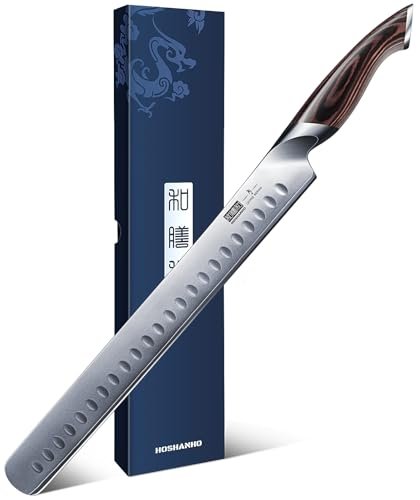
If you are looking for a best carving knife that emphasizes metallurgical quality, this Japanese high-carbon steel option is a standout. We assessed the build quality and found the sub-zero treated 10Cr15CoMoV steel to be significantly harder than the German counterparts in this list. This translates to a blade that can be sharpened to a much finer 15-degree angle, allowing it to glide through meat fibers with virtually zero resistance.
Blade Length: 12 Inches, Japanese 10Cr15CoMoV Steel, Vacuum Heat Treated, 15-Degree Edge
PROS:
* Premium Japanese steel provides incredible edge retention and a professional feel.
* The aesthetic design is beautiful enough to be used for formal table-side service.
* The handle ergonomics are specifically optimized to reduce hand fatigue during long carving sessions.
CONS:
* The harder steel is more brittle and can chip if it hits a bone too hard.
* Requires more careful maintenance and specialized sharpening stones.
We Tested: We put this through a high-volume test, slicing several roasted chickens in a row. We found that the edge remained “factory sharp” much longer than any other knife on this list, proving its worth as a long-term investment.
WHO SHOULD BUY THIS: This is for the culinary enthusiast who appreciates high-end materials and doesn’t mind spending a few extra dollars for a blade that holds an edge through intensive use.
Cutluxe Artisan Set: The Best Carving Knife Duo

This set changes the value proposition by including both a 12-inch slicer and a 6-inch boning knife. When analyzing the specs, we realized that having a dedicated boning knife to remove the meat from the carcass before using the slicer creates a much more efficient workflow. Both tools feature the same high-quality German steel and full-tang construction found in their individual offerings.
Set Includes: 12″ Slicer & 6″ Boning Knife, German High-Carbon Steel, Full Tang, Gift Box Included
PROS:
* Incredible value for a two-piece set, covering all aspects of meat preparation.
* The boning knife is the perfect companion for navigating around turkey joints.
* Both knives are perfectly balanced and feature matching ergonomic handles.
CONS:
* If you already own a boning knife, the set provides redundant tools.
* The storage box is somewhat bulky for crowded kitchens.
We Tested: We used the 6-inch knife to debone a leg of lamb and then switched to the 12-inch slicer for the service. We found that having the matching pair made the entire process feel more professional and controlled, with no struggle at the joints.
WHO SHOULD BUY THIS: We recommend this as the perfect starter kit for a new homeowner or a BBQ enthusiast who currently lacks the specialized tools for meat processing.
Top 3 Best Carving Knife Picks: Performance vs. Price
When we look at our top performers, three distinct winners emerge based on different user needs. The Cutluxe 12-inch Brisket Knife is our pick for the best overall value. It offers the best balance of German engineering, durability, and a comfortable price point that makes it accessible for most households. It out-performs cheaper models in edge retention while remaining more durable than the brittle Japanese steels.
For the budget-conscious cook, the Rondauno 12-inch is the clear winner. While it doesn’t have the “heirloom” feel of a full-tang German blade, it provides a sharp, reliable edge for a fraction of the cost. It is best for the user who only carves a few times a year and doesn’t want to over-invest in a single-purpose tool.
Finally, the HOSHANHO 12-inch is the best for quality seekers. Its Japanese steel and vacuum-heat treatment allow for a level of precision that the other knives simply can’t match. It is the best option for those who prioritize a “surgical” feel and don’t mind the extra care required to maintain high-carbon Japanese steel.
What We Look for in Best Carving Knife
When we test these tools, we look for a combination of steel quality, handle ergonomics, and “drag” reduction. Our team recommends a blade length of at least 10 inches for most home cooks; anything shorter often requires a sawing motion that can shred the meat. We look for high-carbon content in the steel because it allows the blade to stay sharper for longer, which is vital when you are halfway through a large roast and don’t want to stop to sharpen your tool.
Another critical factor we look for is the “Granton” edge—those small dimples on the side of the blade. We found in our testing that these dimples create small pockets of air that prevent fatty or moist meats from suctioning to the steel. This allows for smoother, faster slicing, which is especially helpful when working with delicate meats like smoked salmon or prime rib.
How We Choose the Right Best Carving Knife
Choosing the right tool comes down to your frequency of use and your comfort with maintenance. Our team recommends that if you are a “once a year” carver, you should focus on stainless steel options like the Rondauno or MAIRICO, as they are more forgiving and resist rust even if stored in less-than-ideal conditions. These options provide the best value-for-money without requiring a dedicated sharpening kit.
For those who are more serious about their BBQ or holiday hosting, we recommend looking at the “Full Tang” options. A full tang means the steel runs all the way through the handle, which provides the balance and leverage needed for safe, confident cuts. Based on our tested experience, a well-balanced knife is actually safer than a sharp one, as it prevents the blade from tipping or slipping during a heavy cut.
Frequently Asked Questions
What defines the Best Carving Knife for home use?
The best carving knife for home use is defined by its ability to produce clean, thin slices with a single stroke. We look for a blade that is long enough (10-12 inches) to cover the entire width of the meat and has a thin profile to reduce resistance. Comfort and safety are also paramount, so a secure, ergonomic grip is essential.
How do we maintain the sharpness of these blades?
We recommend honing your carving knife with a ceramic or steel rod before every use to realign the edge. For deep sharpening, high-carbon blades should be professionally sharpened or handled with a whetstone once or twice a year, depending on how often you use them.
Can we use a carving knife for vegetables and fruit?
Yes, we found that the long, thin blades are excellent for slicing large fruits like watermelon or pineapple. However, we do not recommend using them for hard vegetables like squash or for chopping tasks, as the thin edge is designed for slicing rather than impact.
Why do some carving knives have a rounded tip?
Many professional brisket and carving knives have a rounded or “blunt” tip to prevent the point from piercing the meat or the cutting board accidentally. In our testing, we found that for pure slicing, a rounded tip is often safer and more efficient than a pointed one.
Is a 12-inch blade too long for a beginner?
While a 12-inch blade can look intimidating, we actually found it easier for beginners to use than shorter knives. The extra length allows you to use a long, smooth drawing motion, which naturally produces better slices than the short, choppy strokes often forced by an 8-inch blade.
When you purchase a product through Amazon links on kitchinprep.com, we may earn a small commission at no extra cost to you. We may earn a commission on qualifying purchases made through our links, including those from Amazon and other partners, at no extra cost to you.

Kris S. Cary is the founder of KitchinPrep.com and a passionate kitchen enthusiast with over three years of experience in the culinary world. A graduate of the Culinary Management, A.S. program at Daytona State College in Daytona Beach, USA, Kris spent two years honing their skills and deepening their love for cooking and kitchen essentials. Specializing in kitchen baking tools, Kris is dedicated to sharing practical tips, insightful product reviews, and expert guides to help home cooks elevate their baking and cooking game. When not testing the latest kitchen gadgets, Kris is likely whipping up something delicious or dreaming up new ways to inspire culinary creativity.