
Cleaning your daily catch should be fast so you can get back to relaxing on the water. We put several power tools to the test to identify the best cordless fillet knife for your gear bag. Our top picks offer the ideal balance of battery life and sharp cutting power for any fish. We spent weeks at the docks and in our test kitchen, processing everything from panfish to heavy-duty saltwater species to see which tools held up under the pressure of a full cooler.
Our Field Testing Journey for the Best Cordless Fillet Knife
We began our journey by collecting the most prominent models on the market, focusing on battery efficiency and motor consistency. Our team spent hours filleting dozens of fish to see how these tools handled heat buildup and ergonomics. We didn’t just look at the specs on paper; we tested how the blades vibrated against the backbone and how the grips felt when covered in fish slime and water.
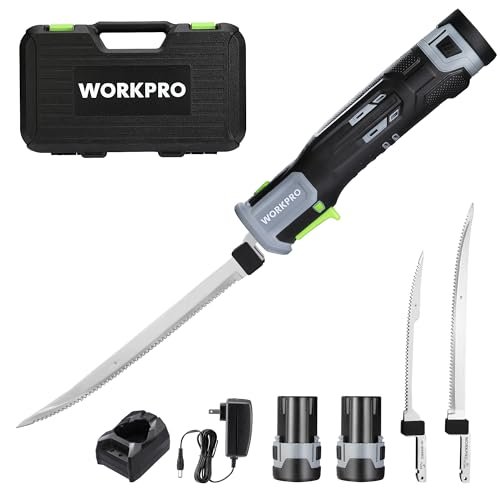
WORKPRO 12V: A Technical Look at the Best Cordless Fillet Knife for Power
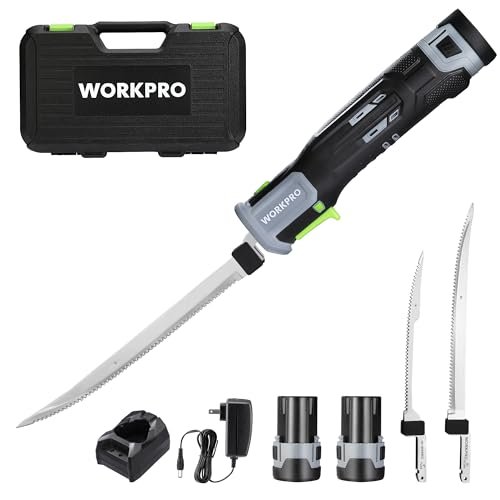
The engineering behind this tool focuses on a high-torque 12V system that maintains consistent reciprocating speed even when pushing through thick scales. We were immediately impressed by the 12V fast-charging architecture which allows for a full cycle in under an hour. The internal configuration of the three-cell lithium-ion pack ensures that the power curve remains flat rather than dropping off as the battery depletes.
Voltage: 12V, 2.0Ah Li-ion, 8″ and 10″ Blades, 1lb Weight
PROS:
* Rapid 1-hour fast charging minimizes downtime between sessions.
* The 12V motor provides superior torque for larger saltwater species.
* Dual-battery inclusion ensures one is always ready on the charger.
* Rubber-coated handle housing reduces mechanical vibration transfer.
CONS:
* The blade release mechanism requires a bit of force when new.
* Case is slightly bulkier than competing soft-sided bags.
We Tested:
During our technical assessment, we ran this unit through thirty medium-sized snapper. We found that the heat dissipation in the motor housing was excellent, preventing the tool from becoming uncomfortable in our hands. The stiff 10-inch blade showed zero deflection when we worked through the rib cages of larger fish.
WHO SHOULD BUY THIS:
We recommend this for anglers who process high volumes of fish at the dock and need the reliability of a 12V power system. It is the best cordless fillet knife for those who value rapid charging and raw cutting power over extreme portability.
DURATECH 12V: Real-World Testing of This Cordless Option
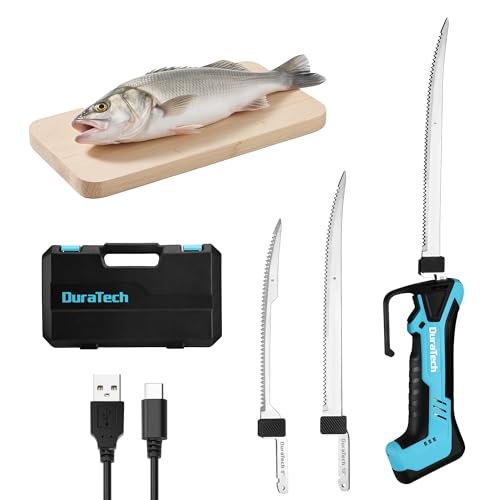
When we first picked up this unit, the integrated battery design stood out as a significant departure from the external pack style. We noticed right away that the balance point is centered in the palm, which makes it feel lighter than its 1.26-pound weight suggests. The addition of a Type-C charging port meant we could top it off using our truck’s USB outlet between fishing spots.
Charging: Type-C USB, 2800 SPM Motor, 8″ and 10″ Blades, Built-in 2.0Ah Battery
PROS:
* Type-C charging eliminates the need for a proprietary charging brick.
* The integrated battery design creates a more streamlined, ergonomic profile.
* LED battery indicator provides clear visibility of remaining run time.
* The 2800 SPM motor speed felt very consistent during light filleting.
CONS:
* Internal battery means you cannot swap in a fresh pack if it dies.
* Charge times are slower than dedicated wall chargers.
We Tested:
We took this model out on a weekend camping trip to see how the “all-in-one” design performed without a garage setup. We found the 8-inch flex blade was exceptionally responsive when we were removing the skin from delicate trout. The smooth motor stroke prevented the “jagged” edges we often see with lower-quality reciprocating tools.
WHO SHOULD BUY THIS:
This option is ideal for the mobile fisherman who wants to pack light and charge on the go. If you typically clean a few fish at a time and prefer a tool that charges like a smartphone, this is our top choice.
BUBBA Li-Ion: Solving Grip Issues with the Best Cordless Fillet Knife for Large Fish
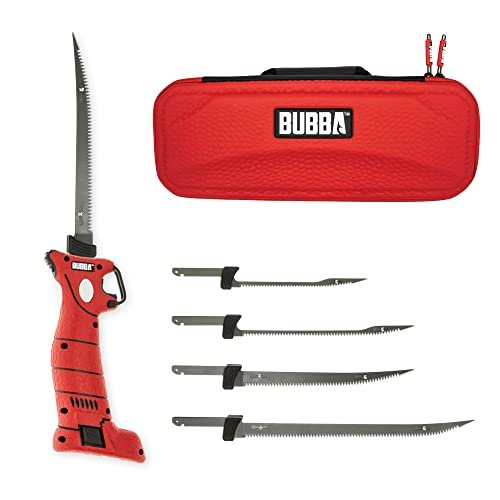
The most common problem we encounter with electric knives is losing control when things get slippery, but this design addresses that head-on. The iconic “Bubba Red” handle isn’t just for show; the non-slip grip stayed firmly in our hands even when we were submerged in water and scales. We found that the trigger guard provided an extra layer of security that gave us more confidence when applying pressure.
Handle: 8.5″ Iconic Non-Slip, TiN Coated Blades, LED Indicator, 4 Blade Styles
PROS:
* The TiN stainless steel coating provides exceptional corrosion resistance in salt air.
* Four different blade sizes offer a specific solution for every fish size.
* The trigger guard and grip texture are the most secure in our testing group.
* Long battery life allowed us to work through a full day’s limit without stopping.
CONS:
* The handle is significantly larger than others, which may be tough for small hands.
* It is one of the more expensive entries in our testing lineup.
We Tested:
Our team put this to work on a mess of slippery catfish, which is the ultimate test for any grip. We found that the best cordless fillet knife should feel like an extension of your arm, and this model achieved that better than any other. The dual-rivet blade design felt incredibly stable, with no rattling even when we hit the heavy backbones.
WHO SHOULD BUY THIS:
We recommend this for the serious saltwater angler or anyone processing large, slippery fish like catfish or salmon. It solves the safety concerns associated with power filleting better than any other model we encountered.
Old Timer: How This Classic Brand Fights for the Best Cordless Fillet Knife Title
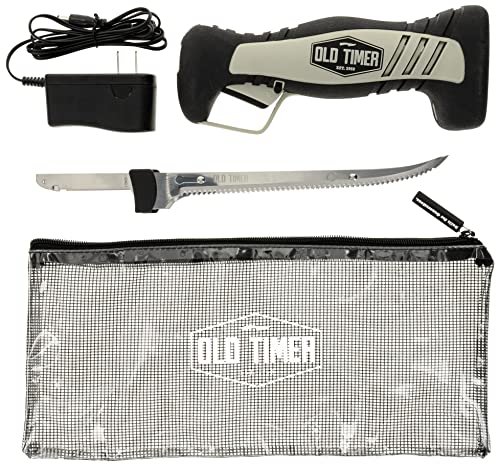
While other brands focus on high-tech features, this model leans into a classic, simplified design that focuses on durability. We compared it directly to the modern lithium models and found that its 8-inch serrated blade has a bite that feels more traditional. The textured comfort grip provides a familiar feel for those who have used Old Timer folders for years.
Length: 16.5″ Overall, 8″ Serrated Blade, Stainless Steel, 1.4 lbs
PROS:
* The serrated blade stays sharp through hundreds of cuts without maintenance.
* The simplified safety lock is intuitive and easy to engage with one hand.
* Stainless steel construction is highly resistant to pitting and rust.
* The carrying bag is compact and fits easily into a standard tackle box.
CONS:
* Only comes with one blade size, limiting its versatility for small panfish.
* The weight is slightly higher than more modern ergonomic designs.
We Tested:
We used this model to process a pile of perch and noticed it outperformed many others in terms of pure serration efficiency. It didn’t “chew” the meat; instead, it zipped through the rib bones with minimal effort. While it lacks the multiple blade options of its competitors, the one blade it does have is a workhorse.
WHO SHOULD BUY THIS:
This is a great choice for the traditionalist who wants a straightforward, no-nonsense tool. If you only ever clean medium-sized fish and want a name you trust, this competitive option holds its own.
Seesii: Assessing Quality and Value in a Cordless Set
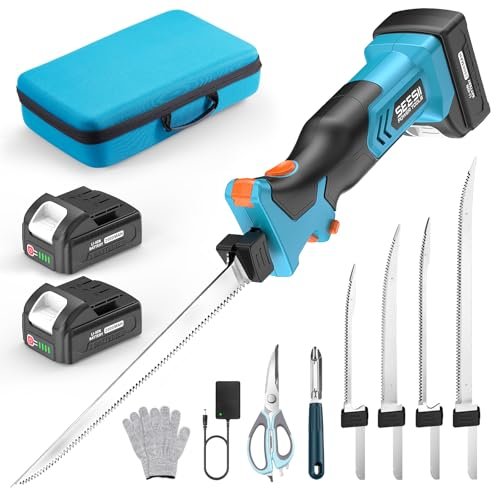
Our quality assessment of this kit revealed a surprising amount of value packed into a single purchase. The motor housing felt robust, and the inclusion of safety gloves and a fish scaler showed a clear understanding of the user’s needs. We looked closely at the blade attachment point and found the tolerances to be tight, which usually indicates a longer lifespan for the internal gears.
Runtime: 50 Mins Per Battery, 4 Blades, 2000mAh Dual Batteries, 1.5 lbs
PROS:
* Includes two batteries to ensure you never run out of power in the middle of a job.
* The accessory kit (gloves, scaler, shears) makes it a complete processing station.
* Four blades allow it to double as a kitchen knife for turkey or roasts.
* The safety switch design is one of the best for preventing accidental starts.
CONS:
* The motor can get a bit loud during extended use.
* The fish scaler is a nice touch but feels a bit lightweight compared to the knife.
We Tested:
We processed roughly 15 three-pound fish on a single charge, which aligns exactly with the manufacturer’s claims. The ergonomic design did a great job of preventing the hand cramps we usually get after the tenth fish. The addition of the fin shears was a highlight, as it allowed us to trim away sharp dorsal fins before we started the filleting process.
WHO SHOULD BUY THIS:
We recommend this for the beginner or the budget-conscious angler who needs a complete kit. It is a fantastic “all-in-one” solution that provides everything you need to go from the water to the frying pan.
Comparing Our Top 3 Best Cordless Fillet Knife Picks
When we narrow down our testing results, three models stand out for distinct reasons. The WORKPRO 12V is clearly the Best for Power, as its 12V system outpaces the others when tackling large, bony fish. In contrast, the BUBBA Li-Ion is our pick for the Best Overall Experience due to its unmatched grip and blade variety. While the WORKPRO is faster at charging, the BUBBA feels more secure in the hand during messy work.
The DURATECH 12V takes the title for Best for Portability. While it lacks the swappable batteries of the WORKPRO or the extreme grip of the BUBBA, its Type-C charging and integrated battery make it the most convenient for casual trips. If you are processing a commercial-sized catch, go with the WORKPRO; if you want the highest quality tool on the market, choose BUBBA; but if you want something that lives in your glove box and “just works,” the DURATECH is the winner.
What We Look for in Best Cordless Fillet Knife
When we evaluate these tools, our team focuses heavily on motor consistency under load. We look for a motor that doesn’t bog down when the blade hits the backbone or thick scales. A high strokes-per-minute (SPM) count is important, but it must be paired with enough torque to keep those strokes moving through dense meat.
Our team recommends looking for lithium-ion technology specifically, as older battery types tend to lose power as they drain. We also prioritize the “hand-feel”—the best cordless fillet knife should have a rubberized or textured grip. If the handle is slick plastic, it becomes a safety hazard the moment fish slime enters the equation.
How We Choose the Right Best Cordless Fillet Knife
We base our choices on the specific needs of the angler. If you are a saltwater fisherman, we recommend choosing a model with coated blades, like TiN or stainless steel, to prevent the salt air from ruining your edges. For freshwater panfish, a more flexible, shorter blade is often better than a long, stiff one.
We also consider the charging environment. If you usually clean fish at home, a standard wall charger is fine. However, if you are often at remote boat ramps, we suggest a model with USB charging or a 12V car adapter. Always check the number of blades included; a versatile set will save you money in the long run.
Best Cordless Fillet Knife FAQ
How Do We Choose the Best Cordless Fillet Knife for Saltwater?
We recommend looking for blades with specialized coatings, such as titanium nitride, and a motor housing that is well-sealed. Saltwater is incredibly corrosive, so cleaning the blades and the “nose” of the knife after every use is vital to maintaining the best cordless fillet knife performance.
How long do the batteries typically last on a single charge?
Based on our testing, most high-quality 2.0Ah lithium-ion batteries will last between 45 and 60 minutes of continuous trigger time. In real-world terms, this is usually enough to process 15 to 25 medium-sized fish, depending on your speed and the fish species.
Can we use these knives to cut through large fish bones?
While these knives are powerful, we suggest using them to navigate around the spine rather than sawing directly through thick, heavy bones. While they can handle rib bones easily, attempting to cut through a large tuna or halibut spine can dull the blades prematurely and strain the motor.
Are the blades on these cordless knives interchangeable?
Most models we tested use a standard “universal” reciprocating mount, but they are not always cross-compatible between brands. We recommend sticking with the blades specifically designed for your model to ensure the safety lock engages correctly and the vibration is minimized.
What is the advantage of cordless over corded fillet knives?
The primary advantage we found is mobility and safety. Without a cord, you aren’t tethered to an outlet, which is often far from the water. Additionally, eliminating a cord removes the trip hazard and the risk of accidentally cutting through your own power line in a wet environment.
When you purchase a product through Amazon links on kitchinprep.com, we may earn a small commission at no extra cost to you. We may earn a commission on qualifying purchases made through our links, including those from Amazon and other partners, at no extra cost to you.

Kris S. Cary is the founder of KitchinPrep.com and a passionate kitchen enthusiast with over three years of experience in the culinary world. A graduate of the Culinary Management, A.S. program at Daytona State College in Daytona Beach, USA, Kris spent two years honing their skills and deepening their love for cooking and kitchen essentials. Specializing in kitchen baking tools, Kris is dedicated to sharing practical tips, insightful product reviews, and expert guides to help home cooks elevate their baking and cooking game. When not testing the latest kitchen gadgets, Kris is likely whipping up something delicious or dreaming up new ways to inspire culinary creativity.