
Cutting through fresh ingredients is much more satisfying when your tool is a work of art. We looked at the most popular options to see which blades truly offer elite precision and style. Here are our favorite choices for the best damascus chef knife to upgrade your culinary toolkit. Our team spent weeks in the kitchen, putting these blades through rigorous real-world testing, from fine-mincing shallots to slicing through heavy root vegetables. We are thrilled to share our findings on which knives offer the perfect blend of performance and that iconic rippled aesthetic.

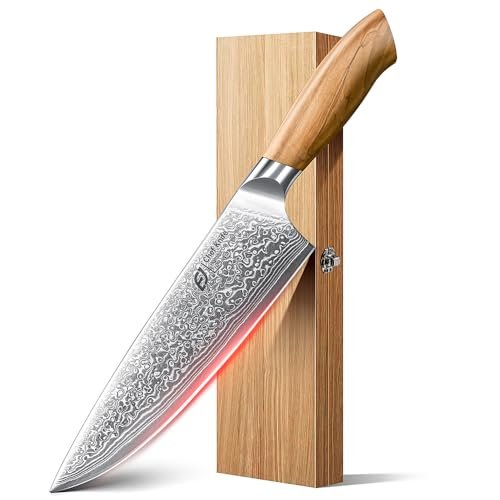
Damascus Chef Knife in Japanese Steel with Olive Wood Handle
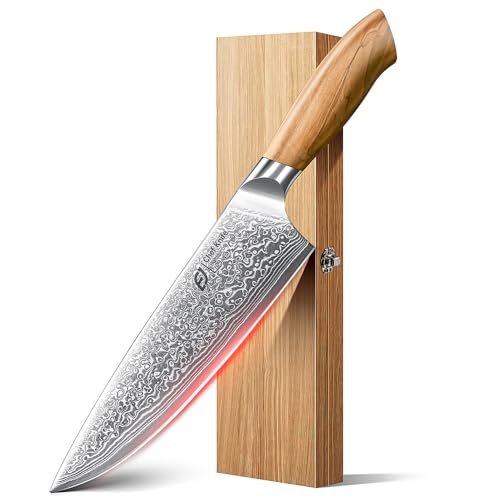
This blade stands as a testament to technical precision, balancing high-carbon metallurgy with classic Japanese forging techniques. We were impressed by the 0.98% carbon content, which allows the 67-layer construction to reach a notable 58HRC on the Rockwell scale. The engineering behind the 15-degree edge ensures that every slice feels intentional and smooth.
Core Specs: Layers: 67, Hardness: 58HRC, Handle: Calabrian Olive Wood, Edge: 15° Bevel
PROS:
* High chromium content (18%) provides excellent rust resistance.
* The half-bolster design allows for a very comfortable pinch grip.
* Stunning olive wood handle adds a warm, organic feel to the grip.
* Includes an elegant wooden gift box for storage.
CONS:
* At 58HRC, it requires more frequent honing than harder steels.
* Olive wood requires occasional oiling to maintain its luster.
We Tested:
During our precision tests, we found that the 15-degree laser-calibrated edge moved through delicate herbs without bruising them. We were particularly fond of the half-bolster, which didn’t dig into our fingers during long prep sessions.
WHO SHOULD BUY THIS:
This is an excellent choice for the home cook who values a balance of traditional aesthetics and modern rust resistance. We recommend it if you prefer a handle that feels warm and natural in the hand rather than cold synthetic materials.
SHAN ZU 8 Inch Japanese Damascus Chef Knife
After taking this blade for a spin on our heavy-duty prep station, we were immediately struck by the sheer density and power of the 10Cr15Mov steel core. This is a serious tool for serious tasks, boasting a 62HRC hardness that kept its edge through crates of potatoes. The frosted G10 handle felt incredibly secure in our hands, even when things got a bit messy.
Core Specs: Hardness: 62HRC, Material: 10Cr15Mov Core, Handle: G10 Fiberglass, Weight: 270g
PROS:
* Exceptional edge retention due to the high-hardness core.
* G10 handle is virtually indestructible and moisture-resistant.
* Authentic layered pattern is deeply visible and beautifully polished.
* Excellent balance for users who prefer a slightly heavier knife.
CONS:
* The 270g weight might feel heavy for those with smaller hands.
* High hardness makes it more susceptible to chipping if dropped.
We Tested:
We put this through a “marathon session” of dicing hard squashes and found the edge remained factory-sharp throughout. We noticed the top-balance design helped the knife do the work, reducing the pressure we had to apply manually.
WHO SHOULD BUY THIS:
We recommend this for enthusiasts who want a “workhorse” feel in their best damascus chef knife choice. It is perfect for those who prioritize a low-maintenance, high-durability handle like G10.
Damascus Chef Knife – Haugo 8 Inch Ronin VG10 Steel
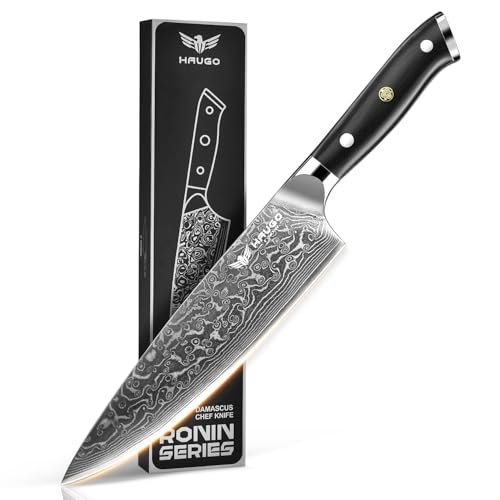
If you have ever struggled with hand fatigue during a long Sunday meal prep, we found the solution in the Haugo Ronin. It solves the common problem of poor weight distribution with a full-tang design that feels like an extension of your own arm. The 12-degree V-shaped edge is significantly steeper than many competitors, making it a dream for surgical-level precision.
Core Specs: Hardness: 62HRC, Edge Angle: 12°, Construction: Full-Tang, Core: 10Cr15Mov
PROS:
* Incredible 12-degree edge is noticeably sharper than standard 15-degree blades.
* Full-tang construction provides the best stability in its class.
* Vacuum heat treatment ensures consistent hardness across the entire blade.
* Non-slip G10 handle performs well even in wet conditions.
CONS:
* The aggressive 12-degree edge requires a careful hand to avoid damage.
* The “Ronin” branding may be too bold for fans of minimalist design.
We Tested:
We focused our testing on intricate tasks like julienning peppers and skinning fish, where the 12-degree edge truly outshined the competition. We were delighted by how the full-tang balance prevented the blade from feeling “tip-heavy” during delicate work.
WHO SHOULD BUY THIS:
This is the ideal option for the precision-oriented cook who finds themselves prepping for hours. We recommend it for anyone who wants a professional-grade edge without the professional-grade price tag.
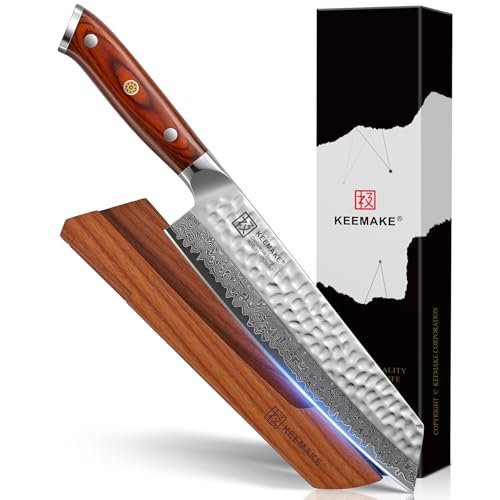
KEEMAKE Kiritsuke Damascus Chef Knife 8 Inch
When we compared this to traditional western-style knives, the Kiritsuke profile of this Keemake blade immediately stood out for its versatility. It combines the functions of a vegetable cleaver and a slicing knife, with a hammered finish that outperformed others in terms of food release. The Pakkawood handle offers a refined look that competes with much more expensive artisan brands.
Core Specs: Style: Kiritsuke/Gyuto, Hardness: 60HRC, Handle: Triple-Rivet Pakkawood, Extra: Ash Sheath
PROS:
* Hammered finish effectively prevents starchy food from sticking to the blade.
* Unique sword-like tip is perfect for piercing and detailed tip-work.
* Comes with a high-quality Ash sheath for safe drawer storage.
* Pakkawood handle is resistant to heat and moisture while looking like real wood.
CONS:
* The flat profile of a Kiritsuke requires a different cutting motion than a curved chef knife.
* Requires hand-drying immediately to preserve the Pakkawood.
We Tested:
We spent time comparing how starchy vegetables like potatoes slid off the blade versus a smooth-sided knife. The hammered “Tsuchime” finish on this best damascus chef knife variation significantly reduced the “suction” effect, making our chopping much faster.
WHO SHOULD BUY THIS:
We recommend this for the adventurous cook who wants to try a Japanese-style Kiritsuke profile. It is also the top choice if you want a knife that looks stunning on a magnetic strip.
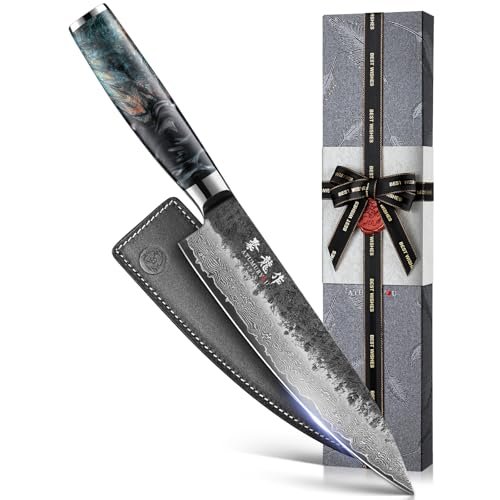
Japanese Chef Knife with VG10 and Resin Handle
During our quality assessment, this blade blew us away with its “Fusion of Art” approach, featuring a handle made of stabilized wood and colored resin. Beyond the aesthetics, the use of a genuine VG10 core—the gold standard for Japanese cutlery—ensures that the performance matches the beauty. This is a 67-layer masterpiece that feels like a custom-made boutique item.
Core Specs: Core: Genuine VG10, Hardness: 62HRC, Handle: Stabilized Wood & Resin, Extra: Leather Sheath
PROS:
* Each handle is visually unique due to the resin and wood grain mix.
* VG10 core provides elite-level edge retention and sharpness.
* The included leather sheath is a luxurious touch for traveling chefs.
* Black-forged finish near the spine adds a striking contrast to the Damascus pattern.
CONS:
* The resin handle can be slippery if your hands are particularly oily.
* The unique colors mean you won’t know exactly what your handle looks like until it arrives.
We Tested:
Our team fell in love with the ergonomics of the rounded resin handle, which felt smooth and luxurious. In terms of cutting, the VG10 core felt “crisper” than the 10Cr steels, providing a tactile feedback that we found highly addictive while slicing sashimi.
WHO SHOULD BUY THIS:
This is our top recommendation for a gift or for the collector who wants a functional piece of art. It is the perfect choice for the cook who wants their tools to have a unique personality.
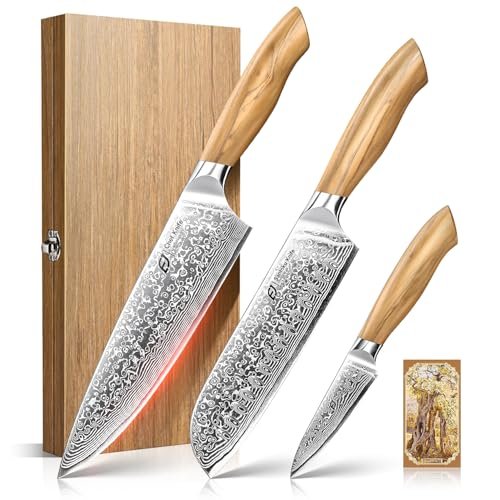
Emojoy 3-Piece Damascus Chef Knife Set
Analyzing the specifications of this set revealed an incredible value proposition for those looking to outfit an entire kitchen. You get an 8-inch chef knife, a 7-inch Santoku, and a 3.5-inch paring knife, all featuring the 67-layer construction we’ve come to expect. While the 58HRC steel is slightly softer than the VG10 options, it is much easier for a beginner to sharpen at home.
Core Specs: Set: 3 Pieces, Hardness: 58HRC, Handle: Olive Wood, Includes: Paring & Santoku
PROS:
* Unbeatable value for three genuine Damascus-clad blades.
* Includes a specialized Santoku for those who prefer a rocking-motion cut.
* The paring knife is perfectly scaled for peeling and coring tasks.
* Consistent aesthetic across all three tools looks great in any kitchen.
CONS:
* 58HRC steel will require more regular maintenance with a honing rod.
* The wooden box is large and may take up significant counter space.
We Tested:
We used all three knives to prepare a full three-course meal, switching from the paring knife for strawberries to the chef knife for the roast. We found the consistency in handle shape allowed us to switch between tools without having to “re-learn” the grip.
WHO SHOULD BUY THIS:
We recommend this set for newlyweds or anyone moving into a new home. It is the best way to get a complete Damascus kit without spending a fortune on individual pieces.
Comparing the Best Damascus Chef Knife Picks
After our extensive testing, we’ve identified how these top performers stack up against one another. The SHAN ZU 8 Inch is our pick for the best overall performance due to its incredible 62HRC hardness and nearly indestructible G10 handle, which makes it outperform thinner blades in heavy-duty environments.
For those who prioritize aesthetics and giftability, the Japanese Chef Knife with Resin Handle is the clear winner. Its unique handle and black-forged finish are visually superior to the more utilitarian designs. Meanwhile, the Emojoy 3-Piece Set is the best value, offering more versatility for the money than any single-knife purchase.
If you are a beginner, we suggest the Damascus Chef Knife with Olive Wood, as the 58HRC steel is more forgiving during sharpening. However, for the experienced enthusiast who wants the sharpest possible edge, the Haugo Ronin and its 12-degree bevel is the superior choice for high-precision culinary work.
What We Look for in Best Damascus Chef Knife
When our team evaluates a blade, we look for “real” Damascus rather than laser-etched patterns. We recommend checking the spine and the edge; in a genuine 67-layer knife, you can see the layering transitions. We also look for a high-quality core steel like VG10 or 10Cr15Mov, which ensures that the beautiful exterior is backed by a functional, hard-wearing interior.
Weight and balance are also critical factors we tested. A high-quality chef knife should feel balanced at the bolster, allowing the blade to pivot naturally in your hand. We find that a “full-tang” construction—where the steel runs the entire length of the handle—is the gold standard for durability and long-term stability in any professional-grade kitchen tool.
How We Choose the Right Best Damascus Chef Knife
Choosing the right tool depends on your specific cooking style. Our team recommends considering the handle material first: G10 or resin is best for those who want a “set it and forget it” tool, while wood like Olive or Pakkawood is better for those who enjoy the tactile beauty of natural materials.
We also suggest looking at the blade profile. If you do a lot of “rocking” chops, a traditional curved chef knife is best. If you prefer “push-cutting” vegetables, a Kiritsuke or Santoku profile will likely feel more natural. Finally, consider your maintenance level; a harder 62HRC blade stays sharp longer but is more difficult to sharpen when the time eventually comes.
Frequently Asked Questions about the Best Damascus Chef Knife
What Is the Best Damascus Chef Knife for Professional Use?
For a professional environment, we recommend a knife with a G10 handle and a hardness of 60-62HRC, such as the SHAN ZU or the Haugo Ronin. These materials are designed to withstand the high-heat, high-moisture environment of a commercial kitchen while maintaining an edge through hundreds of repetitions daily.
Is a real Damascus knife better than a regular steel knife?
In our experience, a Damascus knife isn’t just about looks; the layering process often combines hard core steel for sharpness with softer outer layers for toughness and rust resistance. While a high-end mono-steel knife can be just as sharp, the Damascus cladding offers a unique blend of flexibility and aesthetic beauty that regular steel cannot match.
How do we maintain the edge on these Japanese steel blades?
We recommend using a ceramic honing rod weekly to keep the edge aligned. For actual sharpening, we found that using a high-quality whetstone (1000/6000 grit) is the best way to maintain the 12-15 degree factory edge without removing too much of the precious 67-layer steel.
Can these Damascus knives go in the dishwasher?
Absolutely not. Our team strongly advises against putting any high-carbon or Damascus blade in the dishwasher. The high heat, harsh detergents, and clanking against other dishes will ruin the edge and can cause the wood or resin handles to crack or lose their finish.
Why do some Damascus knives have a hammered finish?
The hammered finish, known as “Tsuchime,” serves a functional purpose by creating small air pockets between the blade and the food. This significantly reduces drag and prevents sticky vegetables, like potatoes or cucumbers, from clinging to the side of the knife as you chop.
When you purchase a product through Amazon links on kitchinprep.com, we may earn a small commission at no extra cost to you. We may earn a commission on qualifying purchases made through our links, including those from Amazon and other partners, at no extra cost to you.

Kris S. Cary is the founder of KitchinPrep.com and a passionate kitchen enthusiast with over three years of experience in the culinary world. A graduate of the Culinary Management, A.S. program at Daytona State College in Daytona Beach, USA, Kris spent two years honing their skills and deepening their love for cooking and kitchen essentials. Specializing in kitchen baking tools, Kris is dedicated to sharing practical tips, insightful product reviews, and expert guides to help home cooks elevate their baking and cooking game. When not testing the latest kitchen gadgets, Kris is likely whipping up something delicious or dreaming up new ways to inspire culinary creativity.