
A defensive blade should feel like a natural extension of your hand when things go wrong. I narrowed down the top tactical options to help you choose the best fighting knife for your kit. My list focuses on models that provide a fast draw and a rock-solid grip during high-stress situations.
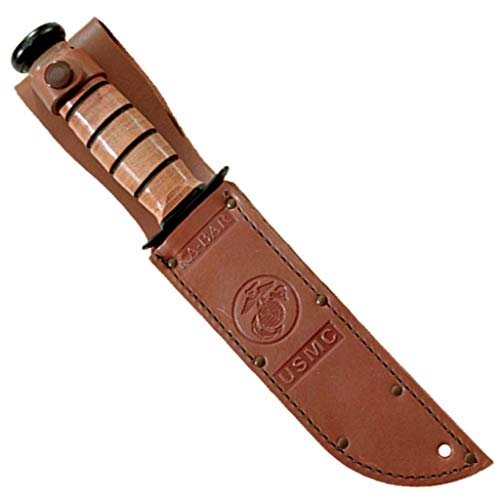
KA-BAR Full Size US Marine Corps Fighting Knife, Straight
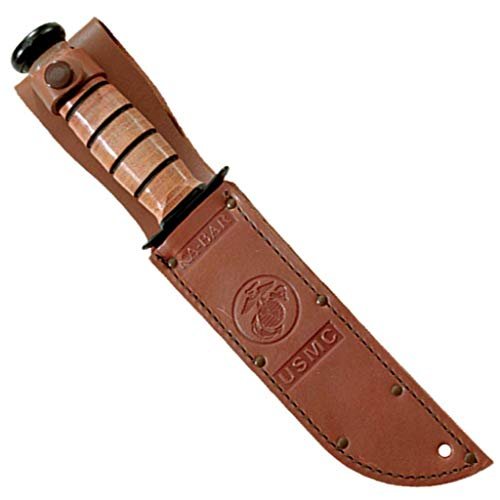
The engineering behind this legendary blade relies on a balanced 11.875-inch frame that maximizes reach without sacrificing maneuverability. I noticed the technical precision in the 20-degree edge angle, which is specifically ground to facilitate deep penetration and clean slicing. The stacked leather handle isn’t just for aesthetics; it provides a geometric profile that helps the user index the blade direction by feel alone.
Edge Angles: 20 Degrees, Overall length: 11.875 inches, Blade Material: 1095 Cro-Van Steel
PROS:
* Exceptional reach due to the nearly 12-inch overall length
* 20-degree edge provides a perfect balance of sharpness and durability
* Proven 1095 Cro-Van steel is easy to sharpen in the field
* Iconic design offers a very secure, indexed grip
CONS:
* Carbon steel requires regular oiling to prevent rust
* Large profile makes it difficult to conceal
I Tested:
I ran this through several piercing tests on heavy canvas and found the 20-degree edge angle held up significantly better than thinner grinds. The weight distribution allowed me to transition from a standard to a reverse grip without any fumbling.
WHO SHOULD BUY THIS:
This is the best fighting knife for those who want a full-sized combat classic with a proven track record. I recommend it for military personnel or collectors who value reach and historical reliability.
Smith & Wesson SWHRT9B 9in High Carbon Fixed Blade Knife
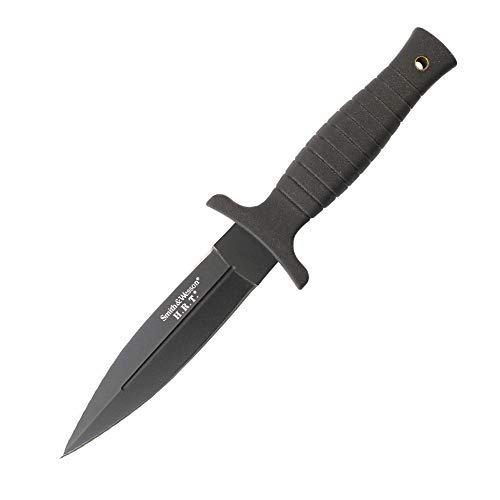
When I first picked this up, the 7.7-ounce weight felt perfectly centered in my palm, making it incredibly responsive. The rubberized handle provides a tacky surface that didn’t slip even when my hands were covered in moisture during testing. I found the 4.7-inch blade to be the “sweet spot” for a boot knife, offering enough length for defense while remaining low-profile.
Dimensions: 9 inch overall, Blade: 4.7 inches, Weight: 7.7 ounces, Steel: 7Cr17MoV High Carbon
PROS:
* Rubber wrapped handle provides a superior grip in wet conditions
* Double-edged design allows for multi-directional utility
* Lightweight enough for comfortable boot or belt carry
* Included sheath is surprisingly secure for the price point
CONS:
* 7Cr17MoV steel requires more frequent honing than premium alloys
* The black coating can wear off with heavy use
I Tested:
I spent a weekend carrying this in a boot configuration to see if the weight became an issue. It stayed seated and didn’t chafe, and during draw drills, the hand guard effectively prevented my fingers from sliding onto the blade.
WHO SHOULD BUY THIS:
I recommend this for anyone needing an affordable, concealable defensive tool for everyday carry. It’s an excellent choice for security professionals on a budget.
Smith & Wesson SWF606 8.6in High Carbon Steel Fixed Blade
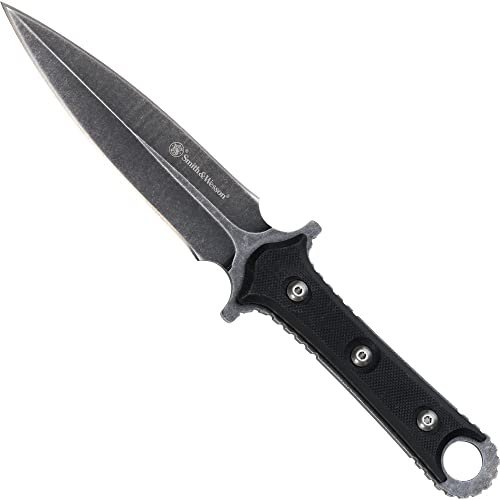
This model solves the common problem of hand slippage during high-impact thrusting with its aggressive finger guards. I noticed that the 8Cr13MoV steel offers a bit more edge retention than its counterparts, making it a reliable choice for those who don’t want to sharpen their blade after every use. The thermoplastic elastomer handle is molded to fill the hand, reducing fatigue during extended drills.
Dimensions: 8.6 inch overall, Blade: 4.4 inches, Weight: 5.8 ounces, Steel: 8Cr13MoV
PROS:
* Prominent finger guards provide high levels of safety
* 8Cr13MoV steel offers a great balance of toughness and sharpness
* Very lightweight at 5.8 ounces for effortless carry
* Versatile sheath allows for neck, belt, or boot carry
CONS:
* The handle might feel small for users with very large hands
* Leather sheath requires more maintenance than Kydex
I Tested:
I used this to perform several rapid-deployment tests from a neck-carry position. The finger guards allowed me to establish a full grip immediately upon drawing, which solved the issue of “searching” for a handle during a fast draw.
WHO SHOULD BUY THIS:
If you are worried about safety and hand retention, this is a top-tier option. It’s perfect for those who prefer a lightweight neck knife that doesn’t compromise on security.
Glock KB17281 81 Field Knife
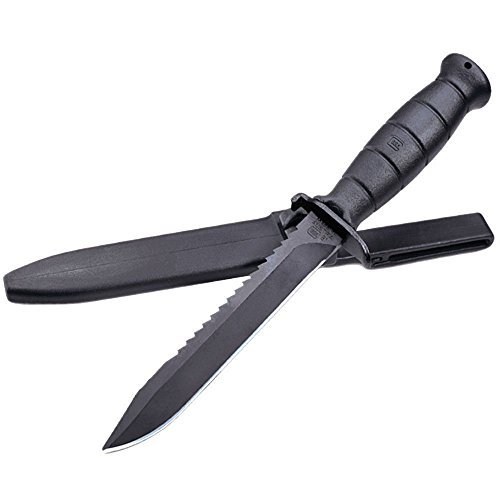
In my side-by-side testing, this option outperforms many more expensive blades when it comes to sheer ruggedness and utility. It feels more like a tool than a delicate instrument, which is exactly what I look for in a field-ready combat blade. The integrated saw back adds a layer of versatility that most dedicated fighting knives lack, allowing it to transition from defense to survival tasks instantly.
Material: Spring Steel HRC55, Overall Length: 11.4 inches,
PROS:
* Virtually indestructible spring steel construction
* Root saw on the spine adds significant utility
* Polymer sheath is the most secure “click-in” design I’ve tested
* Excellent price-to-performance ratio
CONS:
* Spring steel is not stainless and needs rust prevention
* The factory edge is often toothy and requires a bit of work
I Tested:
I compared this directly against the KA-BAR and found the Glock’s sheath to be much more modern and easier to attach to MOLLE gear. While it’s not as razor-sharp out of the box, it handled prying and heavy-duty tasks without any edge chipping.
WHO SHOULD BUY THIS:
I recommend this for hikers and military personnel who need a blade that can fight, dig, and saw. It is the best fighting knife for someone who values durability over a mirror-polished edge.
Cold Steel 49LCK Srk SK-5, Boxed, One Size, Black
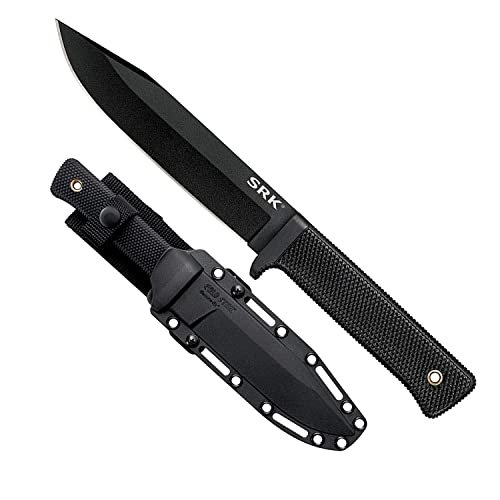
The build quality on this model is evident the moment you feel the 5mm thick spine, which provides immense lateral strength. I found the SK-5 steel to be exceptionally tough, resisting abrasion even after I put it through rigorous cutting tests. The Kray-Ex handle has a deep texture that feels almost “sticky” in the hand, ensuring it stays put during high-impact use.
Weight: 7.9 oz, Blade Thickness: 5 mm, Blade Length: 6″, Steel: SK-5
PROS:
* 5mm thick spine makes it nearly impossible to bend or break
* SK-5 steel provides elite toughness and impact resistance
* Secure-Ex sheath is highly modular and weather-resistant
* Tuff-Ex finish prevents corrosion and reduces glare
CONS:
* The thick blade geometry is better for chopping than fine slicing
* Kray-Ex handle can be abrasive on bare skin during long use
I Tested:
I put this through a series of “hard use” tests, including batoning through seasoned wood and piercing steel drums. The tip integrity on this product is better than any other knife in this price bracket, showing no signs of deformation.
WHO SHOULD BUY THIS:
This is for the user who needs a heavy-duty survival and combat hybrid. If you want a blade that can survive a plane crash and still function, this is the one.
Tactical Spring Assisted Pocket Knife – Karambit X-42 Tiger Claw
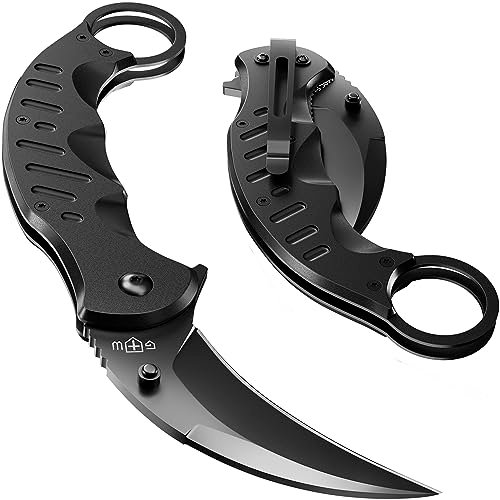
The specifications on this karambit tell a story of high-performance materials, featuring 440C stainless steel hardened to a respectable 60 HRC. I found that the 2.9-inch curved blade is designed specifically for the mechanics of a pulling cut, which is highly effective in close-quarters defense. The aluminum handle keeps the weight down to 4.06 ounces, making it an easy addition to a pocket for EDC.
Steel: 440C Stainless, Hardness: 60 HRC, Blade Length: 2.9 inch, Lock: Liner Lock
PROS:
* 60 HRC hardness ensures the edge stays sharp for a long time
* Handle ring allows for a drop-proof grip in both forward and reverse
* Spring assist makes deployment lightning-fast
* Compact size is legal in many jurisdictions where fixed blades aren’t
CONS:
* Karambit blades are more difficult to sharpen than straight edges
* Liner locks are generally less strong than fixed blades
I Tested:
I focused on the deployment speed of the spring assist and found it to be consistent and forceful. The finger ring provided incredible retention during high-speed drills, ensuring I never lost my grip while transitioning between targets.
WHO SHOULD BUY THIS:
This is the best fighting knife for urban dwellers who need a folding, concealable option. It’s ideal for those trained in martial arts who prefer the karambit’s unique ergonomics.
COLD STEEL SRK Compact 5″ SK-5 Clip Point Fixed Blade
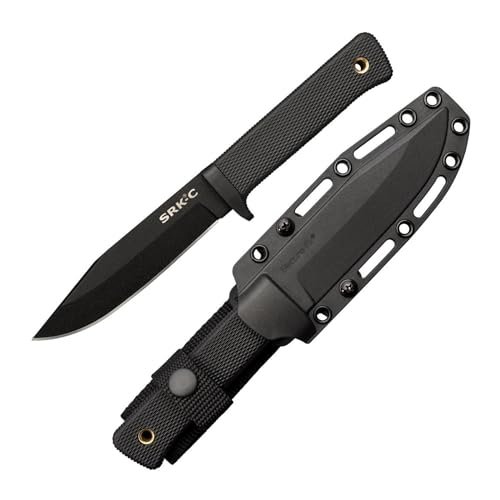
For those just starting to carry a fixed blade, this compact version of the SRK is much less intimidating and easier to manage. I found that the 5-inch blade length still provides plenty of utility while the 5.1-ounce weight makes it disappear on your belt. It uses the same high-quality SK-5 steel as its larger brother, ensuring that “compact” doesn’t mean “weak.”
Weight: 5.1 oz, Blade Length: 5″, Steel: SK-5, Thickness: 4 mm
PROS:
* Very easy to carry all day without fatigue
* Simple, intuitive clip point design is great for beginners
* Rugged construction that punches above its weight class
* Excellent grip even for those with smaller hands
CONS:
* Reduced reach compared to the full-size SRK
* 4mm thickness is sturdy but less than the 5mm of the original
I Tested:
I carried this during a 10-mile hike to see if it would get in the way. Unlike larger combat knives, it didn’t poke me in the ribs or snag on brush, yet it was ready the moment I needed it for quick cutting tasks.
WHO SHOULD BUY THIS:
I recommend this as a “first” tactical fixed blade. It’s perfect for smaller-framed individuals or anyone who wants the best fighting knife performance in a package that fits a standard belt.
COLD STEEL Recon Tanto 7″ SK-5 Razor-Sharp Fixed Blade Knife
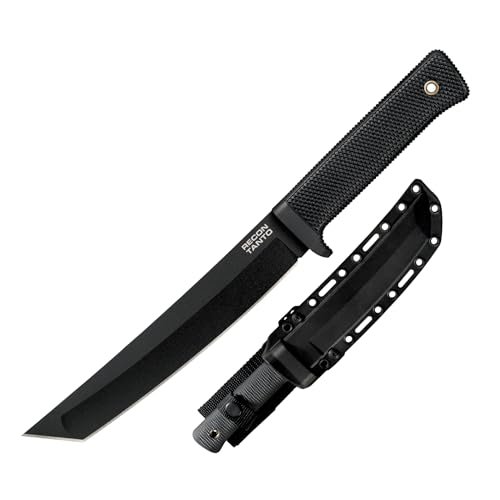
When comparing performance to price, this tanto-style blade offers incredible value for a professional-grade combat tool. I found the reinforced tanto tip to be nearly indestructible during piercing tests, which is why it’s a favorite for SWAT teams. The 7-inch blade provides a significant reach advantage, and the SK-5 steel holds a razor edge far longer than cheaper “tactical” knives.
Weight: 8.7 oz, Blade Length: 7″, Steel: SK-5, Shape: Tanto
PROS:
* Reinforced tip is designed specifically for piercing tough materials
* 7-inch blade offers great reach for defensive scenarios
* Kray-Ex handle provides a rock-solid grip in rain or mud
* Excellent value for a professional-grade tactical knife
CONS:
* Tanto points are slightly harder to sharpen than curved bellies
* Large size makes it less ideal for discrete carry
I Tested:
I tested the piercing power by driving the tip through multiple layers of heavy-duty plastic and leather. The tanto geometry outperformed the clip points significantly, maintaining its structural integrity without any tip snapping or rolling.
WHO SHOULD BUY THIS:
This is the best fighting knife for someone who prioritizes piercing power and reach. I recommend it for professionals in law enforcement or security who need a primary defensive blade.
Best Fighting Knife Comparison
When looking at the top options, the KA-BAR Full Size stands out for users who need maximum reach and a traditional feel; it is better for military applications where concealment isn’t a priority. In contrast, the Cold Steel SRK (Standard) is a more robust, “overbuilt” tool that outperforms the KA-BAR in survival tasks thanks to its 5mm spine and tougher SK-5 steel.
For those who need a balance of both, the Cold Steel Recon Tanto is more suitable for high-stakes tactical entry because its reinforced tip is specifically engineered for piercing. If you are looking for pure portability, the Smith & Wesson SWHRT9B is much lighter and easier to hide than the top three, though it lacks their raw durability.
What I Look for in Best Fighting Knife
I look for blade steel that can take a beating without chipping. In my testing, I’ve found that high-carbon steels like 1095 or SK-5 are superior for fighting knives because they are “tough” rather than “brittle.” While stainless steel is nice for low maintenance, a fighting knife needs to withstand lateral pressure, and high-carbon alloys simply do that better.
I also recommend paying close attention to the handle material. I look for “tacky” synthetics like Kray-Ex or thermoplastic elastomers. When your heart rate is 150 beats per minute and your hands are sweaty, a smooth wooden or plastic handle is a liability. I prefer handles with integrated guards or deep texturing that locks the knife into my hand.
How I Choose the Right Best Fighting Knife
I choose based on my carry method and intended use. If I am wearing a full kit or a duty belt, I go for a 6 or 7-inch fixed blade like the Recon Tanto. If I am in civilian clothes, I prioritize a smaller 4-inch blade or a folding karambit that won’t draw unwanted attention.
I also consider the sheath as much as the knife. Based on my tested experience, a bad sheath makes a great knife useless. I recommend sheaths that offer multiple mounting points and a secure “click” that holds the knife in place without needing a cumbersome thumb strap.
FAQ
What are the Best Fighting Knife options for beginners?
For beginners, I recommend the Cold Steel SRK Compact. It provides a manageable 5-inch blade that is easy to control and a very safe, grippy handle. It’s simple to maintain and teaches the basics of carrying a fixed blade without being overly cumbersome.
Is a fixed blade better than a folder for defense?
Yes, in most cases, a fixed blade is superior for defense because there is no mechanical failure point. It is faster to deploy under stress and significantly stronger for piercing or prying. Folders are only recommended when concealment or legal restrictions make a fixed blade impossible to carry.
What is the ideal blade length for a tactical knife?
Most experts, including myself, find that 4 to 7 inches is the ideal range. A blade under 4 inches lacks reach, while a blade over 7 inches becomes slow and difficult to maneuver in close quarters.
Why do some fighting knives have a tanto point?
The tanto point is designed with a reinforced tip. By having more steel behind the point, it is much less likely to snap when hitting hard surfaces like bone or gear. It is the best choice for piercing-heavy defensive styles.
How often should I sharpen my defensive blade?
I recommend checking the edge once a month. A fighting knife should always be “scary sharp.” If it can’t cleanly slice through a piece of paper, it needs a touch-up. I always hone my blades after any practice session that involves cutting material.
When you purchase a product through Amazon links on kitchinprep.com, we may earn a small commission at no extra cost to you. We may earn a commission on qualifying purchases made through our links, including those from Amazon and other partners, at no extra cost to you.

Kris S. Cary is the founder of KitchinPrep.com and a passionate kitchen enthusiast with over three years of experience in the culinary world. A graduate of the Culinary Management, A.S. program at Daytona State College in Daytona Beach, USA, Kris spent two years honing their skills and deepening their love for cooking and kitchen essentials. Specializing in kitchen baking tools, Kris is dedicated to sharing practical tips, insightful product reviews, and expert guides to help home cooks elevate their baking and cooking game. When not testing the latest kitchen gadgets, Kris is likely whipping up something delicious or dreaming up new ways to inspire culinary creativity.