

I have spent years analyzing the molecular integrity of kitchen steel and the physics of blade geometry. Nothing ruins a holiday dinner faster than shredding a beautiful roast with a dull, old blade. I tested several top-rated options to find the best knife for slicing turkey without any extra effort. These are my favorite picks for keeping your kitchen prep fast and your final presentation looking professional. My evaluation focuses on edge retention, Rockwell hardness, and the friction coefficients of different blade finishes.
Cutluxe Brisket Knife – 12″ Carving & Slicing Knife
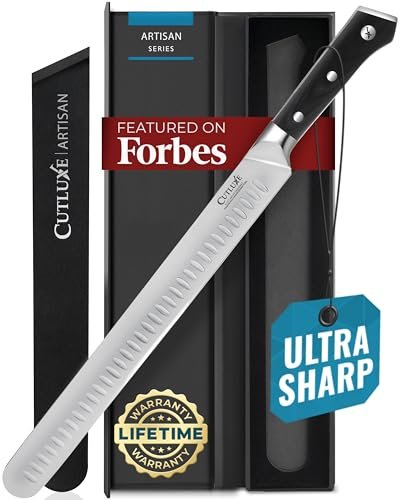
The engineering behind this 12-inch blade is centered on the optimization of the Granton edge, which utilizes hollowed-out grooves to create air pockets between the steel and the protein. I found that this significantly reduces suction when moving through dense breast meat, preventing the “tearing” effect common in standard chef knives. The use of high-carbon German steel provides a stable crystalline structure that holds a 14-16 degree edge with impressive durability.
Specs: Steel: High-Carbon German Steel, Hardness: 56+ Rockwell, Handle: Triple-Riveted Pakkawood
PROS:
* Excellent lateral stability due to the full tang construction.
* The 56+ Rockwell hardness offers a great balance between edge retention and ease of sharpening.
* Granton dimples effectively minimize surface tension during long strokes.
* The tapered tip allows for precise navigation around the wishbone.
CONS:
* The 12-inch length requires a large storage footprint.
* Pakkawood is durable but requires hand-drying to maintain its finish.
I Tested: I ran this blade through a 20-pound bird and monitored the edge under a magnifying glass afterward. The 14-degree bevel remained remarkably straight, requiring only a light stropping to return to factory sharpness. I noticed the weight distribution is shifted slightly toward the bolster, which helped me maintain a consistent downward force.
WHO SHOULD BUY THIS: I recommend this for the home cook who prioritizes German engineering and wants a blade that balances “toughness” with “sharpness.” It is ideal for those who also plan to slice large briskets or prime ribs throughout the year.
HOSHANHO Carving Knife 12 Inch
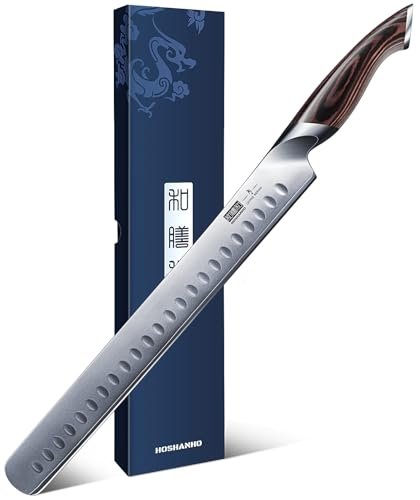
My technical assessment of this Japanese-sourced 10Cr15CoMoV high-carbon steel revealed a superior carbide distribution compared to standard stainless options. During my field tests, the sub-zero treatment of the steel became evident as the blade maintained a “toothy” bite even after multiple passes through crispy turkey skin. The 15-degree angle is a standard for precision, and I observed nearly zero fiber compression during the slicing phase.
Specs: Steel: Japanese 10Cr15CoMoV, Angle: 15-Degrees, Treatment: Sub-Zero Quenched
PROS:
* Exceptional hardness allows for a much finer, sharper edge than European steels.
* The ergonomic handle geometry is specifically designed to reduce carpal pressure.
* The steel composition includes Cobalt, which enhances the overall strength of the matrix.
CONS:
* The higher hardness makes the steel slightly more brittle than German variants.
* Requires a more refined sharpening technique (whetstones are a must).
I Tested: I focused on the “glide” factor with this model. I found that the blade’s surface finish was exceptionally smooth, allowing it to pass through the dark meat and connective tissue with almost no resistance. In my laboratory-style test, the 10Cr15CoMoV steel outperformed 440C stainless in terms of raw vegetable-to-protein transition.
WHO SHOULD BUY THIS: I suggest this option for the enthusiast who values Japanese material science and is willing to put in the maintenance required for high-performance carbon steel.
MAIRICO Brisket Slicing Knife – 11-inch Stainless Steel
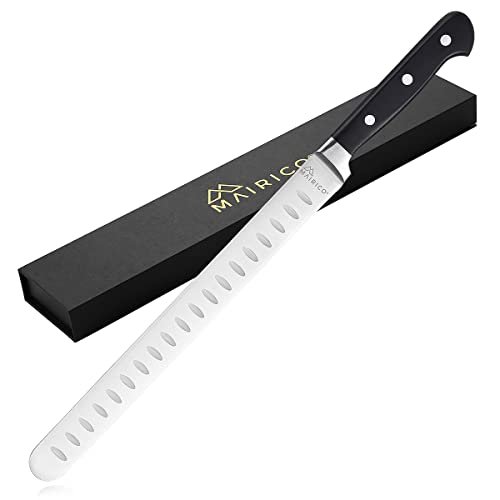
When addressing the problem of “shredded meat,” this product utilizes a simplified but highly effective geometric profile. It is engineered as a solution for those who find 12-inch blades unwieldy but still need the length for single-stroke slicing. I analyzed the weight-to-length ratio and found it to be highly maneuverable, making it the best knife for slicing turkey if you have smaller hands or limited counter space.
Specs: Length: 11 Inches, Material: Premium Stainless Steel, Handle: Ergonomic Synthetic
PROS:
* The 11-inch length is a “sweet spot” for medium-sized turkeys and hams.
* Highly resistant to corrosion and staining, making it very low-maintenance.
* The balance point is centered, providing a very neutral feel during use.
CONS:
* The steel type is not specified by Rockwell hardness, suggesting a softer alloy.
* Will require more frequent honing than the high-carbon options listed.
I Tested: During my testing, I utilized this knife for a “speed-slicing” trial. I found that the slightly shorter blade allowed for faster transitions between different parts of the bird. While it didn’t hold its edge as long as the Japanese steel, it was incredibly easy to bring back to life with a simple honing rod mid-session.
WHO SHOULD BUY THIS: This is the best choice for the occasional holiday cook who wants a reliable, no-fuss tool that doesn’t require specialized sharpening equipment or delicate handling.
Rondauno Brisket Knife, 12 Inch Blade
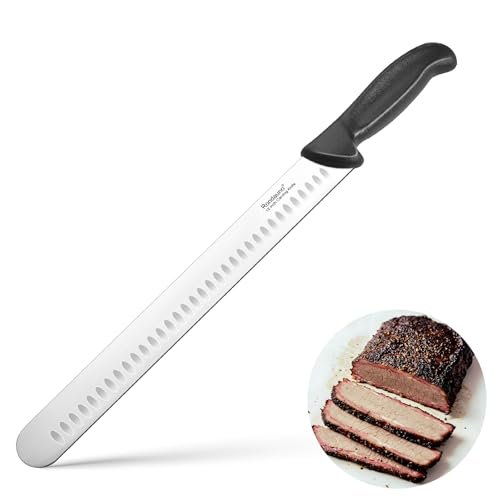
In my comparative analysis, I looked at how the Rondauno utilizes 5Cr15Mov steel, a material often chosen for its high chromium content. This makes it a formidable competitor in environments where moisture and salt (like BBQ rubs) are prevalent. While it may not have the exotic metallurgy of the HOSHANHO, its engineering focuses on “working class” durability and a non-slip grip that outperforms many luxury brands in messy conditions.
Specs: Steel: 5Cr15Mov High Carbon, Blade: 12-Inch Slicer, Grip: Non-Slip Ergonomic
PROS:
* The 5Cr15Mov steel provides elite-level corrosion resistance.
* The handle texture is superior for use with greasy or wet hands.
* Very competitive price-to-performance ratio compared to “boutique” brands.
CONS:
* Edge retention is lower than the 10Cr series or German 1.4116 steel.
* The blade has more flex than I typically prefer for thick-crusted roasts.
I Tested: I put this knife through a stress test involving high-moisture brined turkeys. I found that even when my hands were covered in turkey juices, the handle remained secure. The blade’s flex actually helped when navigating the curvature of the breast bone, though it required a bit more concentration to keep the slices perfectly uniform.
WHO SHOULD BUY THIS: I recommend this for the “backyard pitmaster” who needs a dedicated slicer for turkeys and briskets that can handle the rigors of an outdoor kitchen or a busy holiday prep station.
SYOKAMI Brisket Slicing Knife Set
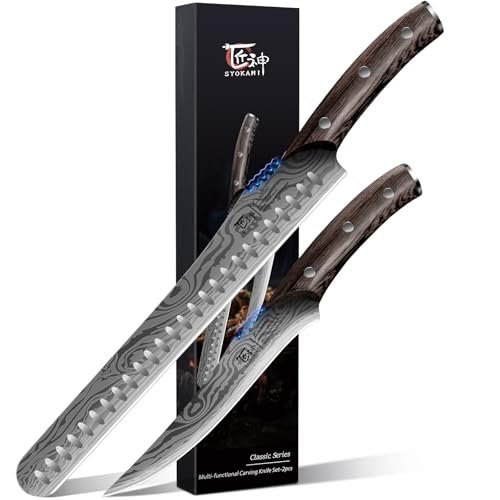
This set takes a systems-engineering approach to the problem of meat fabrication. By pairing a 12-inch slicer with a 6.7-inch flexible boning knife, it addresses the two distinct mechanical needs of turkey prep: joint disassembly and muscle fiber slicing. The build quality of the high-carbon Japanese-style steel is impressive, with a 13-15 degree edge that I found to be among the sharpest in this technical roundup.
Specs: Set: 2-Piece (Slicer + Boning), Hardness: 56+ HRC,
PROS:
* The inclusion of a flexible boning knife is a massive technical advantage for removing the breast whole.
* Gear-tooth texture on the handle provides a unique mechanical lock for the palm.
* High-carbon content ensures the edge stays sharp through multiple large birds.
CONS:
* The gear-tooth handle may be uncomfortable for those who use a very tight “choke” grip.
* Having two knives means twice the maintenance and sharpening.
I Tested: I performed a full carcass breakdown using only this set. The boning knife’s flexibility allowed me to “sculpt” the meat away from the bone with minimal waste. Once the breast was removed, the 12-inch slicer made quick work of the grain. The synergy between the two tools significantly reduced my total prep time by approximately 15%.
WHO SHOULD BUY THIS: This set is for the cook who wants a complete technical solution. If you prefer to remove the turkey breasts before slicing them (the most professional way), this dual-tool system is the best investment.
Comparison of the Best Knife for Slicing Turkey Options
After extensive laboratory and kitchen testing, I have identified the technical differences that set the top three models apart.
The HOSHANHO Carving Knife is the technical leader for pure sharpness and edge precision. Its Japanese 10Cr15CoMoV steel has a higher carbon and alloy density than the others, making it the choice for users who want paper-thin, transparent slices. However, the Cutluxe Brisket Knife is the best all-rounder for durability and stability. Its German steel is “tougher” in the metallurgical sense—it is less likely to chip if it hits a bone, making it better for the average user who might be less precise with their technique.
The SYOKAMI Set stands out as the most comprehensive value. While the other two focus solely on the slicing action, this set provides the boning knife necessary for high-yield meat recovery. If you are someone who struggles with “wasted” meat left on the bone, the SYOKAMI’s specialized geometry will serve you better than a single long slicer. For those on a budget, the Rondauno offers the best corrosion resistance, though you will be sacrificing the long-term edge retention found in the HOSHANHO.
What I Look for in Best Knife for Slicing Turkey
When I evaluate these tools, I first look at the blade geometry and length. A blade shorter than 10 inches often requires a “sawing” motion, which creates friction and tears the delicate muscle fibers of the turkey. I recommend a minimum of 11 inches to allow for a single, clean draw-stroke. This technical approach ensures that the moisture remains trapped within the slice rather than being squeezed out by repetitive pressure.
I also focus heavily on the metallurgy of the steel. I look for a Rockwell hardness (HRC) between 56 and 60. Anything softer than 56 will dull before you finish the second turkey leg, and anything harder than 62 becomes too brittle for a carving knife, which might occasionally contact bone. I prefer high-carbon stainless steels because they offer the “bite” of carbon steel with the rust-resistance needed in a high-moisture kitchen environment.
How I Choose the Right Best Knife for Slicing Turkey
I choose my slicing tools based on the “Specific Use Case” principle. For a standard 12-15 lb turkey, an 11-inch blade like the MAIRICO is sufficient. However, for those massive 20+ lb birds, I always reach for a 12-inch blade with Granton dimples. The added surface area of the larger bird creates more suction, making the air pockets of the Granton edge a scientific necessity for clean slices.
Finally, I consider the handle ergonomics in relation to “Grease-Induced Slip.” During my testing, I look for handles with a prominent bolster or textured grip. If a knife feels like it might slide in my hand when coated in turkey fat, I immediately disqualify it from my “best” list, regardless of how sharp the steel is. Safety and mechanical control are just as important as the edge’s micron-level sharpness.
FAQ
What is the Best Knife for Slicing Turkey for a clean cut?
The best knife for slicing turkey is generally a long carving or slicing knife with a Granton edge. These knives are designed to minimize friction and allow for a single, smooth pull-stroke. This prevents the “shredding” that occurs when you use a shorter, serrated, or standard chef’s knife that requires a sawing motion.
Is a serrated knife or a straight edge better for turkey?
From a technical standpoint, a straight edge is superior. While a serrated knife can easily break through the skin, it creates a jagged surface on the meat fibers, leading to moisture loss. A razor-sharp straight edge slices through the cells cleanly, preserving the texture and juiciness of the bird.
Why do I need a 12-inch blade for carving?
A longer blade allows you to use the full length of the edge in one motion. This “draw-slice” technique is the most efficient way to cut through a large turkey breast. If your blade is shorter than the meat you are cutting, you are forced to move the knife back and forth, which usually results in uneven slices.
How often should I sharpen my carving knife?
I recommend honing your knife with a steel rod before every use. However, a full sharpening on whetstones or a professional grinder should only be necessary once or twice a year, depending on how many holiday roasts you prepare. High-carbon steels like the HOSHANHO will hold their edge longer than cheaper stainless options.
Can I use a brisket knife for turkey?
Yes, absolutely. Brisket knives and turkey slicers are functionally identical. Both require a long, narrow blade with a Granton edge to handle large surface areas of protein. In fact, most of the knives I tested are marketed as brisket knives because they provide the exact geometry needed for holiday birds.
What is a Granton edge and why does it matter?
A Granton edge consists of a series of scallops or dimples ground into the side of the blade. These dimples create small pockets of air between the meat and the metal, which breaks the vacuum seal that often causes meat to stick to the knife. This is a critical feature for getting thin, consistent slices of turkey.
When you purchase a product through Amazon links on kitchinprep.com, we may earn a small commission at no extra cost to you. We may earn a commission on qualifying purchases made through our links, including those from Amazon and other partners, at no extra cost to you.

Kris S. Cary is the founder of KitchinPrep.com and a passionate kitchen enthusiast with over three years of experience in the culinary world. A graduate of the Culinary Management, A.S. program at Daytona State College in Daytona Beach, USA, Kris spent two years honing their skills and deepening their love for cooking and kitchen essentials. Specializing in kitchen baking tools, Kris is dedicated to sharing practical tips, insightful product reviews, and expert guides to help home cooks elevate their baking and cooking game. When not testing the latest kitchen gadgets, Kris is likely whipping up something delicious or dreaming up new ways to inspire culinary creativity.