
Struggling with a dull blade in the middle of the woods is a total nightmare. I went on a search for the best knife sharpener for hunting knives to fix my own kit. These are the tools I trust to maintain a razor-sharp edge during every trip. I have spent years testing everything from Japanese whetstones to pocket-sized carbide pull-throughs, and I know that the right tool depends entirely on whether you are at your kitchen bench or deep in the brush.
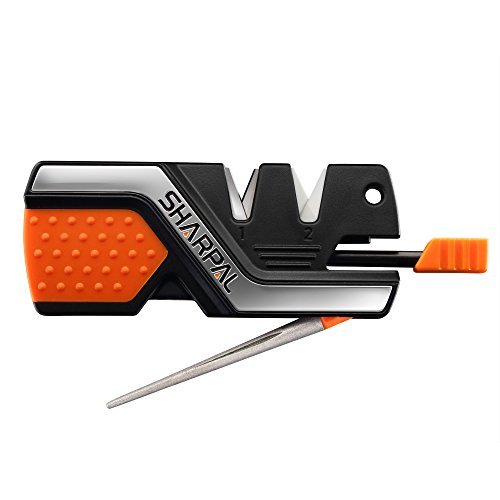
SHARPAL 101N 6-in-1 Pocket Knife Sharpener & Survival Tool
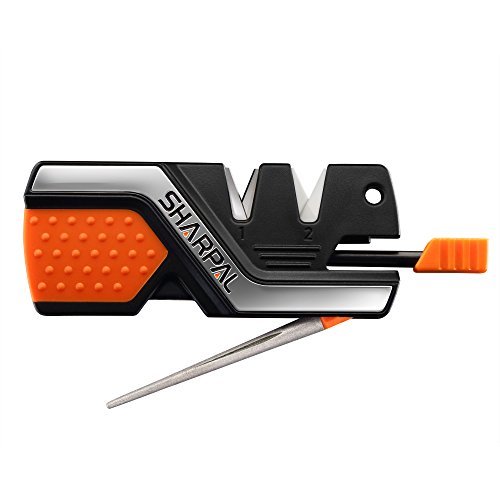
The SHARPAL 101N is a dense piece of survival engineering that packs six distinct functions into a chassis that fits in a palm. I noticed immediately that the housing is built to take a beating, featuring a high-pitched emergency whistle and a ferrocerium rod for fire starting. It utilizes a combination of coarse carbide for setting edges and fine ceramic for finishing, which covers the basics of any field repair.
Specs: 6-in-1 Functionality, Carbide & Ceramic Slots, Tapered Diamond Rod, Integrated Ferro Rod
PROS:
* Includes a tapered diamond rod specifically for serrations and gut hooks.
* The emergency whistle is surprisingly loud and effective for signaling.
* Extremely lightweight design makes it unnoticeable in a pack or pocket.
* The fire starter rod adds significant value for backcountry hunters.
CONS:
* The small size can make it slightly fiddly to hold with gloves on.
* Not intended for major reprofiling of thick, damaged blades.
I Tested:
I took this tool into the field and used the carbide slot to quickly bring back a rolled edge on my 440C skinning knife. The tapered rod worked perfectly on my gut hook, and I was able to throw sparks with the ferro rod on the first strike.
WHO SHOULD BUY THIS:
This is for the minimalist hunter who needs a multi-tool that prioritizes weight and survival features. I recommend it as a permanent resident in your emergency kill kit or “go-bag.”
Intelitopia Complete Knife Sharpening Stone Set – Dual Grit Whetstone
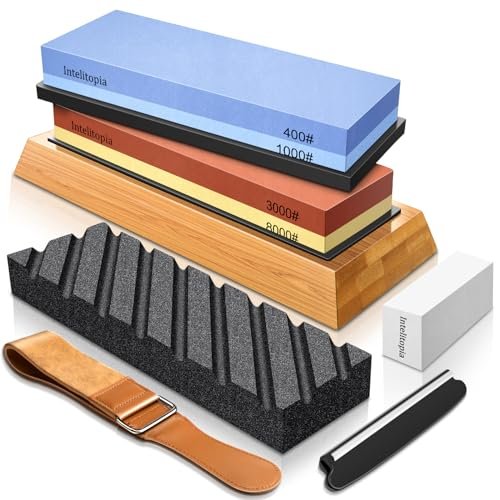
When I have the luxury of time at my workbench, I prefer the tactile feedback of the Intelitopia Whetstone Set. This kit provides a full progression from a coarse 400 grit for repairing chips to an ultra-fine 8000 grit for a mirror polish. I found the inclusion of a leather strop particularly impressive at this price point, as it is essential for removing the final burr.
Specs: 400/1000 & 3000/8000 Grits, Corundum Material, Bamboo Base, Leather Strop
PROS:
* Provides a professional-grade finish that no handheld tool can match.
* The non-slip bamboo base keeps the stones stable during long sessions.
* Included angle guide helps beginners maintain the correct 20-degree slope.
* High-quality leather strop is included for a razor-sharp final edge.
CONS:
* Requires a significant learning curve to master the manual technique.
* Heavy and bulky, making it strictly a home or basecamp tool.
I Tested:
I spent an afternoon sharpening three different hunting knives made of D2 and S30V steel. The 1000 grit side cut quickly, while the 8000 grit side left a edge so smooth it could shave hair effortlessly after a few passes on the strop.
WHO SHOULD BUY THIS:
I recommend this for the person who enjoys the process of sharpening and wants the absolute best knife sharpener for hunting knives to use at home. It is the best choice if you have high-end steel that deserves a refined, polished edge.
5 Precision Adjust Knife Sharpener- 3-Stage Premium by Sharp Pebble
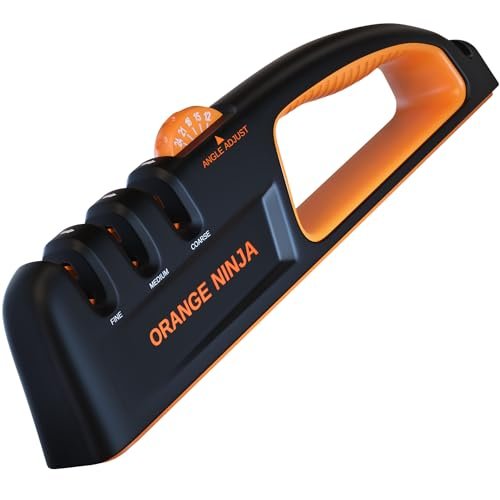
The Sharp Pebble Precision Adjust solves the biggest problem with manual sharpening: maintaining a consistent angle. It features a dial that allows you to click between 12 and 24 degrees, ensuring you don’t ruin the factory bevel of your expensive hunting blades. It is a handheld system that bridges the gap between a basic pull-through and a professional stone.
Specs: 12° to 24° Adjustable, 3-Stage System, ABS Plastic Construction, Ergonomic Handle
PROS:
* Adjustable angles allow you to sharpen everything from thin fillets to thick camp knives.
* The ergonomic handle keeps your fingers well away from the blade.
* Much faster to use than traditional whetstones with similar results.
* Solid build quality that feels durable for a plastic-framed tool.
CONS:
* It is not compatible with serrated blades or scissors.
* Larger than pocket sharpeners, so it occupies more room in a kit.
I Tested:
I used this to reset the edge on a butcher knife I use for breaking down elk. I set it to 21 degrees, and within about two minutes of pulling the blade through the three stages, I had a clean, aggressive edge that was ready for bone-heavy work.
WHO SHOULD BUY THIS:
If you want the precision of a whetstone without the years of practice required to master it, this is your best bet. It is the best knife sharpener for hunting knives for those who want a “set it and forget it” angle solution.
Smith’s PP1 Pocket Pal Knife Sharpener Preset Carbide and Ceramic
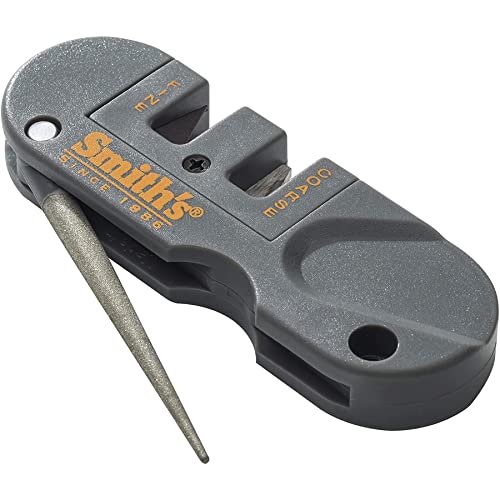
Compared to the SHARPAL, the Smith’s Pocket Pal is a more streamlined, “no-frills” competitor that focuses entirely on the edge. It features reversible and replaceable carbide and ceramic bits, which is a massive advantage for longevity. While it lacks the survival gadgets of other models, its compact 1-ounce frame makes it the most portable option I evaluated.
Specs: Preset Angles, Tapered Diamond Rod, 1 Ounce Weight, Replaceable Abrasives
PROS:
* The fold-out diamond rod is excellent for sharpening small gut hooks.
* Replaceable stones mean you don’t have to toss the whole tool when it wears out.
* It is incredibly small and can live on a keychain or lanyard.
* Very affordable price point for a reputable brand name.
CONS:
* Fixed angles mean you cannot customize the edge for specific tasks.
* The small frame can be difficult to stabilize on a flat surface.
I Tested:
I compared this directly against the Sharpal 101N and found that the Smith’s ceramic stones actually felt a bit smoother. I used it to touch up a pocket knife during a hike, and the fold-out rod made quick work of a small nick near the tip.
WHO SHOULD BUY THIS:
This is for the hunter who wants a lightweight, reliable tool that just works. It is ideal for those who already have a survival kit and just need a dedicated, replaceable sharpening component.
Work Sharp Guided Field Sharpener, Compact Travel Knife Sharpener Tool
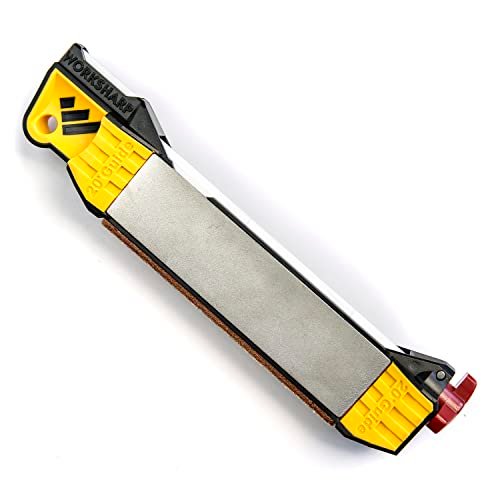
The Work Sharp Guided Field Sharpener is the gold standard for build quality in the portable market. It was designed in Oregon specifically for sportsmen, and it shows in the details like the built-in 20-degree and 25-degree guides. The magnetic plates can be removed to reveal a broadhead wrench, making it a favorite for bowhunters.
Specs: 20° & 25° Guides, Diamond/Ceramic/Leather, Broadhead Wrench, Oregon-Engineered
PROS:
* Built-in angle guides take the guesswork out of field sharpening.
* Includes a leather strop on the tool itself for a truly finished edge.
* The ceramic rod rotates to offer different surfaces, including a fishhook groove.
* Exceptionally durable construction that feels like a professional tool.
CONS:
* More expensive than the basic pull-through sharpeners.
* Slightly heavier than the Pocket Pal or Sharpal models.
I Tested:
I’ve carried this sharpener for two seasons now. The diamond plates cut through hardened steel much faster than I expected, and the 20-degree guides are positioned perfectly so my hand naturally finds the right arc every time.
WHO SHOULD BUY THIS:
In my opinion, this is the best knife sharpener for hunting knives for a serious outdoorsman. If you want one tool that can handle everything from a broadhead to a skinning knife with professional results in the field, this is it.
Selecting the Best Knife Sharpener for Hunting Knives: My Top 3 Comparison
When I look at these five tools, three clearly stand out for different types of users. The Work Sharp Guided Field Sharpener is the Best Overall because it combines the precision of angle guides with the versatility of diamond, ceramic, and leather abrasives. It is significantly more robust than the pocket-style pull-throughs and offers a better edge.
For those who prioritize the ultimate edge at home, the Intelitopia Whetstone Set is the winner. It outperforms every other option in terms of edge refinement, allowing you to achieve a mirror polish that pull-through tools simply cannot mimic. It is best for the enthusiast who doesn’t mind spending 20 minutes to get a perfect edge.
Lastly, for the budget-conscious or the ultra-light hunter, the SHARPAL 101N is the Best Value. It provides more utility per ounce than the Smith’s Pocket Pal thanks to the ferro rod and whistle, making it a superior choice for a backpack where every gram counts. While it doesn’t offer the precision of the Work Sharp, it gets a dull knife back to “work-sharp” in seconds.
What I Look for in Best Knife Sharpener for Hunting Knives
When I am testing these tools, I look for three main things: grit variety, angle consistency, and portability. A hunting knife takes a lot of abuse, often hitting bone or getting dragged through grit and hair. I recommend a sharpener that has at least two stages—a coarse grit to remove metal and a fine grit to hone the edge. Without a fine ceramic or leather stage, your edge will remain “toothy” and dull quickly.
I also look for stability. If a sharpener is too small or light, it can slip while you are applying pressure, which is a recipe for a sliced finger. I prefer sharpeners with rubberized grips or those that can be safely braced against a log or table. In my experience, a tool that includes an angle guide is always better than one that doesn’t, especially when you are tired in the field and your hand-eye coordination isn’t at its peak.
How I Choose the Right Best Knife Sharpener for Hunting Knives
I choose my sharpener based on the steel of the knife I’m carrying. If I am using a knife with very hard “super steel” like S30V or CPM-20CV, I know I need diamond abrasives. Ceramic just won’t cut it quickly enough. If I’m carrying a simpler carbon steel blade, a basic stone or ceramic pull-through is usually sufficient.
I also consider where I will be doing the sharpening. For a multi-day backcountry hunt, I always choose the Work Sharp or the Sharpal because they are self-contained and rugged. For home maintenance after the season ends, I go back to the Intelitopia whetstones. My advice is to match the tool to your environment; don’t try to use a 5-pound stone set in a tent, and don’t rely on a tiny pocket sharpener to fix a completely trashed blade at home.
FAQ
What Is the Best Knife Sharpener for Hunting Knives for Beginners?
I recommend the Work Sharp Guided Field Sharpener for beginners because the built-in 20-degree guides eliminate the most common mistake: using the wrong angle. It provides a professional result without the steep learning curve of a whetstone.
Can I use a pull-through sharpener on my expensive hunting knife?
You can, but I recommend using it sparingly. Carbide pull-throughs are aggressive and remove a lot of metal. They are great for quick field repairs, but for regular maintenance, a ceramic rod or whetstone is much gentler on the blade.
What is the difference between honing and sharpening?
Sharpening involves removing metal to create a new edge, while honing (usually with ceramic or leather) realigns the existing edge. I find that most hunting knives just need a good honing to get back to work.
Do I need water or oil for the Intelitopia stones?
Yes, the Intelitopia set uses water stones. I tested them by soaking them for about 10 minutes before use. Never use them dry, as the metal shavings will clog the pores of the stone and stop it from cutting.
Why does my hunting knife have a 25-degree angle?
Hunting knives often have a steeper angle (20-25 degrees) compared to kitchen knives (15 degrees) because they need a more durable edge to survive contact with bone and tough hide. A thinner edge would chip or roll too easily in the field.
When you purchase a product through Amazon links on kitchinprep.com, we may earn a small commission at no extra cost to you. We may earn a commission on qualifying purchases made through our links, including those from Amazon and other partners, at no extra cost to you.

Kris S. Cary is the founder of KitchinPrep.com and a passionate kitchen enthusiast with over three years of experience in the culinary world. A graduate of the Culinary Management, A.S. program at Daytona State College in Daytona Beach, USA, Kris spent two years honing their skills and deepening their love for cooking and kitchen essentials. Specializing in kitchen baking tools, Kris is dedicated to sharing practical tips, insightful product reviews, and expert guides to help home cooks elevate their baking and cooking game. When not testing the latest kitchen gadgets, Kris is likely whipping up something delicious or dreaming up new ways to inspire culinary creativity.