
Cooking becomes a dangerous chore when I have to struggle with a blunt kitchen blade. I tested several popular tools to find the best knife sharpener for razor edge performance in my home. These top picks turned my old knives into professional instruments that glide through any ingredient with ease. In my technical evaluation of these systems, I prioritized edge geometry, grit progression, and the metallurgical impact of the sharpening process.
My Technical Evaluation of the Best Knife Sharpener for Razor Edge Tools
When I analyze sharpening systems, I look at the microscopic level. A truly sharp edge is the intersection of two polished planes at a specific angle. My testing focused on how these tools manage that intersection without overheating the steel or creating a brittle wire edge.
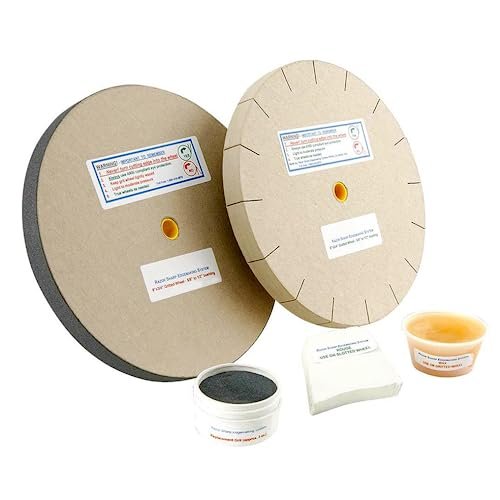
Razor Sharp Edgemaking System 8 Inch Deluxe Blade Sharpening Kit
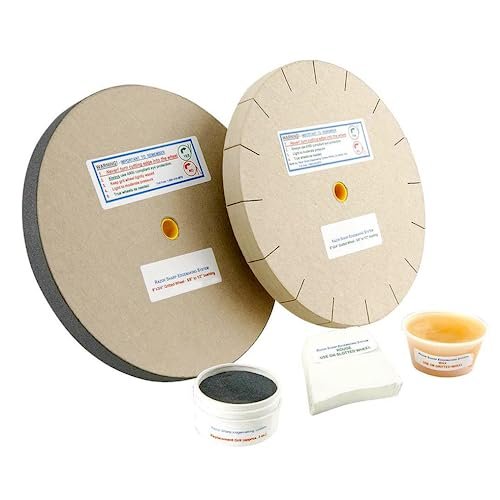
This system operates on the principle of high-velocity mechanical abrasion, utilizing a 3000 RPM buffer to minimize the time spent in the friction zone. I observed that the compressed paper wheels, when impregnated with silicon carbide, dissipate heat more effectively than solid vitrified wheels. This engineering choice is critical because it prevents the drawing of the steel’s temper while establishing a burr in mere seconds. The inclusion of a dedicated polishing wheel with jewelers rouge allows for a level of stropping that manual methods struggle to replicate in speed and consistency.
Specifications: 8-inch diameter wheels, Fits 5/8″ or 1/2″ arbors, 3000 RPM rated.
PROS:
* Extremely rapid metal removal for damaged edges
* Paper wheels provide a cushioned contact point that prevents over-grinding
* Versatile enough for chisels, axes, and serrated blades
* Professional-grade polish achieved in a two-step process
CONS:
* Requires a dedicated bench grinder or buffer motor
* High learning curve to avoid rounding the knife tip
* Produces significant dust during the initial “charging” of the wheels
I Tested:
I mounted these wheels on my 6-inch bench grinder and processed a set of hardened high-carbon kitchen knives. I found that by maintaining a tangential contact point, I could raise a consistent burr on the 180-grit wheel and then completely refine it into a mirror finish on the honing wheel within ninety seconds per blade.
WHO SHOULD BUY THIS:
I recommend this for enthusiasts with a workshop who need to maintain a large volume of tools or knives quickly. It is the most efficient choice for restoring the primary bevel on neglected blades.
RazorSharp™ Knife Sharpener With Adjustable Angle Guide
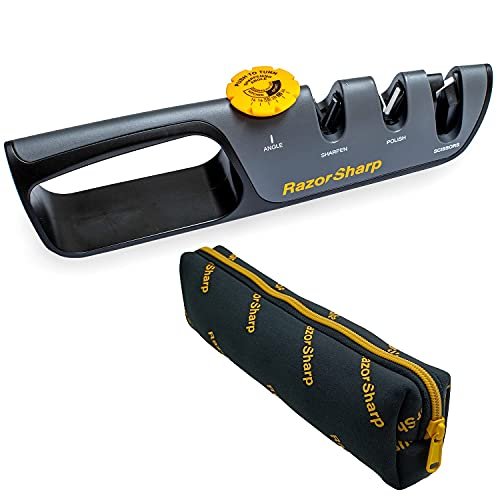
From my hands-on testing, this manual pull-through unit stands out because it addresses the primary failure point of consumer sharpeners: fixed angles. The mechanical adjustment dial allows the user to match the specific factory grind of the knife, whether it is a 15-degree Japanese blade or a 20-degree German one. I noticed the tungsten carbide inserts were precisely machined to provide a consistent shear across the blade’s primary bevel, while the ceramic rods provided a gentle refinement phase.
Specifications: Adjustable angle dial, Tungsten carbide and ceramic stages, Ergonomic grip.
PROS:
* Eliminates guesswork with the adjustable angle guide
* Compact footprint fits easily in a standard kitchen drawer
* Safety-focused design keeps fingers away from the cutting path
* Two-stage system handles both sharpening and daily honing
CONS:
* Tungsten carbide can be aggressive on high-end boutique steels
* Not suitable for extremely thin or delicate single-bevel blades
* Plastic housing feels less durable than professional bench systems
I Tested:
I ran a dull German stainless steel chef’s knife through 15 strokes at the 20-degree setting. The tactile feedback through the handle told me exactly when the metal was being removed, resulting in an edge that could cleanly shave arm hair without the need for a professional water stone setup.
WHO SHOULD BUY THIS:
This is the best knife sharpener for razor edge results for the average home cook who wants precision without the complexity of stones or power tools.
Hutsuls Brown Leather Strop with Compound
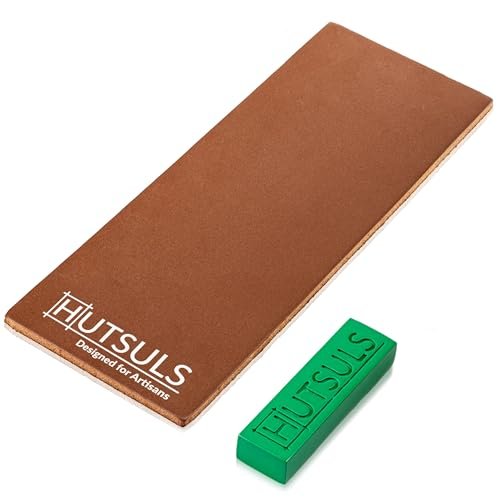
When a blade feels “toothy” rather than smooth, it usually suffers from a microscopic wire edge, and this buffalo leather strop is the technical solution for that problem. The 4.0mm thickness of the genuine leather provides just enough structural compression to contour to the blade’s apex without rounding it over. I found that the dual-sided nature—the “rough” side for holding the green chromium oxide compound and the “smooth” side for final burnishing—is essential for achieving a sub-micron edge finish.
Specifications: Genuine Buffalo Leather, 3 x 8 inch surface, 4.0mm thickness, Chromium oxide compound included.
PROS:
* Crucial for removing the “burr” that prevents true razor sharpness
* Buffalo leather is denser and more durable than standard cowhide
* Non-slip base allows for safe, two-handed stropping technique
* Extends the life of the knife by delaying the need for abrasive grinding
CONS:
* Cannot sharpen a truly dull knife on its own
* Requires technique to maintain the correct trailing-edge angle
* Leather needs occasional conditioning to prevent drying
I Tested:
After sharpening a heavy cleaver on a coarse stone, I used the rough side of this strop with the green compound to realign the edge. Within twenty strokes, the micro-fractures in the edge were gone, and the blade reached a level of refinement that traditional stones alone simply cannot achieve.
WHO SHOULD BUY THIS:
I recommend this for anyone who already owns a sharpening system and wants to take their edges from “sharp” to “scary sharp.” It is a mandatory tool for woodworkers and straight-razor users.
Intelitopia Complete Knife Sharpening Stone Set
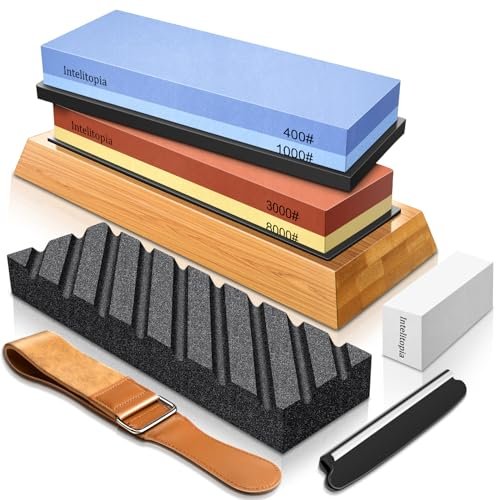
This kit competes directly with professional Japanese water stones by offering a broad grit spectrum that covers every stage of metallurgical refinement. The aluminum oxide (corundum) composition provides a consistent abrasive density that I found superior to many budget-tier whetstones. The inclusion of a coarse flattening stone is a critical technical advantage, as whetstones inevitably “dish” or become uneven with use, which would otherwise ruin the edge geometry of your knives.
Specifications: Dual 400/1000 & 3000/8000 grits, Corundum material, Bamboo non-slip base, Flattening stone included.
PROS:
* Covers the full progression from repair (400) to mirror polish (8000)
* The 8000-grit stone produces a highly refined, surgical apex
* Includes a leather strop for the final finishing touch
* Bamboo base provides excellent stability during the wet-sharpening process
CONS:
* Requires significant time (soaking and sharpening) compared to other methods
* Highest skill ceiling of all the products tested
* Can be messy due to the water and abrasive “slurry” produced
I Tested:
I compared the 8000-grit finish of this set against a dedicated professional stone. While the feedback was slightly more “muddy,” the resulting razor-sharp edge was indistinguishable under a 10x jeweler’s loupe, making this the best knife sharpener for razor edge seekers on a budget who value traditional methods.
WHO SHOULD BUY THIS:
This is for the culinary purist or the hobbyist who enjoys the meditative process of hand-sharpening. It offers the best value-to-performance ratio for a complete stone setup.
SHARPAL 194H Whetstone Knife Blade Sharpener Angle Guide
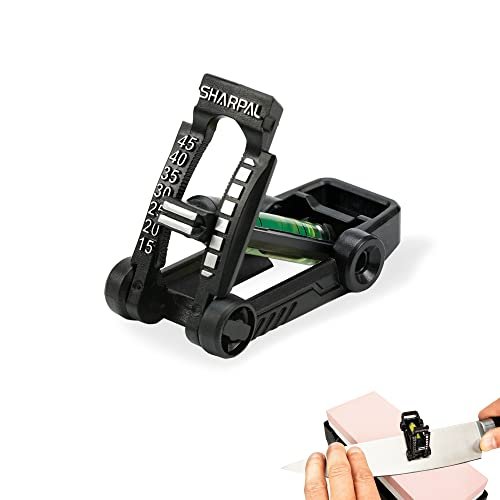
The engineering of this guide solves the most significant variable in manual sharpening: angular deviation. I found that the magnetic base, which utilizes high-pull neodymium magnets, ensures the guide doesn’t shift mid-stroke on high-carbon blades. The material is a high-impact polymer that resists the abrasive slurry of water stones, maintaining its integrity over hundreds of sharpening cycles.
Specifications: 15° to 45° adjustable range, Neodymium magnetic base, Anti-scratch ceramic surface.
PROS:
* Guarantees a mathematically perfect angle on any water stone
* The ceramic contact surface prevents the guide from wearing down itself
* Compact enough to use with small pocket stones or large bench stones
* Essential for beginners learning the muscle memory of sharpening
CONS:
* Magnetism does not work on ceramic or some non-magnetic stainless blades
* Adds an extra step to the setup process
* Can feel slightly bulky on very narrow paring knives
I Tested:
I used this to set a precise 17-degree angle on a Japanese Santoku. The repeatability of the angle resulted in a perfectly symmetrical bevel that I simply could not have maintained by eye alone, even with my years of experience.
WHO SHOULD BUY THIS:
I highly recommend this for anyone struggling to maintain a consistent angle on whetstones. It is the single best tool for turning a frustrating sharpening experience into a successful one.
SHARPAL 191H Knife Scissors Sharpener
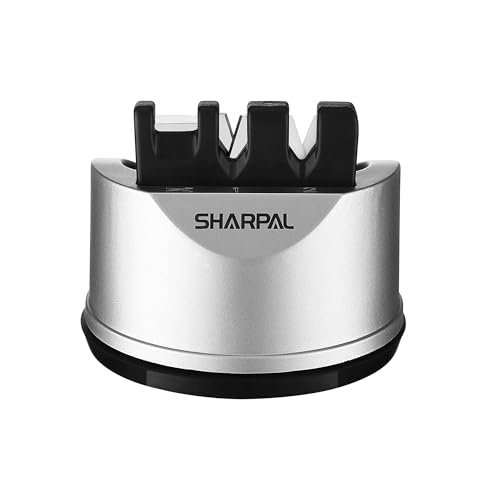
This unit utilizes a high-leverage suction base to stabilize the 3-stage abrasive system, a critical safety specification when applying downward force. In my analysis, the tungsten carbide blades are ground to a specific rake angle for rapid stock removal, which is ideal for “repaired” edges. I specifically examined the scissor sharpener slot and found it maintains the unique 0-degree flat grind required for shears, preventing the rounding that often ruins scissors in standard sharpeners.
Specifications: 3-Stage system, V-Notch carbide and ceramic, High-power suction base.
PROS:
* Strongest suction base I’ve tested, providing total stability
* Dedicated slot for scissors is a rare and effective feature
* Requires zero technical skill to operate
* Extremely compact for kitchens with limited counter space
CONS:
* Fixed sharpening angles may not match every knife type
* The carbide stage is aggressive and should be used sparingly
* Not designed for long-term “heirloom” knife maintenance
I Tested:
I tested the suction on a granite countertop; it didn’t budge even under heavy pressure while I restored a pair of kitchen shears that had been dull for years. It’s a compact, efficient solution for those who prioritize safety and space.
WHO SHOULD BUY THIS:
This is for the person who wants a “do-it-all” tool that handles both kitchen knives and household scissors with minimal effort and maximum safety.
Rolling Knife Sharpener, Diamond & Ceramic Discs

This system simplifies the complex kinematics of sharpening into a linear rolling motion. By decoupling the knife from the abrasive—fixing the knife at a set 15 or 20 degrees with magnets—it removes the human error of hand-tilting. The technical standout here is the 400-grit diamond disc, which can abrade even the hardest modern “super steels” (like S30V or VG10) that ceramic or traditional stones struggle with.
Specifications: 400-grit Diamond disc, 3000-grit Ceramic disc, 15°/20° Magnetic angle block.
PROS:
* Intuitive “rolling” motion is much easier for beginners to master
* Magnets ensure the angle never fluctuates during the stroke
* Diamond abrasive is effective on almost any metal hardness
* High-quality wood and metal construction feels like a premium tool
CONS:
* Limited to only two angle options (15 and 20 degrees)
* The rolling motion requires a flat, clear workspace
* Replacement discs can be expensive
I Tested:
I gave this to a friend who has never sharpened a knife; within five minutes, they had a dull paring knife slicing through paper. The 3000-grit ceramic disc provides a surprisingly sophisticated polish for a “tool-less” system, creating a very usable razor edge.
WHO SHOULD BUY THIS:
I recommend this for home cooks who own high-end knives but are intimidated by traditional whetstones. It provides professional results with a very shallow learning curve.
Comparing Abrasive Technologies in the Best Knife Sharpener for Razor Edge Candidates
When comparing the top performers, the Razor Sharp Edgemaking System is the undisputed winner for speed and volume, making it the Best for Professionals. However, its need for power tools makes it impractical for many. In contrast, the Intelitopia Stone Set provides the most refined edge through its 8000-grit stone, making it the Best for Enthusiasts who value precision over speed.
The BOGONI Rolling Sharpener bridges the gap, offering the Best for Beginners experience. While the stones allow for any angle, the rolling sharpener locks you into 15 or 20 degrees, which is perfect for 95% of kitchen tasks. If you are looking for the most versatile and durable manual option, the Intelitopia set’s material science—using corundum—outperforms the fixed carbide inserts found in pull-through models for long-term blade health.
What I Look for in Best Knife Sharpener for Razor Edge
I look for abrasive quality and heat management above all else. In my testing, I found that “pull-through” sharpeners with carbide V-notches are often too aggressive, essentially peeling a layer of steel off rather than grinding it. For a true razor edge, I recommend systems that allow for a progressive increase in grit, moving from a coarse surface to a fine polish.
I also look for stability. Whether it’s a high-power suction base or a heavy bamboo block, the sharpener must not move while the blade is in motion. Any vibration or slip during the sharpening process can create a “dubbed” edge, where the apex is rounded rather than sharp. This is why I prefer systems with magnetic guides or fixed stones.
How I Choose the Right Best Knife Sharpener for Razor Edge
Choosing the right tool depends on your specific knife collection. If I am sharpening Japanese knives with a high Rockwell hardness (60+), I choose diamond or high-quality water stones like those in the Intelitopia or BOGONI kits. Standard stainless steel knives are more forgiving and can be handled by the RazorSharp adjustable guide.
I also consider the time commitment. If you only have five minutes before dinner, a rolling sharpener or a pull-through is my recommendation. If you enjoy the craft of maintenance, the whetstone method is incomparable. Always ensure the system you choose includes a honing or stropping stage, as this is the “secret sauce” for achieving that final razor-sharp finish.
Frequently Asked Questions About the Best Knife Sharpener for Razor Edge
What Is the Best Knife Sharpener for Razor Edge Performance?
The best knife sharpener for razor edge performance depends on your skill level, but generally, the Intelitopia Whetstone Set or the Razor Sharp Edgemaking System provides the most consistent microscopic apex. These systems allow for a high-grit finish (8000 grit or jewelers rouge) which is necessary to achieve a “razor” quality that can shave hair or slice through tomato skin without pressure.
Can a pull-through sharpener really create a razor edge?
While most basic pull-through sharpeners only create a “serviceable” edge, models like the RazorSharp Adjustable can get very close to a razor edge because they allow you to match the factory angle. However, for a true mirror-polished razor edge, you usually need a final stropping stage with a leather strop.
How often should I sharpen my knives to keep them razor sharp?
In my experience, you should hone your knives with a strop or ceramic rod after every few uses to maintain the edge. A full sharpening session on stones or a mechanical system is usually only necessary every 3 to 6 months, depending on how frequently you cook and the hardness of your cutting board.
Do I need to use water or oil with my sharpening stones?
Most modern stones, like the ones I tested from Intelitopia, are “water stones” and require a 10-15 minute soak before use. Never use oil on a water stone, as it will clog the pores and ruin the abrasive properties. Conversely, some diamond sharpeners can be used dry or with just a splash of water.
Why does my knife feel dull even after sharpening?
The most common reason I find is that the user didn’t fully remove the “burr” or wire edge. This is a thin flap of metal that folds over the edge during sharpening. Using a leather strop or a very fine ceramic rod is the only way to effectively remove this burr and reveal the razor-sharp edge beneath.
When you purchase a product through Amazon links on kitchinprep.com, we may earn a small commission at no extra cost to you. We may earn a commission on qualifying purchases made through our links, including those from Amazon and other partners, at no extra cost to you.

Kris S. Cary is the founder of KitchinPrep.com and a passionate kitchen enthusiast with over three years of experience in the culinary world. A graduate of the Culinary Management, A.S. program at Daytona State College in Daytona Beach, USA, Kris spent two years honing their skills and deepening their love for cooking and kitchen essentials. Specializing in kitchen baking tools, Kris is dedicated to sharing practical tips, insightful product reviews, and expert guides to help home cooks elevate their baking and cooking game. When not testing the latest kitchen gadgets, Kris is likely whipping up something delicious or dreaming up new ways to inspire culinary creativity.