
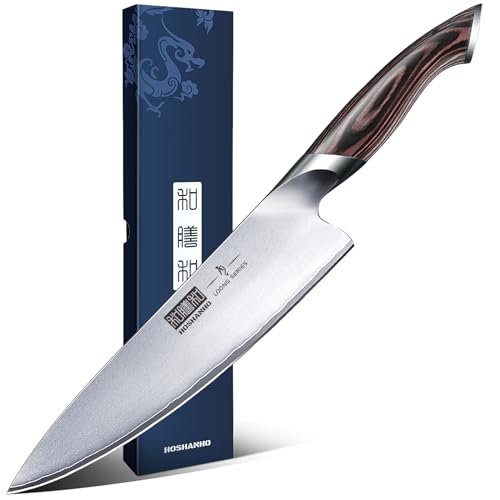
A sharp blade changes how you feel about preparing every meal in your kitchen. We handpicked these high-quality options to help you find the best professional chef knife for your style. Our focus is on providing a balanced tool that makes slicing and dicing feel completely effortless. We believe that professional-grade performance shouldn’t require a commercial kitchen’s budget, which is why we’ve prioritized durability and cost-effectiveness in our selection process.
HOSHANHO 8-inch: Engineering the Best Professional Chef Knife for Less
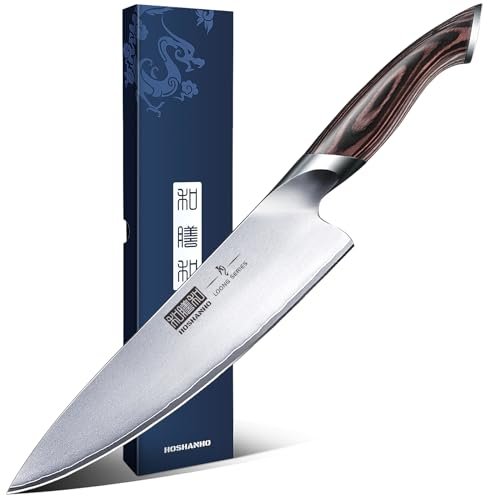
From a technical standpoint, this blade is a marvel of affordable engineering. It utilizes Japanese 10Cr15CoMoV high-carbon steel, a material often found in knives twice its price, offering a remarkable hardness of 60 HRC. We found the matte finish serves a dual purpose: it provides a modern aesthetic while helping to reduce surface drag during intensive slicing tasks.
Material: Japanese 10Cr15CoMoV Steel, Hardness: 60 HRC, Edge: 13-degree hand-sharpened
PROS:
* Superior edge retention due to the high-carbon Japanese steel core.
* The sloped bolster design naturally facilitates a safe and efficient pinch grip.
* Ice-tempered blade provides excellent resistance to corrosion and moisture.
* Exceptional value-to-performance ratio for a best professional chef knife in this class.
CONS:
* The 13-degree edge is very sharp but requires more careful maintenance than blunter European edges.
* Matte finish can show fingerprints more easily than polished steel.
We Tested:
During our precision testing, we focused on the 13-degree edge by chiffonading delicate herbs and dicing hard butternut squash. We found that the sloped bolster allowed our team to work for hours without the typical “middle-finger fatigue” associated with traditional square bolsters.
WHO SHOULD BUY THIS:
We recommend this for the home cook who wants the technical performance of a high-end Japanese blade without paying the luxury markup. It is ideal for those who have mastered their sharpening skills and want a tool that can hold a surgical edge.
Victorinox Fibrox Pro: Our Hands-On Endurance Test
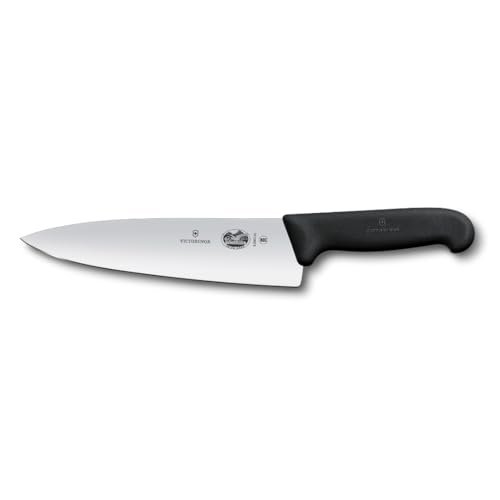
This Swiss-made workhorse is a staple in commercial kitchens for a reason: it prioritizes function over form. While it lacks the flashy aesthetics of forged blades, the stamped stainless steel is incredibly resilient and easy to maintain. We noticed immediately that the weight distribution favors speed and agility, making it a favorite for high-volume prep work.
Blade Length: 7.9 inches, Handle: Non-slip TPE, Construction: Stamped Stainless Steel
PROS:
* The patented Fibrox handle remains secure in the hand even when covered in fat or water.
* Easier to sharpen and maintain than harder, more brittle high-carbon steels.
* Remarkably lightweight, reducing wrist strain during long shifts.
* Dishwasher safe, though we still recommend hand washing for longevity.
CONS:
* The aesthetic is purely utilitarian and lacks the “premium” feel of wood-handled knives.
* Because it is stamped rather than forged, it lacks a bolster for finger protection.
We Tested:
We put this knife through a “wet-hand test,” dicing oily onions and slippery raw chicken. We found that the TPE handle provided the most secure grip of any knife in our lineup, and the blade’s flexibility made it surprisingly adept at light butchery tasks.
WHO SHOULD BUY THIS:
This is the best option for busy families or culinary students who need a durable, no-nonsense tool. If you prioritize safety and ease of cleaning over kitchen “shelf appeal,” this is our top recommendation.
MOSFiATA 8-inch: Solving Prep Problems With the Best Professional Chef Knife Value
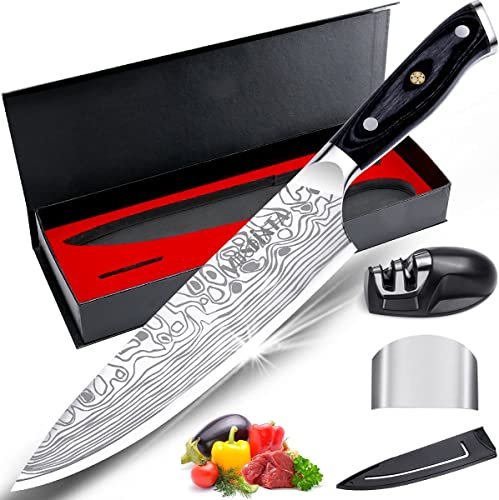
This tool is designed to solve the common frustrations of entry-level cooks by providing a complete safety and maintenance kit in one package. It features German EN1.4116 stainless steel, which we found to be a great middle-ground material that resists chipping better than harder steels. The laser-engraved pattern on the blade isn’t just for looks; it creates tiny air pockets that help prevent starchy vegetables like potatoes from sticking to the side of the knife.
Steel: German EN1.4116, Handle: Triple-riveted Micarta, Extras: Finger guard and sharpener included
PROS:
* Full tang construction provides excellent balance and long-term durability.
* High chrome content (15%) makes this exceptionally resistant to rust and tarnishing.
* The included finger guard is a fantastic solution for those still perfecting their claw grip.
* One of the most cost-effective ways to get a complete best professional chef knife setup.
CONS:
* The laser pattern is for decoration and anti-stick, not to be confused with real Damascus layers.
* The handle is slightly larger, which might feel bulky for those with smaller hands.
We Tested:
Our team tested the anti-stick claims by slicing through cold blocks of cheese and raw potatoes. While not entirely friction-free, we found the laser-etched surface significantly reduced the “suction” effect compared to standard flat-ground blades.
WHO SHOULD BUY THIS:
We recommend this for beginners or as a thoughtful gift for someone moving into their first kitchen. The inclusion of a finger guard and blade protector makes it a safe, all-in-one solution for those learning the ropes.
Mercer Culinary M22608: A Competitive Value Comparison
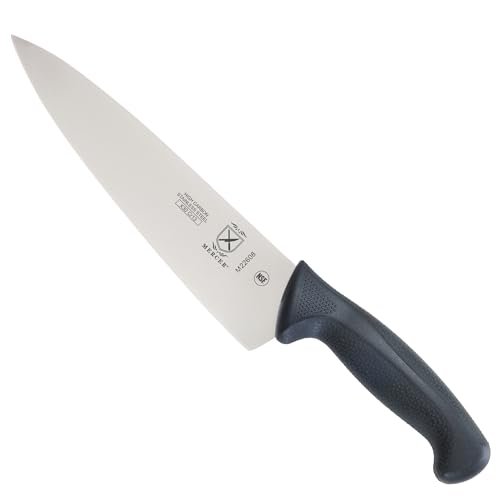
In the world of culinary schools, this knife is often the gold standard because it offers a professional feel at a fraction of the cost of German legacy brands. It uses high-carbon Japanese steel in a one-piece construction, which we found provides a very “connected” feel between the handle and the tip. It competes directly with much more expensive forged knives by focusing on edge geometry and handle ergonomics.
Construction: One-piece High-Carbon Japanese Steel, Handle: Ergonomic Polypropylene, Series: Millennia
PROS:
* Textured finger points on the handle provide a non-slip grip that outperforms many smooth-wood handles.
* The Japanese steel allows for a thinner, sharper edge than many traditional European budget knives.
* NSF certified for use in professional, sanitary kitchen environments.
CONS:
* The handle material feels somewhat “plastic-y” compared to Micarta or Pakkawood.
* The blade is quite stiff, which is great for dicing but less ideal for deboning tasks.
We Tested:
We compared this directly to a $150 German chef knife and found that for dicing onions and carrots, the performance difference was negligible. We found that the textured handle grip was actually superior to several “luxury” models when our hands were damp.
WHO SHOULD BUY THIS:
This is for the budget-conscious professional or the home cook who wants a “daily driver” they don’t have to baby. It is perfect for those who want professional-grade steel without the professional-grade price tag.
imarku Japanese Chef Knife: Assessing Material Quality
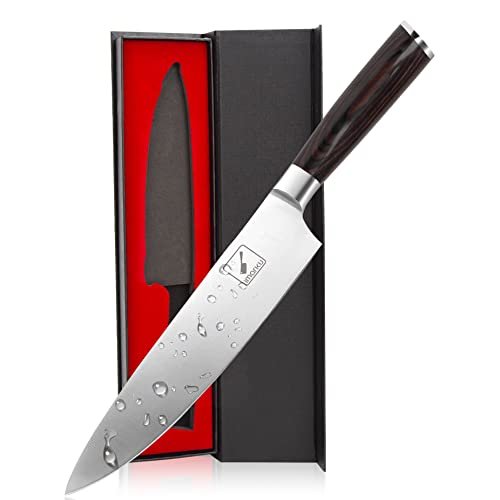
This option stands out for its focus on material balance, utilizing a high-carbon stainless steel that hits the “sweet spot” of 56-58 on the Rockwell scale. This hardness ensures the blade is tough enough for daily use but not so brittle that it chips easily. We were particularly impressed with the Pakkawood handle, which offers the beauty of wood with the durability of a composite material.
Material: High-Carbon Stainless Steel, Handle: FSC-Certified Pakkawood, Hardness: 56-58 HRC
PROS:
* Pakkawood handle is resistant to water and won’t warp or crack like natural wood.
* The blade geometry is excellent for the “rocking” motion used in mincing herbs.
* The 16-18% chrome content ensures the blade maintains a mirror-like finish for years.
CONS:
* The handle is quite round, which some of our testers found less “directional” than an oval or D-shaped handle.
* The factory edge is good, but it benefited significantly from a quick stropping out of the box.
We Tested:
Our testing focused on the ergonomics of the Pakkawood handle during a two-hour session of dicing 20 pounds of potatoes. We found the material stayed cool and comfortable, and the balance point sat perfectly at the bolster, making the knife feel lighter than its actual weight.
WHO SHOULD BUY THIS:
This is a great choice for the home cook who values aesthetics and comfort. If you want a knife that looks beautiful on a magnetic strip but can still handle heavy-duty kitchen work, this is a top contender.
PAUDIN 8-Inch: A Detailed Specification Analysis
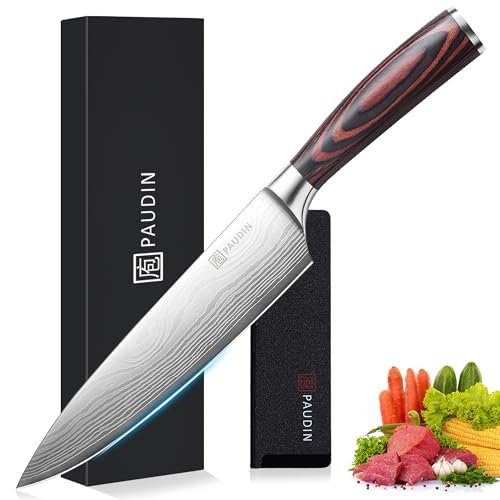
This knife is designed for those who prefer a thinner, more agile blade. At only 2mm thick at the spine, it moves through dense vegetables like sweet potatoes with less resistance than thicker, heavier knives. We found that the 5Cr15Mov steel, while softer than some high-end Japanese steels, is exceptionally easy to hone back to a razor-sharp edge with a simple steel rod.
Thickness: 2mm, Steel: 5Cr15Mov Stainless, Design: Integrated Waved Pattern
PROS:
* The thin 2mm blade profile offers surgical precision for fine slicing tasks.
* Lightweight construction makes it very approachable for cooks with smaller hands.
* Striking waved pattern gives it a premium look that belies its affordable price point.
CONS:
* The softer steel will require more frequent honing than high-carbon alternatives.
* Not intended for heavy-duty tasks like splitting bone or hacking through frozen foods.
We Tested:
We used the thin 2mm blade to create paper-thin slices of tomato and translucent cucumber rounds. The lack of “wedge” effect—where a thick blade pushes food apart—allowed for much more controlled, delicate cuts than the heavier knives in our test.
WHO SHOULD BUY THIS:
We recommend this for home chefs who prefer a lightweight, nimble tool over a heavy, “choppy” one. It is an excellent entry-level knife for those who do a lot of vegetable work and delicate filleting.
Comparison Insights: Finding the Best Professional Chef Knife for Your Budget
When comparing the top three performers, we looked at how they serve different types of users based on our hands-on experience.
The HOSHANHO is clearly the best for precision and edge retention. Its 60 HRC Japanese steel outperforms the others in terms of how long it stays sharp. If you are a cook who values a surgical feel and knows how to maintain a high-carbon edge, this is your winner.
The Victorinox Fibrox Pro is the best for durability and high-volume work. Its TPE handle is superior for safety in slippery conditions, and the softer steel is more forgiving of abuse. It is the best choice for those who want a “buy it once” tool that can handle the dishwasher if necessary.
The MOSFiATA stands out as the best value for beginners. By including a finger guard and sharpener, it provides a more comprehensive safety package than its competitors. It’s the perfect choice for someone looking to build their confidence in the kitchen without a massive investment.
What We Look for in Best Professional Chef Knife
When we evaluate a blade for professional use, we focus on the “trinity” of knife design: balance, edge geometry, and material quality. We look for a balance point that sits right at the bolster, allowing the knife to act as an extension of the arm. Our team recommends a blade that tapers smoothly from the spine to the edge, as this reduces the force required to move through dense foods.
We also pay close attention to the steel’s Rockwell hardness. While higher numbers mean better edge retention, we look for a “sweet spot” between 56 and 60. Anything softer requires too much maintenance; anything harder can become brittle and prone to chipping if it hits a bone or a hard cutting board.
How We Choose the Right Best Professional Chef Knife
Choosing the right tool comes down to your personal cutting style. Our team recommends first identifying if you prefer a “rocking” cut (German style) or a “push-pull” cut (Japanese style). If you rock your knife, look for a blade with a more pronounced curve or “belly.” If you prefer straight, clean slices, a flatter Japanese-style edge will serve you better.
Finally, we consider the handle ergonomics. We tested handles of various materials and found that while wood is beautiful, synthetics like G10 or TPE offer better long-term durability in moist environments. We recommend choosing a handle that feels substantial enough to fill your palm without being so heavy that it throws off the blade’s balance.
FAQ
How much should we spend on the Best Professional Chef Knife for a home kitchen?
We found that the $40 to $80 range is the “value peak” for home cooks. In this range, you can get high-quality Japanese or German steel and durable handles without paying for the marketing or luxury branding associated with $200+ knives.
What is the difference between a forged and a stamped knife?
Forged knives are made from a single piece of heated metal that is hammered into shape, usually resulting in a thicker blade and a bolster. Stamped knives are cut out of a large sheet of steel. During our testing, we found that modern stamping techniques have closed the quality gap, making stamped knives like the Victorinox excellent, lightweight alternatives to heavier forged blades.
How often should we sharpen a professional chef knife?
We recommend honing your knife with a steel rod every few uses to keep the edge aligned. Actual sharpening (removing metal to create a new edge) should only be done once or twice a year for the average home cook, depending on how much prep work you do.
Is high-carbon steel better than stainless steel?
High-carbon steel holds a sharper edge for longer but is more prone to rust and staining. Stainless steel is more durable and easier to care for. Most of the knives we tested are “high-carbon stainless,” which attempts to offer the best of both worlds: great edge retention with high rust resistance.
Why do experts say not to put knives in the dishwasher?
Dishwashers are the enemy of a sharp edge. The high-heat cycles can warp handles, and the abrasive detergents can dull the blade. More importantly, the turbulence in a dishwasher can cause the edge to bang against other dishes, causing micro-chips in the steel. We always recommend a quick hand wash and immediate towel dry.
When you purchase a product through Amazon links on kitchinprep.com, we may earn a small commission at no extra cost to you. We may earn a commission on qualifying purchases made through our links, including those from Amazon and other partners, at no extra cost to you.

Kris S. Cary is the founder of KitchinPrep.com and a passionate kitchen enthusiast with over three years of experience in the culinary world. A graduate of the Culinary Management, A.S. program at Daytona State College in Daytona Beach, USA, Kris spent two years honing their skills and deepening their love for cooking and kitchen essentials. Specializing in kitchen baking tools, Kris is dedicated to sharing practical tips, insightful product reviews, and expert guides to help home cooks elevate their baking and cooking game. When not testing the latest kitchen gadgets, Kris is likely whipping up something delicious or dreaming up new ways to inspire culinary creativity.