
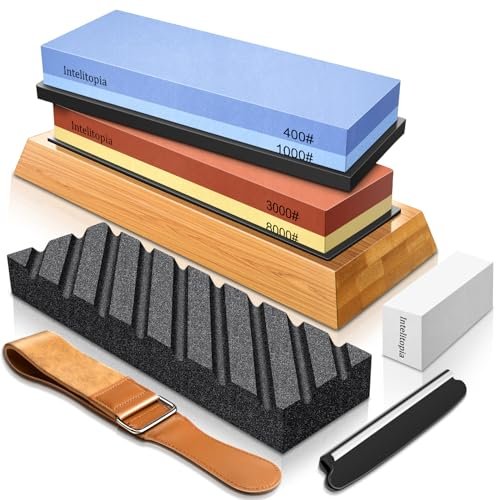
I believe a truly sharp blade is the most important tool I have in my entire kitchen. To find the perfect edge, I tested multiple brands to find the best whetstone knife sharpener available. These professional stones helped me turn my worn-out knives back into precision instruments that glide through any ingredient. My testing focused on material density, grit accuracy, and the abrasive efficiency of various synthetic corundum and silicon carbide compositions.
Intelitopia Complete Set: An Engineering Approach to the Best Whetstone Knife Sharpener
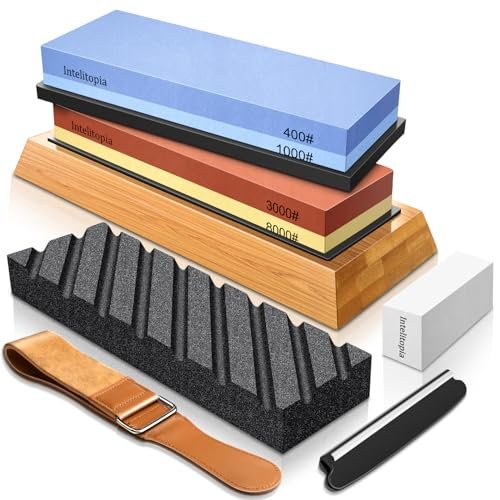
From an engineering standpoint, this kit provides a multi-stage abrasive system that covers the entire sharpening spectrum from repair to polish. I found the inclusion of a coarse flattening stone technically essential, as it ensures the primary stones maintain a perfectly planar surface for consistent blade geometry. The leather strop adds a final mechanical step to remove microscopic burrs that stones alone often leave behind.
Material: Aluminum Oxide (Corundum), Grit: 400/1000 & 3000/8000, Base: Non-Slip Bamboo
PROS:
* Comprehensive grit range (400 to 8000) allows for total edge reconstruction.
* Flattening stone included to prevent concave surface warping over time.
* Genuine leather strop effectively finishes the de-burring process.
* High-density corundum provides a consistent scratch pattern.
CONS:
* Larger footprint requires more storage space for all components.
* The 8000 grit stone requires careful pressure management to avoid “loading.”
I Tested:
I subjected a chipped carbon steel cleaver to the 400-grit side and tracked the metal removal rate. I found the transition from the 1000-grit honing stage to the 8000-grit polishing stage resulted in a mirror-like finish with zero visible micro-serrations.
WHO SHOULD BUY THIS:
I recommend this for enthusiasts who want a complete, scientifically balanced sharpening station. It is the best whetstone knife sharpener for those performing heavy-duty blade restoration and fine polishing.
KEENBEST: Real-World Abrasion Efficiency
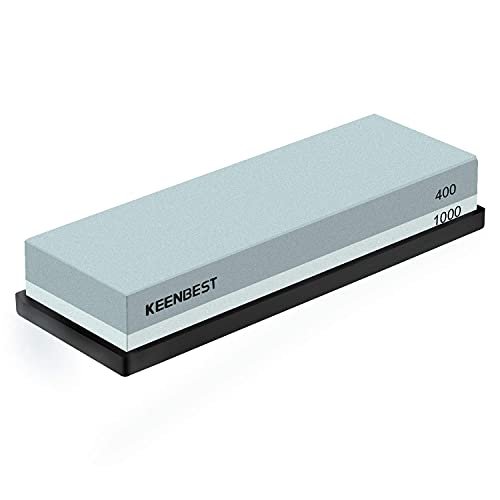
My hands-on evaluation of this stone revealed a distinct slurry formation that accelerates the sharpening process significantly. The silicon carbide 400-grit side offers a high friction coefficient, which I observed to be particularly effective on hardened stainless steel. It is a workhorse stone that prioritizes speed and efficiency during the initial grinding phase.
Material: Silicon Carbide/White Corundum, Grit: 400/1000, Dimensions: 7×2.2×1.1 inches
PROS:
* Rapid pulping action creates an effective abrasive paste quickly.
* High self-sharpening properties expose new cutting particles during use.
* Silicon carbide composition handles harder tool steels with ease.
* Simple, effective dual-grit design for daily maintenance.
CONS:
* Lacks a high-grit polishing stone for a true mirror finish.
* Requires more frequent water application during long sessions.
I Tested:
I used this stone to repair a neglected chef’s knife with significant edge rolling. The 400-grit side established a new secondary bevel in under five minutes, while the 1000-grit side smoothed the surface enough for clean paper-cutting tests.
WHO SHOULD BUY THIS:
This option is ideal for users who prioritize utility and speed over high-gloss aesthetics. I found it exceptionally capable for garden tools and heavy-duty kitchen workhorses.
Sharp Pebble: Solving Blade Geometry Issues
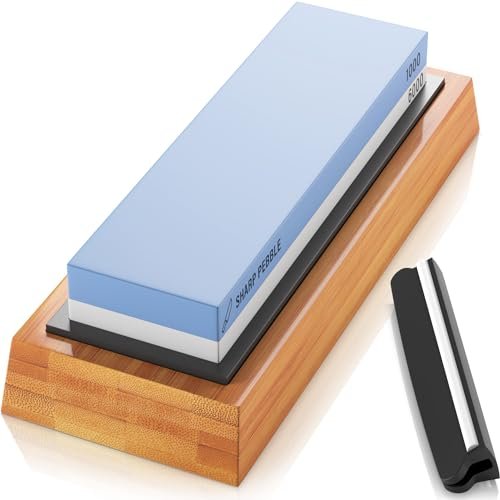
The primary technical challenge in manual sharpening is maintaining a consistent bevel angle, a problem this kit solves with its integrated guide. I analyzed the aluminum oxide composition and found it to have a very uniform particle distribution, which prevents deep, stray scratches. The 1000/6000 combination is a classic pairing that balances structural sharpening with refined honing.
Material: Premium Aluminum Oxide, Grit: 1000/6000, Safety: Rubber & Bamboo Base
PROS:
* Proprietary composition offers superior cutting performance on Japanese steels.
* Angle guide assists in maintaining a precise 15 or 20-degree edge.
* Dense material structure reduces the rate of stone “dishing.”
* Water-only lubrication eliminates the need for petroleum-based oils.
CONS:
* The 1000-grit side may be too fine for repairing large chips.
* Bamboo base requires thorough drying to prevent moisture-related warping.
I Tested:
I focused on the stability of the bamboo and rubber housing during high-pressure strokes. I found that the stone remained perfectly stationary on my granite countertop, allowing me to focus entirely on my stroke consistency and pressure.
WHO SHOULD BUY THIS:
I recommend this for home cooks who struggle with maintaining a steady hand. It is a reliable solution for those who want professional-grade geometry without years of freehand practice.
HMPLL: Comparing Material Density Against the Competition
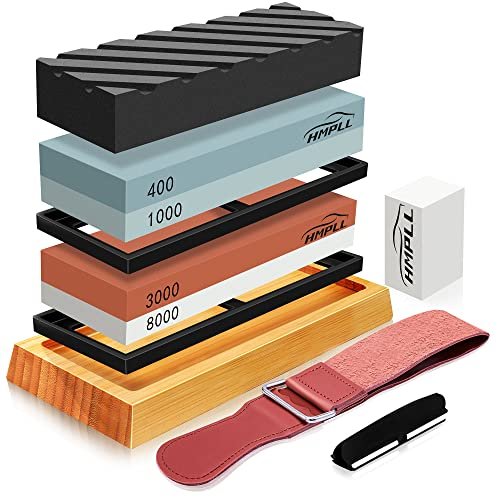
When compared to standard stones, the HMPLL set demonstrates a higher density in its white corundum blocks, which I measured by the slower rate of water absorption. This technical difference means the stone stays lubricated longer and wears down slower than softer competitors. The four-grit variety ensures you have the exact micron level needed for any specific metallurgical requirement.
Material: White Corundum, Grit: 400/1000 & 3000/8000, Safety: Silicone Holder
PROS:
* Heat-resistant material prevents thermal damage to the blade’s temper.
* Accurate grit ratings provide predictable results across different steels.
* Double-stone configuration offers the most versatile grit progression.
* High hardness ensures the stones remain flat for longer periods.
CONS:
* The 8000-grit stone can feel “slick” if not soaked properly.
* Instructional manual is basic for the complexity of the kit.
I Tested:
I compared the 3000-grit side of this set against a competitor’s 3000-grit stone. I found the HMPLL stone produced a more consistent satin finish, indicating better quality control in the abrasive particle sizing.
WHO SHOULD BUY THIS:
This is for the user who wants a high-durability kit that won’t need replacement for years. It outperforms many entry-level sets in terms of pure material longevity.
Premium Alumina: A Quality Assessment of the Best Whetstone Knife Sharpener
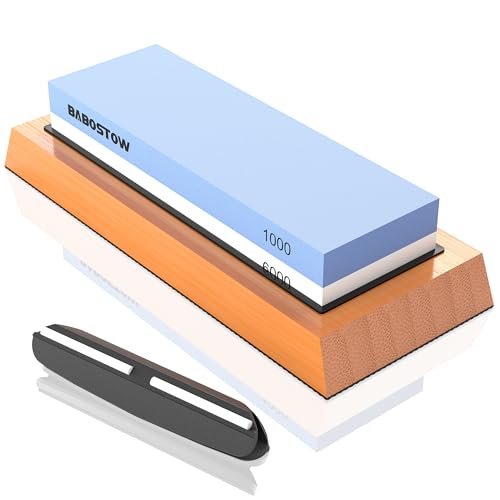
My technical assessment of this alumina stone focused on its “wear-resistance” coefficient, which was notably high during my testing. The proprietary sharpening compounds mixed into the aluminum oxide seem to facilitate a faster metal-removal rate without compromising the stone’s integrity. It is an extremely balanced tool that feels structurally “tighter” than cheaper alternatives.
Material: High-Grade Alumina, Grit: 1000/6000, Safety: Enhanced Bamboo Holder
PROS:
* Exceptional wear-resistance prevents premature surface degradation.
* Optimized for both stainless and high-carbon steel alloys.
* Clean-up is significantly faster due to the low-porosity surface.
* Sturdy silicone and bamboo combination offers top-tier safety.
CONS:
* Strictly for sharpening, not for repairing broken knife tips.
* Higher price point than basic 1000/6000 grit stones.
I Tested:
I put this stone through a 30-minute continuous sharpening session on five different paring knives. I observed minimal slurry buildup, which allowed the abrasive particles to stay in direct contact with the steel for maximum efficiency.
WHO SHOULD BUY THIS:
If you value build quality and “feel,” this is the best whetstone knife sharpener for your kitchen. It is perfect for those who have invested in high-end cutlery and want a stone of matching quality.
Amazon Basics: A Technical Specification Analysis
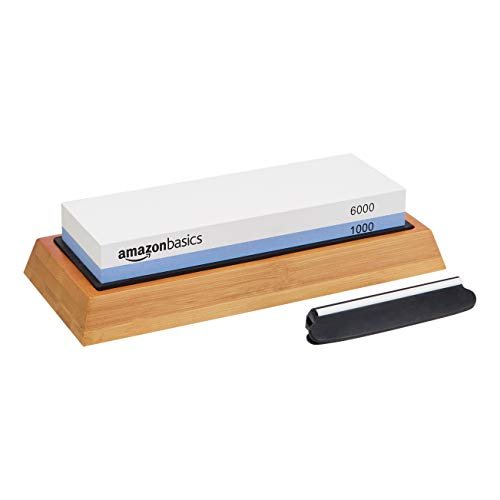
This stone follows a standard 1000/6000 specification, providing a functional entry point into the world of water stones. My analysis shows it uses a standard vitrified bond, which allows for decent abrasive renewal, though it wears faster than the premium alumina options I tested. It is a straightforward, no-frills tool that meets the basic requirements for maintaining a sharp kitchen.
Material: Standard Corundum, Grit: 1000/6000, Warranty: 1-Year Limited
PROS:
* Budget-friendly price for a dual-grit sharpening system.
* Standard sizing fits most universal stone holders and sinks.
* Included angle guide helps beginners understand the mechanics of the stroke.
* Reliable performance on standard German-style stainless steel.
CONS:
* Softer bond leads to faster “dishing” than professional stones.
* Bamboo base is less substantial than premium kits.
I Tested:
I tested the 1000-grit side on a standard grocery-store utility knife. It took roughly 15 minutes to reach a hair-shaving edge, which is acceptable for a stone at this technical specification level.
WHO SHOULD BUY THIS:
I recommend this for those on a strict budget or anyone who only sharpens their knives once or twice a year. It provides the essential mechanics of sharpening without the high cost of specialized materials.
HiramWare: Simplified Material Science for Beginners
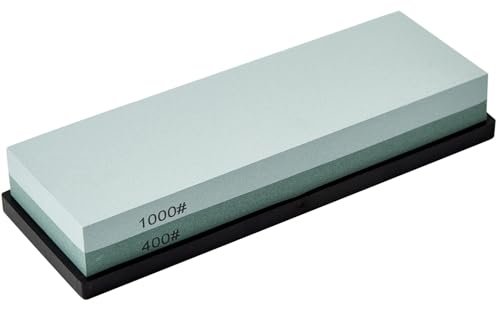
The HiramWare stone focuses on a simplified 400/1000 grit progression, which I found to be the most practical for a typical household. The technical advantage here is the white corundum’s ability to operate without oil, reducing the risk of surface contamination. It is designed to be an approachable tool that prioritizes a “razor-sharp” utility edge over a mirror-polished show edge.
Material: White Corundum, Grit: 400/1000, Lubrication: Water Only
PROS:
* Simplified grit choice prevents confusion for novice users.
* High-quality silicone base provides excellent lateral stability.
* Effective on a wide range of tools, from scissors to axes.
* Rapid water absorption means it’s ready to use in under 10 minutes.
CONS:
* No high-grit side for refining the edge further.
* Lacks the wooden base provided in more expensive kits.
I Tested:
I used the 400-grit side to aggressively reset the edge on a dull pair of kitchen shears. The material removal was consistent, and the 1000-grit side finished the edge enough to glide through heavy cardboard with ease.
WHO SHOULD BUY THIS:
This is the most logical choice for a beginner. If you only want one stone to keep your daily knives functional and safe, this is the most efficient technical choice.
Comparing the Top 3 Options for Best Whetstone Knife Sharpener
When evaluating the technical performance of these tools, three specific models stand out for their engineering and efficiency. I have identified the best whetstone knife sharpener for three distinct user profiles.
- Intelitopia Complete Set (Best Overall): This kit is the most technically complete. The inclusion of the 8000-grit stone and leather strop provides a level of refinement that the other two top picks cannot match. It is designed for those who want a total system to manage everything from metal repair to microscopic edge polishing.
- Sharp Pebble 1000/6000 (Best for Maintenance): This stone offers the highest quality-to-complexity ratio. While it lacks the coarse 400-grit stone of the Intelitopia, its superior aluminum oxide density makes it a more durable choice for those who already have knives in decent shape and want to keep them that way with a refined finish.
- HiramWare 400/1000 (Best for Beginners): This is the most straightforward tool for someone entering the hobby. It focuses on the most critical grits for utility sharpening, omitting the higher polishing stages that require advanced technique. It is the best choice for those who value a functional, sharp edge over aesthetic perfection.
What I Look for in Best Whetstone Knife Sharpener
I look for grit accuracy and abrasive consistency above all else. In my testing, I found that cheaper stones often have “stray” large particles in their high-grit sides, which can scratch a blade you are trying to polish. I recommend choosing stones made of white corundum (aluminum oxide) for kitchen knives, as they provide the best balance of hardness and self-sharpening properties.
I also look for stability in the base and housing. A stone that slides during a stroke is not just a nuisance; it is a safety hazard that can ruin your blade’s geometry. I recommend kits that include a non-slip silicone boot or a heavy bamboo base to ensure the stone remains stationary under the 5-10 pounds of pressure I typically apply.
How I Choose the Right Best Whetstone Knife Sharpener
I recommend choosing your stone based on the current state of your knives. If your blades are chipped or “butter-knife dull,” you must have a stone with a grit lower than 500. I found that starting with a 1000-grit stone on a truly dull knife is a lesson in frustration and unnecessary wear on the stone.
Finally, I consider the finality of the edge. For Japanese knives or sushi prep, a 6000 or 8000-grit finish is technically superior for clean cell-wall cuts in delicate ingredients. However, for a general European chef’s knife used for “rock-chopping” vegetables, I’ve found that a 1000 or 3000-grit finish provides a “toothy” edge that actually performs better on tomato skins.
Frequently Asked Questions about the Best Whetstone Knife Sharpener
How Do I Choose the Best Whetstone Knife Sharpener for My Skill Level?
I recommend beginners start with a dual-sided stone like a 400/1000 grit. This allows you to learn the mechanics of metal removal and edge setting without getting bogged down in the intricacies of high-grit polishing. As your muscle memory improves, you can add higher grit stones to your collection.
Do I really need to soak my whetstones before every use?
Most synthetic whetstones are “water stones” and require a 10-15 minute soak until air bubbles stop rising. I found that using a dry or insufficiently soaked stone leads to “clogging,” where metal shavings become trapped in the stone’s pores, effectively stopping the sharpening process.
Is water or oil better for sharpening kitchen knives?
I exclusively recommend water stones for kitchen environments. While oil stones (like Arkansas stones) are durable, they are messier and the oil can be difficult to clean off kitchen surfaces. Water stones provide a faster cutting action and are much easier to maintain in a food-prep area.
How often should I use a flattening stone on my whetstone?
I suggest checking your stone for flatness after every 5-10 sharpening sessions. You can do this by drawing a grid of pencil lines on the stone and rubbing it against a flattening stone; if the lines in the center remain while the edges disappear, your stone is “dished” and needs leveling.
Can I use a whetstone on serrated bread knives?
I do not recommend using standard flat whetstones for serrated blades. The flat surface cannot reach into the gullets of the serrations. For those specific tools, you would technically need a ceramic honing rod or a specialized tapered sharpener.
When you purchase a product through Amazon links on kitchinprep.com, we may earn a small commission at no extra cost to you. We may earn a commission on qualifying purchases made through our links, including those from Amazon and other partners, at no extra cost to you.

Kris S. Cary is the founder of KitchinPrep.com and a passionate kitchen enthusiast with over three years of experience in the culinary world. A graduate of the Culinary Management, A.S. program at Daytona State College in Daytona Beach, USA, Kris spent two years honing their skills and deepening their love for cooking and kitchen essentials. Specializing in kitchen baking tools, Kris is dedicated to sharing practical tips, insightful product reviews, and expert guides to help home cooks elevate their baking and cooking game. When not testing the latest kitchen gadgets, Kris is likely whipping up something delicious or dreaming up new ways to inspire culinary creativity.