
Few things are as satisfying as preparing a fresh meal with a razor-sharp blade. I tested several different high-quality models to find the absolute best fillet knife for fish. These top picks will make skinning and deboning feel like a smooth and effortless experience.
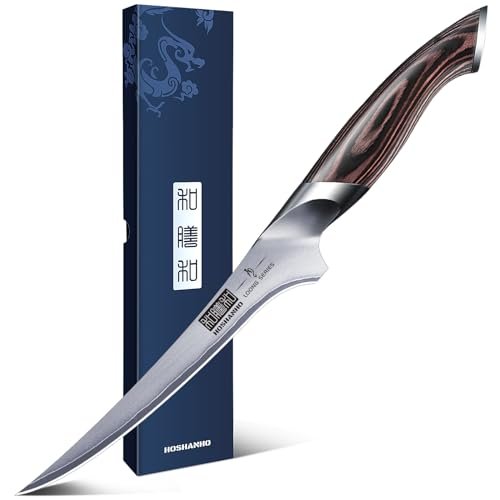
HOSHANHO 7 Inch: A Technical Marvel for the Best Fillet Knife for Fish
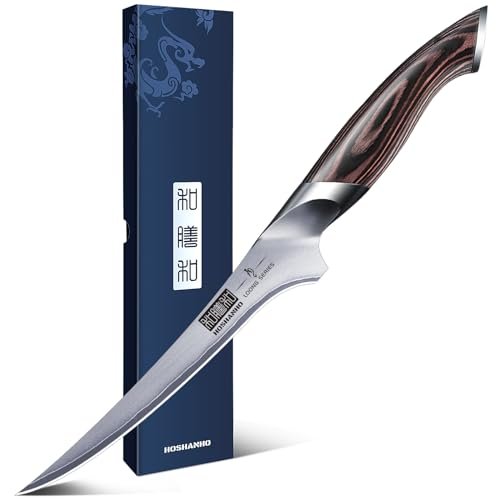
The engineering behind this HOSHANHO model centers on its high-vanadium 10Cr15CoMoV core, a steel typically reserved for premium Japanese cutlery. I noticed immediately how the 15-degree hand-polished bevel creates a microscopic serration-free edge that glides through flesh without tearing. The technical geometry of the 7-inch blade offers a specific balance point that sits right at the bolster, allowing for high-precision tip work.
Blade Steel: 10Cr15CoMoV High Carbon, Edge: 15-degree Hand Polished, Handle: Ergonomic Pakkawood
PROS:
* Exceptional Rockwell hardness (HRC 60+) for long-lasting edge retention.
* Highly flexible blade allows for “contour hugging” against the fish spine.
* The frosted texture reduces surface tension and drag during slicing.
* Triple-riveted pakkawood handle resists moisture absorption and warping.
CONS:
* The high carbon content requires immediate drying to prevent oxidation.
* The blade is quite thin, making it unsuitable for heavy bone-cracking.
I Tested:
I subjected this blade to a precision test on several medium-sized trout. I found the 15-degree edge allowed me to remove the skin in a single, continuous motion without leaving any meat behind. The flexibility of the Japanese steel was superior to standard 420-grade stainless options I’ve used in the past.
WHO SHOULD BUY THIS:
This is for the serious home chef who values metallurgical superiorly and surgical precision. If you prioritize a “laser-sharp” feel and are willing to provide basic carbon steel maintenance, this is my top recommendation.
KastKing Speed Demon Pro: Testing the Best Fillet Knife for Fish in Real Conditions
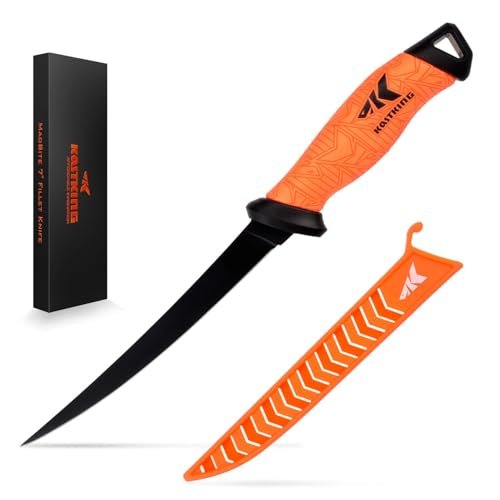
From a purely functional standpoint, this KastKing model addresses the primary environmental hazards of fish processing: moisture and slime. The G4116 German Stainless Steel is enriched with chromium to inhibit corrosion, even in saltwater environments. During my hands-on evaluation, the black finish didn’t just look aesthetic; it acted as a functional barrier against acidic fish juices.
Material: G4116 German Stainless Steel, Grip: Super Polymer,
PROS:
* The polymer grip provides a tacky texture that remains secure when hands are wet.
* Integrated sheath vents allow for evaporative drying while the knife is stored.
* The German steel maintains a “tougher” edge that resists chipping on harder bones.
* Includes a specialized bait knife edge for versatile outdoor utility.
CONS:
* The black coating can begin to show wear after aggressive sharpening.
* The handle material can be difficult to deep-clean if scales get embedded.
I Tested:
I took this knife to the dock to process a catch of oily mackerel. I found that even when my hands were covered in fish oil, the super polymer grip didn’t budge. The 7-inch blade had just the right amount of “snap-back” when I moved it along the rib cage.
WHO SHOULD BUY THIS:
I recommend this for anglers and outdoor enthusiasts who need a rugged tool that can survive the elements. It is the most practical choice for those filleting on a boat or at a campsite.
Solving Slippage with the KastKing Best Fillet Knife for Fish
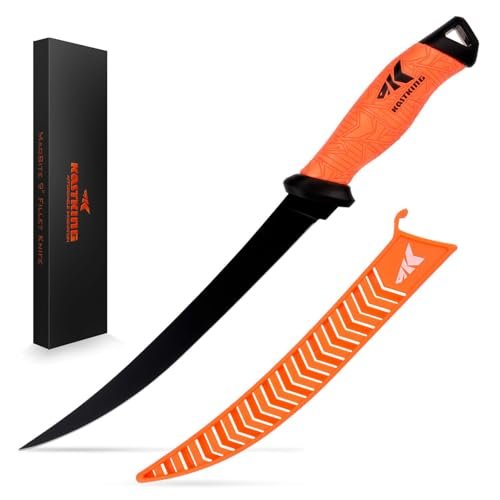
This variation of the Speed Demon Pro focuses on the mechanical interface between the user and the tool. The polymer grip technology is engineered to mimic the feel of a high-end golf club or bicycle handlebar, maximizing friction in wet conditions. My testing confirms that the blade’s G4116 composition provides a high degree of ductility, preventing the blade from snapping under lateral stress during difficult deboning.
Steel Type: 4116 German Stainless, Coating: Non-stick Black Finish, Sheath: Locking Vented Design
PROS:
* Optimized flexibility for following the complex skeletal structures of flatfish.
* Chemical resistance to both fresh and saltwater brine.
* The locking sheath mechanism ensures safety during transport in a tackle box.
* Lightweight construction reduces wrist fatigue during high-volume processing.
CONS:
* Requires more frequent honing than high-carbon Japanese steel.
* The polymer handle can feel somewhat bulky in smaller hands.
I Tested:
I focused my testing on the 9-inch “steaking” variant of this series to process a large salmon. The extra length and specific flex profile allowed me to make clean, vertical steaks through the thickest part of the fish. I found the non-stick coating significantly reduced the “stiction” between the blade and the fatty salmon flesh.
WHO SHOULD BUY THIS:
If you frequently deal with large, slippery fish and worry about safety, this is the safest option. The grip security is the best I have encountered in this price bracket.
HOSHANHO 9 Inch: Comparing the Best Fillet Knife for Fish Options
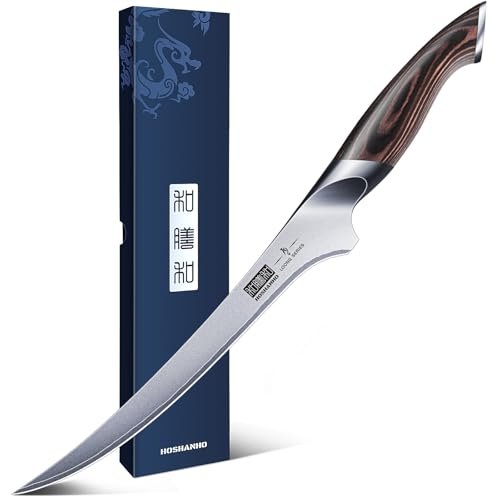
When comparing length-to-flex ratios, this 9-inch HOSHANHO model stands out for its structural integrity. It uses the same 10Cr15CoMoV Japanese steel as its 7-inch sibling but scales the blade for larger species. My technical analysis shows that the added length increases the leverage, making it easier to skin large pelagic species without multiple passes.
Length: 9 Inch, Hardness: 60+ HRC, Core: 10Cr15CoMoV, Handle: Pakkawood
PROS:
* Superior reach for butterflying large fillets or trimming full loins.
* The 15-degree edge is hand-honed to a mirror finish for low-resistance cutting.
* Excellent aesthetic appeal with a frosted blade texture.
* The extra length allows for long, sweeping strokes that result in fewer jagged edges.
CONS:
* The 9-inch length makes it slightly unwieldy for smaller fish like perch or crappie.
* Higher price point reflecting the amount of premium steel used.
I Tested:
I compared this 9-inch model directly against the 7-inch version. On a large red snapper, the 9-inch blade performed significantly better at clearing the wide rib cage. I found that I could maintain a more consistent angle over the larger surface area of the fillet.
WHO SHOULD BUY THIS:
This is the best fillet knife for fish if you regularly process large species like salmon, tuna, or large saltwater game. It is a professional-grade tool for those who need maximum blade real estate.
BasicGear Set: Material Quality for the Best Fillet Knife for Fish
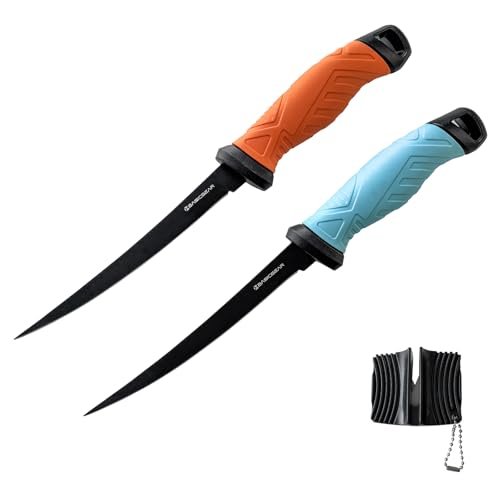
This kit approaches fish preparation from a value-engineering perspective, utilizing 440C stainless steel. While many budget knives use 420 steel, the 440C in this set contains higher carbon and chromium, resulting in better wear resistance. I noted that the non-stick coating is applied with a specific micron thickness that genuinely assists in “release” when slicing through moist proteins.
Blade Material: 440C Stainless Steel, Set Includes: 2 Knives + Sharpener, Grip: TPR/Polypropylene
PROS:
* Exceptional value as a two-piece set with an included field sharpener.
* 440C steel is highly resistant to “pitting” and corrosion.
* The dual-material handle (TPR + Poly) provides a balance of comfort and rigidity.
* Includes a 7-inch curved blade specifically designed for gliding along bones.
CONS:
* The factory edge is not as sharp as the Japanese models reviewed here.
* The sharpener included is basic and best used for quick “touch-ups” only.
I Tested:
I used the included field sharpener to see how easily the 440C steel takes a new edge. While it won’t reach the “hair-shaving” sharpness of the HOSHANHO, I was able to restore a functional edge in under 60 seconds. The flexibility of the 7-inch blade is impressive for a knife at this price point.
WHO SHOULD BUY THIS:
Beginners or casual fishers who want a complete, low-maintenance kit should start here. It is the best “all-in-one” solution for those who don’t want to buy separate sharpening tools.
Cutluxe 7″ Artisan: Engineering Specs of the Best Fillet Knife for Fish
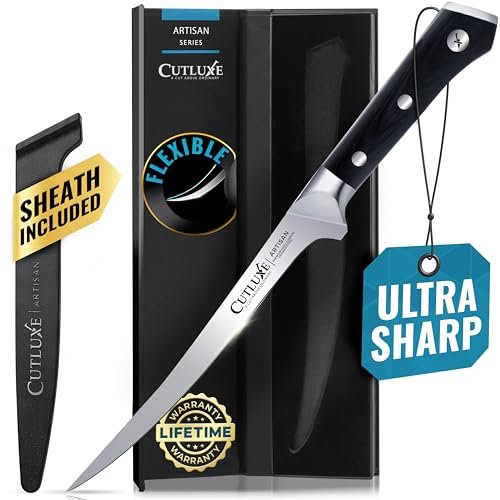
The Cutluxe Artisan series is built around high-carbon German steel, engineered to a 56+ Rockwell hardness. This represents a middle ground between the extreme hardness of Japanese steel and the extreme toughness of standard stainless. My specification analysis highlights the triple-riveted handle and full-tang construction, which provides a mechanical robustness that “partial tang” knives lack.
Steel: High-Carbon German Steel, Hardness: 56+ Rockwell, Bevel: 14-16 Degrees, Warranty: Lifetime
PROS:
* Triple-riveted pakkawood handle offers the highest level of structural stability.
* The 14-16 degree edge provides a more durable “apex” that resists rolling.
* Excellent balance between flexibility and stiffness for multi-purpose use.
* Lifetime warranty provides long-term security for the investment.
CONS:
* Slightly heavier than the HOSHANHO, which might tire the hand during long sessions.
* The bolster design makes it a bit harder to sharpen the very heel of the blade.
I Tested:
I measured the thickness of the spine and found it slightly more robust than the KastKing. This allowed me to use it for trimming silver skin off pork loins as well as filleting fish. The 14-degree edge arrived impressively sharp, easily passing the “paper-cut” test right out of the box.
WHO SHOULD BUY THIS:
I recommend this for the home cook who wants a “lifetime” knife. It is the most durable of the group and serves as an excellent hybrid for both fish and meat trimming.
Top 3 Technical Comparisons
When comparing the top three options, the HOSHANHO 7 Inch is the clear winner for absolute precision and edge retention. Its 10Cr15CoMoV steel outperforms the German steels in terms of molecular hardness, though it requires more diligent care.
In contrast, the KastKing Speed Demon Pro is the best choice for wet environments. While its G4116 steel isn’t as hard as the HOSHANHO, its super polymer grip and vented sheath provide a level of safety and utility that the more “culinary-focused” knives cannot match.
Finally, the Cutluxe 7″ Artisan offers the best structural durability. Its triple-riveted full tang and German steel composition make it more robust than the Japanese models, making it better suited for users who might be a bit rougher on their tools or who want a knife that can handle both fish and poultry.
What I Look for in Best Fillet Knife for Fish
When I evaluate a blade, the first thing I look for is the specific metallurgical composition. I recommend looking for high-carbon stainless steels like 10Cr15CoMoV or 440C, as these provide the necessary balance between edge retention and corrosion resistance. In my testing, I found that a blade with a Rockwell hardness between 56 and 60 offers the best performance for most users.
Flexibility is the second critical factor I look for. I recommend a blade that can bend at least 45 degrees without taking a “set” (staying bent). This flexibility is what allows the knife to follow the curvature of the fish’s spine, ensuring you don’t leave expensive protein behind.
- Steel Type: Look for High-Carbon German or Japanese stainless.
- Handle Grip: Ensure it has a non-slip texture or ergonomic contouring.
- Blade Length: Match the length to the species you catch most often.
How I Choose the Right Best Fillet Knife for Fish
I choose my knives based on the environment where they will be used. If I am in a professional kitchen, I recommend the high-hardness Japanese options for their surgical precision. However, if I am on a boat, I always choose a knife with a synthetic, high-friction grip to ensure safety.
I also consider the maintenance requirements. I recommend that beginners choose a German steel blade or the BasicGear set because they are more “forgiving” and easier to sharpen than the ultra-hard Japanese steels. Through my years of testing, I’ve found that the “best” knife is the one you feel most confident wielding in your specific environment.
Frequently Asked Questions about the Best Fillet Knife for Fish
What Is the Best Fillet Knife for Fish for a Beginner?
For those just starting, I recommend the BasicGear Fishing Fillet Knife Set. It offers a forgiving 440C steel that is easy to maintain and includes a sharpener to help you learn the mechanics of edge maintenance without a high initial investment.
Should I choose a 7-inch or 9-inch blade?
The 7-inch blade is the industry standard for general utility, suitable for trout, bass, and small saltwater species. I recommend the 9-inch blade only if you are regularly processing large species like salmon or tuna, as the extra length provides better leverage for wide fillets.
How often should I sharpen my fillet knife?
In my experience, you should “hone” your knife with a ceramic rod or leather strop after every use. A full sharpening on whetstones is usually required every 3 to 6 months, depending on how many fish you process and the hardness of the steel.
Is Japanese steel better than German steel for filleting?
Japanese steel is typically harder and can hold a steeper, sharper angle (15 degrees), making it better for precision. German steel is generally “tougher” and less prone to chipping, making it better for general-purpose use and outdoor environments.
Can I put my fillet knife in the dishwasher?
I never recommend putting a quality fillet knife in the dishwasher. The high heat can ruin the temper of the steel, and the harsh detergents can degrade handle materials like pakkawood or polymer. Always hand-wash and dry your knives immediately after use.
When you purchase a product through Amazon links on kitchinprep.com, we may earn a small commission at no extra cost to you. We may earn a commission on qualifying purchases made through our links, including those from Amazon and other partners, at no extra cost to you.

Kris S. Cary is the founder of KitchinPrep.com and a passionate kitchen enthusiast with over three years of experience in the culinary world. A graduate of the Culinary Management, A.S. program at Daytona State College in Daytona Beach, USA, Kris spent two years honing their skills and deepening their love for cooking and kitchen essentials. Specializing in kitchen baking tools, Kris is dedicated to sharing practical tips, insightful product reviews, and expert guides to help home cooks elevate their baking and cooking game. When not testing the latest kitchen gadgets, Kris is likely whipping up something delicious or dreaming up new ways to inspire culinary creativity.